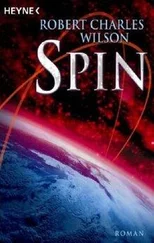
Robert Charles Wilson - SPIN
Здесь есть возможность читать онлайн «Robert Charles Wilson - SPIN» весь текст электронной книги совершенно бесплатно (целиком полную версию без сокращений). В некоторых случаях можно слушать аудио, скачать через торрент в формате fb2 и присутствует краткое содержание. Город: New York,NY, Год выпуска: 2005, ISBN: 2005, Издательство: Tom Doherty Associates,LLC, Жанр: Фантастика и фэнтези, на английском языке. Описание произведения, (предисловие) а так же отзывы посетителей доступны на портале библиотеки ЛибКат.

- Название:SPIN
- Автор:
- Издательство:Tom Doherty Associates,LLC
- Жанр:
- Год:2005
- Город:New York,NY
- ISBN:978-0-765-34825
- Рейтинг книги:5 / 5. Голосов: 1
-
Избранное:Добавить в избранное
- Отзывы:
-
Ваша оценка:
SPIN: краткое содержание, описание и аннотация
Предлагаем к чтению аннотацию, описание, краткое содержание или предисловие (зависит от того, что написал сам автор книги «SPIN»). Если вы не нашли необходимую информацию о книге — напишите в комментариях, мы постараемся отыскать её.
The effect is worldwide. The sun is now a featureless disk a heat source, rather than an astronomical object. The moon is gone, but tides remain. Not only have the world's artificial satellites fallen out of orbit, their recovered remains are pitted and aged, as though they'd been in space far longer than their known lifespans. As Tyler, Jason, and Diane grow up, space probe reveals a bizarre truth: The barrier is artificial, generated by huge alien artifacts. Time is passing faster outside the barrier than inside more than a hundred million years per day on Earth. At this rate, the death throes of the sun are only about forty years in our future.Jason, now a promising young scientist, devotes his life to working against this slow-moving apocalypse. Diane throws herself into hedonism, marrying a sinister cult leader who's forged a new religion out of the fears of the masses. Earth sends terraforming machines to Mars to let the onrush of time do its work, turning the planet green. Next they send humans...and immediately get back an emissary with thousands of years of stories to tell about the settling of Mars. Then Earth's probes reveal that an identical barrier has appeared around Mars. Jason, desperate, seeds near space with self-replicating machines that will scatter copies of themselves outward from the sun and report back on what they find. Life on Earth is about to get much, much stranger.
SPIN — читать онлайн бесплатно полную книгу (весь текст) целиком
Ниже представлен текст книги, разбитый по страницам. Система сохранения места последней прочитанной страницы, позволяет с удобством читать онлайн бесплатно книгу «SPIN», без необходимости каждый раз заново искать на чём Вы остановились. Поставьте закладку, и сможете в любой момент перейти на страницу, на которой закончили чтение.
Интервал:
Закладка:
"As did Jason's father, perhaps? On your stomach now, please."
"But not in that proprietary way. It was pure goggle-eyed enchantment."
"Excuse me, 'goggle-eyed'?"
"Wide-eyed. Then the wind started to pick up, and Jason turned on the flashlight and pointed it into the poplars so Diane could see the way the branches moved." With this came a vivid memory of young Diane in a sweater at least a size too big for her, hands lost in knitted wool, hugging herself, her face turned up into the cone of light and her eyes reflecting it back in solemn moons. "He showed her the way the biggest branches tossed in a kind of slow motion, and the smaller branches more quickly. That was because each branch and twig had what Jase called a resonant frequency. And you could think of those resonant frequencies as musical notes, he said. The tree's motion in the wind was really a kind of music pitched too low for human ears, the trunk of the tree singing a bass note and the branches singing tenor lines and the twigs playing piccolo. Or, he said, you could think of it as pure numbers, each resonance, from the wind itself to the tremor of a leaf, working out a calculation inside a calculation inside a calculation."
"You describe it very beautifully," Ina said.
"Not half as beautifully as Jason did. It was like he was in love with the world, or at least the patterns in it. The music in it. Ouch."
"I'm sorry. And Diane was in love with Jason?"
"In love with being his sister. Proud of him."
"And were you in love with being his friend?"
"I suppose I was."
"And in love with Diane."
"Yes."
"And she with you."
"Maybe. I hoped so."
"Then, if I may ask, what went wrong?"
"What makes you think anything went wrong?"
"You're obviously still in love. The two of you, I mean. But not like a man and woman who have been together for many years. Something must have kept you apart. Excuse me, this is terribly impertinent."
Yes, something had kept us apart. Many things. Most obviously, I supposed, it was the Spin. She had been especially, particularly frightened by it, for reasons I had never completely understood; as if the Spin were a challenge and a rebuke to everything that made her feel safe. What made her feel safe? The orderly progression of life; friends, family, work—a kind of fundamental sensibility of things, which in E.D. and Carol Lawton's Big House must already have seemed fragile, more wished-for than real.
The Big House had betrayed her, and eventually even Jason had betrayed her: the scientific ideas he presented to her like peculiar gifts, which had once seemed reassuring—the cozy major chords of Newton and Euclid—became stranger and more alienating: the Planck length (beneath which things no longer behaved like things); black holes, sealed by their own imponderable density into a realm beyond cause and effect; a universe not only expanding but accelerating toward its own decay. She told me once, while St. Augustine was still alive, that when she put her hand on the dog's coat she wanted to feel his heat and his liveliness—not count the beats of his heart or consider the vast spaces between the nuclei and the electrons that constituted his physical being. She wanted St. Dog to be himself and whole, not the sum of his terrifying parts, not a fleeting evolutionary epiphenomenon in the life of a dying star. There was little enough love and affection in her life and each instance of it had to be accounted and stored up in heaven, hoarded against the winter of the universe.
The Spin, when it came, must have seemed like a monstrous vindication of Jason's worldview—more so because of his obsession with it Clearly, there was intelligent life elsewhere in the galaxy; and, just as obviously, it was nothing like our own. It was immensely powerful, terrifyingly patient, and blankly indifferent to the terror it had inflicted on the world. Imagining the Hypotheticals, one might picture hyperintelligent robots or inscrutable energy beings; but never the touch of a hand, a kiss, a warm bed, or a consoling word.
So she had hated the Spin in a deeply personal way, and I think it was that hatred that ultimately led her to Simon Townsend and the NK movement. In NK theology the Spin became a sacred event but also a subordinate one: large but not as large as the God of Abraham; shocking but less shocking than a crucified Savior, an empty tomb.
I said some of this to Ina. She said, "Of course, I'm not a Christian. I'm not even Islamic enough to satisfy the local authorities. Corrupted by the atheistic West, that's me. But even in Islam there were such movements. People babbling about Imam Mehdi and Ad-Dajjal, Yajuj and Majuj drinking up the Sea of Galilee. Because they thought this made a better kind of sense. There. I'm finished." She had scrubbed the soles of my feet. "Have you always known these things about Diane?"
Known in what sense? Felt, suspected, intuited; but known—no, I couldn't say so.
"Then perhaps the Martian drug is living up to your expectations," Ina said as she exited with her stainless steel pan of warm water and her assortment of sponges, leaving me something to think about in the dark of the night.
* * * * *
There were three doors leading into or out of Ibu Ina's medical clinic. She walked me through the building once, after her last scheduled patient had departed with a splinted finger.
"This is what I've built in my lifetime," she said. "Little enough, you might think. But the people of this village needed something between here and the hospital in Padang— quite a distance, especially if you have to travel by bus or the roads are undependable."
One door was the front door, where her patients came and went.
One door was the back door, metal-lined and sturdy. Ina parked her little power-cell car in the pressed-earth lot behind the clinic, and she used this door when she arrived in the morning and locked it when she left at night. It was adjacent to the room where I lived and I had learned to recognize the sound of her keys jingling in it not long after the first call to prayer from the village mosque a quarter mile away.
The third door was a side door, down a little corridor that also housed the toilet and a row of supply cupboards. This was where she accepted deliveries and this was the route by which En preferred to come and go.
En was just as Ina had described him: bashful but bright, smart enough to earn the medical degree on which he had set his heart's hopes. His parents weren't rich, Ina said, but if he landed a scholarship, studied premed at the new university in Padang, excelled, found a way to finance a graduate degree— "Then, who knows? The village might have another doctor. That's how I did it."
"You think he'd come back and practice here?"
"He might. We go out, we come back." She shrugged, as if this were the natural order of things. And for the Minang, it was: rantau, the tradition of sending young men abroad, was part of the system of adat, custom and obligation. Adat, like conservative Islam, had been eroded by the last thirty years of modernization, but it pulsed under the surface of Minang life like a heartbeat.
En had been warned not to bother me, but he gradually lost his fear of me. With Ibu Ina's express permission, when I was between bouts of fever, En would hone his English vocabulary by bringing me items of food and naming them for me: silomak, sticky rice; singgang ayam, curried chicken. When I said, "Thank you," En would call out "Welcome!" and grin, displaying a set of bright white but wildly irregular teeth: Ina was trying to convince his parents to have braces installed.
Ina herself shared a small house in the village with relatives, although lately she had been sleeping in a consulting room in the clinic, a space that couldn't have been any more comfortable than my own bleak cell. Some nights, however, family duties called her away; on those nights she would note my temperature and condition, provision me with food and water, and leave me a pager in case of emergencies. And I would be alone until her key rattled in the door the next morning.
Читать дальшеИнтервал:
Закладка:
Похожие книги на «SPIN»
Представляем Вашему вниманию похожие книги на «SPIN» списком для выбора. Мы отобрали схожую по названию и смыслу литературу в надежде предоставить читателям больше вариантов отыскать новые, интересные, ещё непрочитанные произведения.




Обсуждение, отзывы о книге «SPIN» и просто собственные мнения читателей. Оставьте ваши комментарии, напишите, что Вы думаете о произведении, его смысле или главных героях. Укажите что конкретно понравилось, а что нет, и почему Вы так считаете.