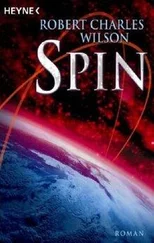
Robert Charles Wilson - SPIN
Здесь есть возможность читать онлайн «Robert Charles Wilson - SPIN» весь текст электронной книги совершенно бесплатно (целиком полную версию без сокращений). В некоторых случаях можно слушать аудио, скачать через торрент в формате fb2 и присутствует краткое содержание. Город: New York,NY, Год выпуска: 2005, ISBN: 2005, Издательство: Tom Doherty Associates,LLC, Жанр: Фантастика и фэнтези, на английском языке. Описание произведения, (предисловие) а так же отзывы посетителей доступны на портале библиотеки ЛибКат.

- Название:SPIN
- Автор:
- Издательство:Tom Doherty Associates,LLC
- Жанр:
- Год:2005
- Город:New York,NY
- ISBN:978-0-765-34825
- Рейтинг книги:5 / 5. Голосов: 1
-
Избранное:Добавить в избранное
- Отзывы:
-
Ваша оценка:
SPIN: краткое содержание, описание и аннотация
Предлагаем к чтению аннотацию, описание, краткое содержание или предисловие (зависит от того, что написал сам автор книги «SPIN»). Если вы не нашли необходимую информацию о книге — напишите в комментариях, мы постараемся отыскать её.
The effect is worldwide. The sun is now a featureless disk a heat source, rather than an astronomical object. The moon is gone, but tides remain. Not only have the world's artificial satellites fallen out of orbit, their recovered remains are pitted and aged, as though they'd been in space far longer than their known lifespans. As Tyler, Jason, and Diane grow up, space probe reveals a bizarre truth: The barrier is artificial, generated by huge alien artifacts. Time is passing faster outside the barrier than inside more than a hundred million years per day on Earth. At this rate, the death throes of the sun are only about forty years in our future.Jason, now a promising young scientist, devotes his life to working against this slow-moving apocalypse. Diane throws herself into hedonism, marrying a sinister cult leader who's forged a new religion out of the fears of the masses. Earth sends terraforming machines to Mars to let the onrush of time do its work, turning the planet green. Next they send humans...and immediately get back an emissary with thousands of years of stories to tell about the settling of Mars. Then Earth's probes reveal that an identical barrier has appeared around Mars. Jason, desperate, seeds near space with self-replicating machines that will scatter copies of themselves outward from the sun and report back on what they find. Life on Earth is about to get much, much stranger.
SPIN — читать онлайн бесплатно полную книгу (весь текст) целиком
Ниже представлен текст книги, разбитый по страницам. Система сохранения места последней прочитанной страницы, позволяет с удобством читать онлайн бесплатно книгу «SPIN», без необходимости каждый раз заново искать на чём Вы остановились. Поставьте закладку, и сможете в любой момент перейти на страницу, на которой закончили чтение.
Интервал:
Закладка:
"Not exactly the Promised Land."
"Yeah, but you know? I don't think it's supposed to be. That's what I tell him. Maybe we can feel the chiliasm coming, but it's not here yet—we still have to play out the last minutes of the game even if the outcome is a foregone conclusion. And maybe we're being judged on that. We have to play it like it matters."
We rode the elevator up to our rooms. Diane paused at her door and said, "What I'm remembering is how good it feels to talk to you. We used to be pretty good talkers, remember?"
Confiding our fears through the chaste medium of the telephone. Intimacy at a distance. She had always preferred it that way. I nodded.
"Maybe can do that again," she said. "Maybe I can call you from Arizona sometimes."
She, of course, would call me, because Simon might not like it if I called her. That was understood. As was the nature of the relationship she was proposing. I would be her platonic buddy. Someone harmless to confide in during troubled times, like the leading lady's gay male friend in a cineplex drama. We would chat. We would share. Nobody would get hurt.
It wasn't what I wanted or needed. But I couldn't say that to the eager, slightly lost look she was giving me. Instead I said, "Yeah, of course."
And she grinned and hugged me and left me in the hall.
I sat up later than I should have, nursing my wounded dignity, embedded in the noise and laughter from nearby rooms, flunking about all the scientists and engineers at Perihelion and JPL and Kennedy, all these newspaper people and video journalists watching klieg lights play over the distant rockets, all of us doing our jobs here at the tag end of human history, doing what was expected of us, playing it like it mattered.
* * * * *
Jason arrived at noon the next day, ten hours before the first wave of launches was scheduled to begin. The weather was bright and calm, a good omen. Of all the global launch sites the only obvious no-go was the European Space Agency's expanded Kourov complex in French New Guinea, shut down by a fierce March storm. (The ESA microorganisms would be delayed a day or two—or half a million years, Spin-time.)
Jase came directly to my suite, where Diane and I were waiting for him. He wore a cheap plastic windbreaker and a Marlins cap pulled low over his eyes to disguise him from the resident reporters. "Tyler," he said when I opened the door. "I'm sorry. If I could have been there I would have."
The funeral service. "I know."
"Belinda Dupree was the best thing about the Big House. I mean that."
"I appreciate it," I said, and stepped out of his way.
Diane came across the room with a wary expression. Jason closed the door behind him, not smiling. They stood a yard apart, eyeing each other. The silence was weighty. Jason broke it.
"That collar," he said, "makes you look like a Victorian banker. And you ought to put on a little weight. Is it so hard to scrounge a meal out there in cow country?" Diane said, "More cactus than cows, Jase." And they laughed and fell into each other's arms.
* * * * *
We staked out the balcony after dark, brought out comfortable chairs and ordered up a tray of crudites (Diane's choice) from room service. The night was as dark as every starless Spin-shrouded night, but the launch platforms were illuminated by gigantic spotlights and their reflections danced in the gently rolling swells.
Jason had been seeing a neurologist for some weeks now. The specialist's diagnosis had been the same as mine: Jason suffered from severe and nonresponsive multiple sclerosis for which the only useful treatment was a regimen of palliative drugs. In fact the neurologist had wanted to submit Jason's case to the Centers for Disease Control as part of their ongoing study of what some people were calling AMS— atypical multiple sclerosis. Jase had threatened or bribed him out of the idea. And for now, at least, the new drug cocktail was keeping him in remission. He was as functional and mobile as he had ever been. Any suspicions Diane might have harbored were quickly allayed.
He had brought along a bottle of expensive and authentically French champagne to celebrate the launches. "We could have had VIP seats," I told Diane. "Bleachers outside the Vehicle Assembly Building. Brushing elbows with President Garland."
"The view from here is as good," Jason said. "Better. Here, we're not props in a photo opportunity."
"I've never met a president," Diane said.
The sky, of course, was dark, but the TV in the hotel room (we had turned it up to hear the countdown) was talking about the Spin barrier, and Diane looked into the sky as if it might have become miraculously visible, the lid that enclosed the world. Jason saw the tilt of her head. "They shouldn't call it a barrier," he said. "None of the journals call it that anymore."
"Oh? What do they call it?"
He cleared his throat. "A 'strange membrane.'"
"Oh no." Diane laughed. "No, that's awful. That's not acceptable. It sounds like a gynecological disorder."
"Yeah, but 'barrier' is incorrect. It's more like a boundary layer. It's not a line you cross. It acquires objects selectively and accelerates them into the external universe. The process is more like osmosis than, say, crashing a fence. Ergo, membrane."
"I'd forgotten what it's like talking to you, Jase. It can be a little surreal."
"Hush," I told them both. "Listen."
Now the TV had cut to the NASA feed, a bland Mission Control voice talking the numbers down. Thirty seconds. There were twelve rockets fueled and nominal on their pads. Twelve simultaneous launches, an act that a less ambitious space agency would once have deemed impractical and radically unsafe. But we lived in more daring or desperate times.
"Why do they all have to go up at once?" Diane asked.
"Because," Jason began; then he said, "No. Wait. Watch."
Twenty seconds. Ten. Jase stood up and leaned into the balcony railing. The hotel balconies were mobbed. The beach was mobbed. A thousand heads and lenses swiveled in the same direction. Estimates later put the crowd in and around the Cape at nearly two million. According to police reports, more than a hundred wallets were lifted that night. There were two fatal stabbings, fifteen attempted assaults, and one premature labor. (The child, a four-pound girl, was delivered on a trestle table at the International House of Pancakes in Cocoa Beach.)
Five seconds. The TV in the hotel room went quiet. For a moment there was no sound but the buzz and whine of photographic gear.
Then the ocean was ablaze with firelight as far as the horizon.
No single one of these rockets would have impressed a local crowd even in darkness, but this wasn't one column of flame, it was five, seven, ten, twelve. The seaborne gantries were briefly silhouetted like skeletal skyscrapers, lost soon after in billows of vaporized ocean water. Twelve pillars of white fire, separated by miles but compressed by perspective, clawed into a sky turned indigo blue by their combined light. The beach crowd began to cheer, and the sound merged with the sound of the solid-fuel boosters hammering for altitude, a throb that compressed the heart like ecstasy or terror. But it wasn't only the brute spectacle we were cheering. Almost certainly every one of these two million people had seen a rocket launch before, at least on television, and although this multiple ascendancy was grand and loud it was remarkable mainly for its intent, its motivating idea. We weren't just planting the flag of terrestrial life on Mars, we were defying the Spin itself.
The rockets rose. (And on the rectangular screen of the TV, when I glanced at it through the balcony door, similar rockets bent into cloudy daylight in Jiuquan, Svobodnyy, Baikonur, Xichang.) The fierce horizontal light became oblique and began to dim as night rushed back from the sea. The sound spent itself in sand and concrete and superheated salt water. I imagined I could smell the reek of fireworks coming ashore with the tide, the pleasantly awful stench of Roman candles.
Читать дальшеИнтервал:
Закладка:
Похожие книги на «SPIN»
Представляем Вашему вниманию похожие книги на «SPIN» списком для выбора. Мы отобрали схожую по названию и смыслу литературу в надежде предоставить читателям больше вариантов отыскать новые, интересные, ещё непрочитанные произведения.


Обсуждение, отзывы о книге «SPIN» и просто собственные мнения читателей. Оставьте ваши комментарии, напишите, что Вы думаете о произведении, его смысле или главных героях. Укажите что конкретно понравилось, а что нет, и почему Вы так считаете.