Robert Charles Wilson - SPIN
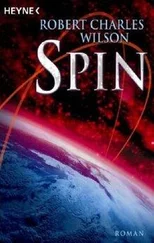
Здесь есть возможность читать онлайн «Robert Charles Wilson - SPIN» весь текст электронной книги совершенно бесплатно (целиком полную версию без сокращений). В некоторых случаях можно слушать аудио, скачать через торрент в формате fb2 и присутствует краткое содержание. Город: New York,NY, Год выпуска: 2005, ISBN: 2005, Издательство: Tom Doherty Associates,LLC, Жанр: Фантастика и фэнтези, на английском языке. Описание произведения, (предисловие) а так же отзывы посетителей доступны на портале библиотеки ЛибКат.

- Название:SPIN
- Автор:
- Издательство:Tom Doherty Associates,LLC
- Жанр:
- Год:2005
- Город:New York,NY
- ISBN:978-0-765-34825
- Рейтинг книги:5 / 5. Голосов: 1
-
Избранное:Добавить в избранное
- Отзывы:
-
Ваша оценка:
SPIN: краткое содержание, описание и аннотация
Предлагаем к чтению аннотацию, описание, краткое содержание или предисловие (зависит от того, что написал сам автор книги «SPIN»). Если вы не нашли необходимую информацию о книге — напишите в комментариях, мы постараемся отыскать её.
The effect is worldwide. The sun is now a featureless disk a heat source, rather than an astronomical object. The moon is gone, but tides remain. Not only have the world's artificial satellites fallen out of orbit, their recovered remains are pitted and aged, as though they'd been in space far longer than their known lifespans. As Tyler, Jason, and Diane grow up, space probe reveals a bizarre truth: The barrier is artificial, generated by huge alien artifacts. Time is passing faster outside the barrier than inside more than a hundred million years per day on Earth. At this rate, the death throes of the sun are only about forty years in our future.Jason, now a promising young scientist, devotes his life to working against this slow-moving apocalypse. Diane throws herself into hedonism, marrying a sinister cult leader who's forged a new religion out of the fears of the masses. Earth sends terraforming machines to Mars to let the onrush of time do its work, turning the planet green. Next they send humans...and immediately get back an emissary with thousands of years of stories to tell about the settling of Mars. Then Earth's probes reveal that an identical barrier has appeared around Mars. Jason, desperate, seeds near space with self-replicating machines that will scatter copies of themselves outward from the sun and report back on what they find. Life on Earth is about to get much, much stranger.
SPIN — читать онлайн бесплатно полную книгу (весь текст) целиком
Ниже представлен текст книги, разбитый по страницам. Система сохранения места последней прочитанной страницы, позволяет с удобством читать онлайн бесплатно книгу «SPIN», без необходимости каждый раз заново искать на чём Вы остановились. Поставьте закладку, и сможете в любой момент перейти на страницу, на которой закончили чтение.
Интервал:
Закладка:
The Spin had already done the heavy lifting for us. Every planet in the solar system—barring Earth—had been warmed significantly by the expanding sun. What remained was the subtler work of ecopoiesis. But there were many possible routes to ecopoiesis, many candidate organisms, from rock-dwelling bacteria to alpine mosses.
"So it's called shotgun," Diane surmised, "because you're sending all of them."
"All of them, and as many of them as we can afford, because no single organism is guaranteed to adapt and survive. But one of them might."
"More than one might."
"Which is fine. We want an ecology, not a monoculture." In fact the launches would be timed and staggered. The first wave would carry only anaerobic and photoautotrophic organisms, simple forms of life that required no oxygen and derived energy from sunlight. If they thrived and died in sufficient numbers they would create a layer of biomass to nurture more complex ecosystems. The next wave, a year from now, would introduce oxygenating organisms; the last unmanned launches would include primitive plants to fix the soil and regulate evaporation and rainfall cycles.
"It all seems so unlikely."
"We live in unlikely times. But no, it's not guaranteed to work."
"And if it doesn't?"
I shrugged. "What have we lost?"
"A lot of money. A lot of manpower."
"I can't think of a better use for it. Yes, this is a wager, and no, it's not a sure thing, but the potential payoff is more than worth the risk. And it's been good for everybody, at least so far. Good for morale at home and a good way of promoting international cooperation."
"But you'll have misled a lot of ordinary people. Convinced them the Spin is something we can manage, something we can find a technological fix for."
"Given them hope, you mean."
"The wrong kind of hope. And if you fail you leave them with no hope at all."
"What would you have us do, Diane? Retreat to our prayer mats?"
"It would hardly be an admission of defeat—prayer, I mean. And if you do succeed, the next step is to send people?"
"Yes. If we green the planet we send people." A much more difficult and ethically complex proposition. We'd be sending candidates in crews of ten. They would have to endure an unpredictably long passage in absurdly small quarters on limited rations. They would have to suffer atmospheric braking at a near-lethal delta-V after months of weightlessness, followed by a perilous descent to the planet's surface. If all this worked, and if their meager allotment of survival gear made its parallel descent and landed anywhere near them, they would then have to teach themselves subsistence skills in an environment only approximately fit for human habitation. Their mission brief was not to return to Earth but to live long enough to reproduce in sufficient numbers and pass on to their offspring a sustainable mode of existence.
"What sane person would agree to that?"
"You'd be surprised." I couldn't speak for the Chinese, the Russians, or any of the other international volunteers, but the North American flight candidates were a shockingly ordinary group of men and women. They had been selected for their youth, physical hardiness, and ability to tolerate and endure discomfort. Only a few had been Air Force test pilots but all possessed what Jason called "the test pilot mentality," a willingness to accept grave physical risk in the name of a spectacular achievement. And, of course, most of them were in all likelihood doomed, just as most of the bacteria mounted on these distant rockets were doomed. The best outcome we could reasonably expect was that some band of nomadic survivors wandering the mossy canyons of Valles Marineris might encounter a similar group of Russians or Danes or Canadians and engender a viable Martian humanity.
"And you countenance this?"
"Nobody asked my opinion. But I wish them well."
Diane gave me a that's-not-good-enough look but chose not to pursue the argument. We rode an elevator down to the lobby restaurant. As we lined up for table service behind a dozen network news technicians she must have felt the growing excitement.
After we ordered she turned her head, listening as fragments of conversation—words like "photodissociation" and "cryptoendelithic" and, yes, "ecopoiesis"—spilled over from crowded tables, journalists rehearsing the jargon for their next day's work or just struggling to understand it. There was also laughter and the reckless clash of cutlery, an air of giddy if uncertain expectation. This was the first time since the moon landing more than sixty years ago that the world's attention had been so completely focused on a space adventure, and the Spin gave this one what even the moon landing had lacked: real urgency and a global sense of risk.
"This is all Jason's work, isn't it?"
"Without Jason and E.D. this might still be happening. But it would be happening differently, probably less quickly and efficiently. Jase has always been at the center of it."
"And us at the periphery. Orbiting his genius. Tell you a secret. I'm a little afraid of him. Afraid of seeing him after so long. I know he disapproves of me."
"Not you. Your lifestyle, maybe."
"You mean my faith. It's okay to talk about it. I know Jase feels a little—I guess betrayed. As if Simon and I have repudiated everything he believes in. But that's not true. Jason and I were never on the same path."
"Basically, you know, he's just Jase. Same old Jase."
"But am I the same old Diane?"
For which I had no answer.
She ate with an obvious appetite, and after the main course we ordered dessert and coffee. I said, "It's lucky you could take the time for this."
"Lucky that Simon let me off my leash?"
"I didn't mean that."
"I know. But in a way it's true. Simon can be a little controlling. He likes to know where I am."
"Is that a problem for you?"
"You mean, is my marriage in trouble? No. It isn't, and I wouldn't let it be. That doesn't mean we don't occasionally disagree." She hesitated. "If I talk about this, I'm sharing it with you, right? Not Jason. Just you."
I nodded.
"Simon has changed some since you met him. We all have, everybody from the old NK days. NK was all about being young and making a community of belief, a kind of sacred space where we didn't have to be afraid of each other, where we could embrace each other not just figuratively but literally. Eden on Earth. But we were mistaken. We thought AIDS didn't matter, jealousy didn't matter—they couldn't matter, because we'd come to the end of the world. But it's a slow Tribulation, Ty. The Tribulation is a lifetime's work, and we need to be strong and healthy for it."
"You and Simon—"
"Oh, we're healthy." She smiled. "And thank you for asking, Dr. Dupree. But we lost friends to AIDS and drugs. The movement was a roller-coaster ride, love all the way up and grief all the way down. Anyone who was part of it will tell you that."
Probably so, but the only NK veteran I knew was Diane herself. "The last few years haven't been easy for anyone."
"Simon had a hard time dealing with it. He really believed we were a blessed generation. He once told me God had come so close to humanity it was like sitting next to a furnace on a winter night, that he could practically warm his hands at the Kingdom of Heaven. We all felt that way, but it really did bring out the best in Simon. And when it started to go bad, when so many of our friends were sick or drifting into addictions of one kind or another, it hurt him pretty deeply. That was when the money started running out, too, and eventually Simon had to look for work—we both did. I did temp work for a few years. Simon couldn't find a secular job but he does janitorial work at our church in Tempe, Jordan Tabernacle, and they pay him when they can… he's studying for his pipe fitter's certificate."
Читать дальшеИнтервал:
Закладка:
Похожие книги на «SPIN»
Представляем Вашему вниманию похожие книги на «SPIN» списком для выбора. Мы отобрали схожую по названию и смыслу литературу в надежде предоставить читателям больше вариантов отыскать новые, интересные, ещё непрочитанные произведения.


Обсуждение, отзывы о книге «SPIN» и просто собственные мнения читателей. Оставьте ваши комментарии, напишите, что Вы думаете о произведении, его смысле или главных героях. Укажите что конкретно понравилось, а что нет, и почему Вы так считаете.