Connie Willis - Doomsday Book
Здесь есть возможность читать онлайн «Connie Willis - Doomsday Book» весь текст электронной книги совершенно бесплатно (целиком полную версию без сокращений). В некоторых случаях можно слушать аудио, скачать через торрент в формате fb2 и присутствует краткое содержание. Год выпуска: 1992, ISBN: 1992, Издательство: Bantam Books, Жанр: Фантастика и фэнтези, Социально-психологическая фантастика, на английском языке. Описание произведения, (предисловие) а так же отзывы посетителей доступны на портале библиотеки ЛибКат.
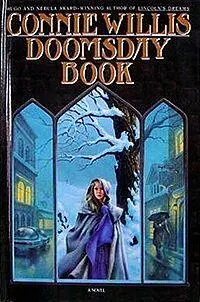
- Название:Doomsday Book
- Автор:
- Издательство:Bantam Books
- Жанр:
- Год:1992
- ISBN:ISBN 0-553-35167-2
- Рейтинг книги:3 / 5. Голосов: 1
-
Избранное:Добавить в избранное
- Отзывы:
-
Ваша оценка:
Doomsday Book: краткое содержание, описание и аннотация
Предлагаем к чтению аннотацию, описание, краткое содержание или предисловие (зависит от того, что написал сам автор книги «Doomsday Book»). Если вы не нашли необходимую информацию о книге — напишите в комментариях, мы постараемся отыскать её.
is an intelligent and satisfying blend of classic science fiction and historical reconstruction. Kivrin, a history student at Oxford in 2048, travels back in time to a 14th-century English village, despite a host of misgivings on the part of her unofficial tutor. When the technician responsible for the procedure falls prey to a 21st-century epidemic, he accidentally sends Kivrin back not to 1320 but to 1348 — right into the path of the Black Death. Unaware at first of the error, Kivrin becomes deeply involved in the life of the family that takes her in. But before long she learns the truth and comes face to face with the horrible, unending suffering of the plague that would wipe out half the population of Europe. Meanwhile, back in the future, modern science shows itself infinitely superior in its response to epidemics, but human nature evidences no similar evolution, and scapegoating is still alive and well in a campaign against "infected foreigners." This book finds villains and heroes in all ages, and love, too, which Kivrin hears in the revealing and quietly touching deathbed confession of a village priest. Won Nebula Award for Best Novel in 1992
Won Hugo Award for Best Novel in 1993
Doomsday Book — читать онлайн бесплатно полную книгу (весь текст) целиком
Ниже представлен текст книги, разбитый по страницам. Система сохранения места последней прочитанной страницы, позволяет с удобством читать онлайн бесплатно книгу «Doomsday Book», без необходимости каждый раз заново искать на чём Вы остановились. Поставьте закладку, и сможете в любой момент перейти на страницу, на которой закончили чтение.
Интервал:
Закладка:
She had expected a formal meeting, the family at the door with stiff speeches and polite smiles, but this was like the first day of term — everyone carrying in boxes and bags, greeting each other with exclamations and embraces, talking at the same time, laughing. Rosemund hadn't even been missed. A large woman wearing an enormous starched coif grabbed Agnes up and kissed her, and three young girls clustered around Rosemund, squealing.
Servants, obviously in their holiday best, too, carried covered baskets and an enormous goose into the kitchen, and led the horses into the stable. Gawyn, still on Gringolet, was leaning down to speak to Imeyne. Kivrin heard him say, "Nay, the bishop is at Wiveliscombe," but Imeyne didn't look unhappy, so he must have got the message to the archdeacon.
She turned to help a young woman in a bright blue cloak even brighter than Kivrin's down from her horse, and led her over to Eliwys, smiling. Eliwys was smiling, too.
Kivrin tried to make out which was Sir Bloet, but there were at least a half-dozen mounted men, all with silver-chased bridles and fur-trimmed cloaks. None of them looked decrepit, thank goodness, and one or two were quite presentable-looking. She turned to ask Agnes which one he was, but she was still in the grip of the starched coif, who kept patting her head and saying, "You have grown so I scarce knew you." Kivrin stifled a smile. Some things truly never changed.
Several of the newcomers had red hair, including a woman nearly as old as Imeyne, who nevertheless wore her faded-pink hair down her back like a young girl. She had a pinched, unhappy-looking mouth and was obviously dissatisfied with the way the servants were unloading things. She snatched one overloaded basket out of the hands of a servant who was struggling with it and thrust it at a fat man in a green velvet kirtle.
He had red hair, too, and so did the nicest looking of the younger men. He was in his late twenties, but he had a round, open, freckled face and a pleasant expression at least.
"Sir Bloet!" Agnes cried, and flung herself past Kivrin and against the knees of the fat man.
Oh, no, Kivrin thought. She had assumed he was married to the pink-tressed shrew or the woman in the starched coif. He was at least fifty, and nearly twenty stone, and when he smiled at Agnes his large teeth were brown with decay.
"Have you no trinket for me?" Agnes was demanding, tugging on the hem of his kirtle.
"Ay," he said, looking toward where Rosemund still stood talking to the other girls, "for you and for your sister."
"I will fetch her," Agnes said, and darted across to Rosemund before Kivrin could stop her. Bloet lumbered after her. The girls giggled and parted as he approached, and Rosemund shot a murderous look at Agnes and then smiled and extended her hand to him. "Good day and welcome, sir," she said.
Her chin was up about as far as it would go, and there were two spots of feverish red in her pale cheeks, but Bloet apparently took these for shyness and excitement. He took her little fingers in his own fat ones and said, "Surely you will not greet your husband with such formality come spring."
The spots got redder. "It is still winter, sir."
"It will be spring soon enough," he said and laughed, showing his brown teeth.
"Where is my trinket?" Agnes demanded.
"Agnes, be not so greedy," Eliwys said, coming to stand between her daughters. "It is a poor welcome to demand gifts of a guest." She smiled at him, and if she dreaded this marriage, she showed no sign of it. She looked more relaxed than Kivrin had yet seen her.
"I promised my sister-in-law a trinket," he said, reaching into his too-tight belt and bringing out a little cloth bag, "and my betrothed a bride-gift." He fumbled in the little bag and brought out a brooch set with stones. "A loveknot for my bride," he said, unfastening the clasp. "You must think of me when you wear it."
He moved forward, puffing, to pin it to her cloak. I hope he has a stroke, Kivrin thought. Rosemund stood stockstill, her cheeks sharply red, while his fat hands fumbled at her neck.
"Rubies," Eliwys said delightedly. "Do you not thank your betrothed for his goodly gift, Rosemund?"
"I thank thee for the brooch," Rosemund said tonelessly.
"Where is my trinket?" Agnes said, dancing on one foot, then the other while he reached in the little bag again and brought out something clenched in his fist. He stooped down to Agnes's level, breathing hard, and opened his hand.
"It is a bell!" Agnes said delightedly, holding it up and shaking it. It was brass and round, like a horse's sleigh bell, and had a metal loop at the top.
Agnes insisted on Kivrin taking her up to the bower to fetch a ribbon to thread through it so she could wear it around her wrist for a bracelet. "My father brought me this ribbon from the fair," Agnes said, pulling it out of the chest Kivrin's clothes had been kept in. It was patchily dyed and so stiff Kivrin had trouble threading it through the hole. Even the cheapest ribbons at Woolworth's or the paper ribbons used for wrapping Christmas presents were better than this obviously treasured one.
Kivrin tied it to Agnes's wrist, and they went back downstairs. The bustle and unloading had moved inside, servants carrying chests and bedding and what looked like early versions of the carpet bag into the hall. She needn't have worried about Sir Bloet et al carrying her off. It looked like they were here for the winter at the least.
She needn't have worried about them discussing her fate, either. None of them had so much as cast a glance at her, even when Agnes insisted on going over to her mother and showing off her bracelet. Eliwys was deep in conversation with Bloet, Gawyn, and the nice-looking man, who must be a son or a nephew, and Eliwys was twisting her hands again. The news from Bath must be bad.
Lady Imeyne was at the end of the hall, talking to the stout woman and a pale-looking man in a cleric's robe, and it was clear from the expression on her face that she was complaining about Father Roche.
Kivrin took advantage of the noisy confusion to pull Rosemund away from the other girls and ask her who everyone was. The pale man was Sir Bloet's chaplain, which she had more or less figured out. The lady in the bright blue cloak was his foster- daughter. The stout woman with the starched coif was Sir Bloet's brother's wife, come up from Dorset to stay with him. The two redheaded young men and the giggling girls were all hers. Sir Bloet didn't have any children.
Which of course was why he was marrying one, with, apparently, everyone's approval. The carrying on of the line was the all-important concern in 1320. The younger the woman, the better her chance of producing enough heirs that one at least would survive to adulthood, even if its mother didn't.
The shrew with the faded red hair was, horror of horrors, Lady Yvolde, his unmarried sister. She lived at Courcy with him and, Kivrin saw, watching her shouting at poor Maisry for dropping a basket, had a bunch of keys at her belt. That meant she ran the household, or would until Easter. Poor Rosemund wouldn't stand a chance.
"Who are all the others?" Kivrin had asked, hoping there might be at least one ally for Rosemund among them.
"Servants," Rosemund said, as if it were obvious, and ran back to the girls.
There were at least twenty of them, not counting the grooms who were putting the horses up, and nobody, not even the nervous Eliwys, seemed surprised by their number. She had read that noble households had had dozens of servants, but had thought those figures must be off. Eliwys and Imeyne had scarcely any servants at all, had had to put practically the whole village to work to get ready for Yule, and although she had put part of it down to their being in trouble, she had also thought the numbers of attendants for the rural manors must have been exaggerated. They obviously weren't.
Читать дальшеИнтервал:
Закладка:
Похожие книги на «Doomsday Book»
Представляем Вашему вниманию похожие книги на «Doomsday Book» списком для выбора. Мы отобрали схожую по названию и смыслу литературу в надежде предоставить читателям больше вариантов отыскать новые, интересные, ещё непрочитанные произведения.








Обсуждение, отзывы о книге «Doomsday Book» и просто собственные мнения читателей. Оставьте ваши комментарии, напишите, что Вы думаете о произведении, его смысле или главных героях. Укажите что конкретно понравилось, а что нет, и почему Вы так считаете.