Connie Willis - Doomsday Book
Здесь есть возможность читать онлайн «Connie Willis - Doomsday Book» весь текст электронной книги совершенно бесплатно (целиком полную версию без сокращений). В некоторых случаях можно слушать аудио, скачать через торрент в формате fb2 и присутствует краткое содержание. Год выпуска: 1992, ISBN: 1992, Издательство: Bantam Books, Жанр: Фантастика и фэнтези, Социально-психологическая фантастика, на английском языке. Описание произведения, (предисловие) а так же отзывы посетителей доступны на портале библиотеки ЛибКат.
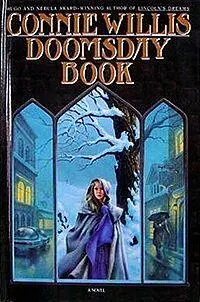
- Название:Doomsday Book
- Автор:
- Издательство:Bantam Books
- Жанр:
- Год:1992
- ISBN:ISBN 0-553-35167-2
- Рейтинг книги:3 / 5. Голосов: 1
-
Избранное:Добавить в избранное
- Отзывы:
-
Ваша оценка:
Doomsday Book: краткое содержание, описание и аннотация
Предлагаем к чтению аннотацию, описание, краткое содержание или предисловие (зависит от того, что написал сам автор книги «Doomsday Book»). Если вы не нашли необходимую информацию о книге — напишите в комментариях, мы постараемся отыскать её.
is an intelligent and satisfying blend of classic science fiction and historical reconstruction. Kivrin, a history student at Oxford in 2048, travels back in time to a 14th-century English village, despite a host of misgivings on the part of her unofficial tutor. When the technician responsible for the procedure falls prey to a 21st-century epidemic, he accidentally sends Kivrin back not to 1320 but to 1348 — right into the path of the Black Death. Unaware at first of the error, Kivrin becomes deeply involved in the life of the family that takes her in. But before long she learns the truth and comes face to face with the horrible, unending suffering of the plague that would wipe out half the population of Europe. Meanwhile, back in the future, modern science shows itself infinitely superior in its response to epidemics, but human nature evidences no similar evolution, and scapegoating is still alive and well in a campaign against "infected foreigners." This book finds villains and heroes in all ages, and love, too, which Kivrin hears in the revealing and quietly touching deathbed confession of a village priest. Won Nebula Award for Best Novel in 1992
Won Hugo Award for Best Novel in 1993
Doomsday Book — читать онлайн бесплатно полную книгу (весь текст) целиком
Ниже представлен текст книги, разбитый по страницам. Система сохранения места последней прочитанной страницы, позволяет с удобством читать онлайн бесплатно книгу «Doomsday Book», без необходимости каждый раз заново искать на чём Вы остановились. Поставьте закладку, и сможете в любой момент перейти на страницу, на которой закончили чтение.
Интервал:
Закладка:
Gawyn's feelings of courtly love for Eliwys are apparently not disturbed by dalliances with the servants. I asked Agnes to take me out to the stable to see her pony on the chance that Gawyn would be there. He was, in one of the boxes with Maisry, making less-than-courtly grunting noises. Maisry looked no more terrified than usual, and her hands were holding her skirts in a wad above her waist instead of clutching her ears, so it apparently wasn't rape. It wasn't l'amour courtois either.
I had to hastily distract Agnes and get her out of the stable, so I told her I wanted to go across the green to see the bell tower. We went inside and looked at the heavy rope.
"Father Roche rings the bell when someone dies," Agnes said. "If he does not, the devil will come and take their soul, and they can not go to heaven," which, I suppose, is more of the superstitious prate which irritates Lady Imeyne.
Agnes wanted to ring the bell, but I talked her into going into the church to find Father Roche instead.
Father Roche wasn't there. Agnes told me that he was probably still with the cottar, "who dies not though he has been shriven," or was somewhere praying. "Father Roche is wont to pray in the woods," she said, peering through the rood screen to the altar.
The church is Norman, with a central aisle and sandstone pillars, and a flagged stone floor. The stained-glass windows are very narrow and small and of dark colors. They let in almost no light. There is only one tomb, halfway up the nave.
An effigy of a knight lies on top of the tomb, his arms in gauntlets, crossed over his breast, and his sword at his side. The carving on the side says, " Requiscat cum Sanctis tuis in aeternum. " May he rest with Thy saints forever.
Agnes told me the tomb is her grandfather's, who died of a fever "a long time ago."
Except for the tomb and a rough statue, the nave is completely empty. The contemps stood during church so there aren't any pews, and the practice of filling the nave with monuments and memorials didn't take hold until the 1500's.
A carved wooden rood screen, twelfth century, separates the nave from the shadowy recesses of the chancel and the altar. Above it, on either side of the crucifix, are two crude paintings of the Last Judgment. One is of the faithful entering heaven and the other of sinners being consigned to hell, but they seem nearly alike. Both are painted in garish reds and blues, and their expressions look equally dismayed.
The altar's plain, covered with a white linen cloth, with two silver candelabra on either side of it. The badly-carved statue is not, as I'd assumed, the Virgin, but St. Catherine of Alexandria. It has the foreshortened body and large head of pre- Renaissance sculpture, and an odd, squarish coif that stops just below her ears. She stands with one arm around a doll-sized child and the other holding a wheel. A short yellowish candle and two oil cressets were sitting on the floor in front of it.
"Lady Kivrin, Father Roche says you are a saint," Agnes said when we went back outside.
It was easy to see where the confusion had come in this time, and I wondered if she'd done the same thing with the bell and the devil in the black horse.
"I am named for St. Catherine of Alexandria," I said, "as you are named for St. Agnes, but we ourselves are not saints."
She shook her head. "He says in the last days God will send his saints to sinful man. He says when you pray, you speak in God's own tongue."
I've tried to be careful about talking into the corder, to record my observations only when there's no one in the room, but I don't know about when I was ill. I remember that I kept asking him to help me, and you to come and get me. And if Father Roche heard me speaking modern English, he could very well believe I was speaking in tongues. At least he thinks I'm a saint, and not a witch, but Lady Imeyne was in the sickroom, too. I will have to be more careful.
I went out to the stable again (after making sure Maisry was in the kitchen), but Gawyn wasn't there, and neither was Gringolet. My boxes and the dismantled remains of the wagon were, though. Gawyn must have made a dozen trips to bring everything here. I looked through it all, and I can't find the casket. I'm hoping he missed it, and it's still by the road where I left it. If it is, it's probably completely buried in snow, but the sun is out today, and it's beginning to melt a little.
CHAPTER FIFTEEN
Kivrin's recovery from pneumonia came so suddenly she was convinced that something had happened to finally activate in her immune system. The pain in her chest went away, she stopped coughing, and the cut on her forehead disappeared completely.
Imeyne examined it suspiciously, as if she suspected Kivrin of faking her injury, and Kivrin was infinitely glad the wound hadn't been duped. "You must thank God that He has healed you on this Sabbath day," Imeyne said disapprovingly, and knelt beside the bed.
She had been to mass and was wearing her silver reliquary. She folded it between her palms — "like the corder," Kivrin thought — and recited the Paternoster, then pulled herself to her feet.
"I wish I could have gone with you to the mass," Kivrin said.
Imeyne sniffed. "I deemed you were too ill," she said, with an insinuating emphasis on the word "ill," "and it was but a poor mass."
She launched into a recital of Father Roche's sins: he had read the gospel before the Kyrie, his alb was stained with candlewax, he had forgotten part of the Confiteor Deo. Listing his sins seemed to put her in a better mood, and when she finished she patted Kivrin's hand and said, "You are not yet fully healed. Stay you in bed yet another day."
Kivrin did, using the time to record her observations onto the corder, describing the manor and the village and everyone she'd met so far. The steward came with another bowl of his wife's bitter tea, a dark, burly man who looked uncomfortable in his Sunday best jerkin and a too-elaborate silver belt, and a boy about Rosemund's age came in to tell Eliwys that her mare's forefoot was "amiss." But the priest didn't come again. "He has gone to shrive the cottar," Agnes told her.
Agnes was continuing to be an excellent informant, answering all of Kivrin's questions readily, whether she knew the answers or not, and volunteering all sorts of information about the village and its occupants. Rosemund was quieter and very much concerned with appearing grown-up. "Agnes, it is childish to speak so. You must learn to keep a watch on your tongue," she said repeatedly, a comment which happily had no effect whatsoever on Agnes. Rosemund did talk about her brothers and her father who "has promised he will come to us for Christmas without fail." She obviously worshipped him and missed him. "I wish I had been a boy," she said when Agnes was showing Kivrin the silver penny Sir Bloet had given her. "Then I had stayed with Father in Bath."
Between the two girls, and snatches of Eliwys's and Imeyne's conversations, plus her own observations, she was able to piece together a good deal about the village. It was smaller than Probability had predicted Skendgate would be, small even for a mediaeval village. Kivrin guessed it contained no more than forty people, including Lord Guillaume's family and the steward's. He had five children "And a new-christened babe," according to Rosemund.
There were two shepherds and several farmers, but it was "the poorest of all Guillaume's holdings," Imeyne said, complaining again about them having to spend Christmas there. The steward's wife was the resident social climber, and Maisry's family the local ne'er-do-wells. Kivrin recorded everything, statistics and gossip, folding her hands in prayer whenever she had the chance.
Читать дальшеИнтервал:
Закладка:
Похожие книги на «Doomsday Book»
Представляем Вашему вниманию похожие книги на «Doomsday Book» списком для выбора. Мы отобрали схожую по названию и смыслу литературу в надежде предоставить читателям больше вариантов отыскать новые, интересные, ещё непрочитанные произведения.










Обсуждение, отзывы о книге «Doomsday Book» и просто собственные мнения читателей. Оставьте ваши комментарии, напишите, что Вы думаете о произведении, его смысле или главных героях. Укажите что конкретно понравилось, а что нет, и почему Вы так считаете.