Connie Willis - Doomsday Book
Здесь есть возможность читать онлайн «Connie Willis - Doomsday Book» весь текст электронной книги совершенно бесплатно (целиком полную версию без сокращений). В некоторых случаях можно слушать аудио, скачать через торрент в формате fb2 и присутствует краткое содержание. Год выпуска: 1992, ISBN: 1992, Издательство: Bantam Books, Жанр: Фантастика и фэнтези, Социально-психологическая фантастика, на английском языке. Описание произведения, (предисловие) а так же отзывы посетителей доступны на портале библиотеки ЛибКат.
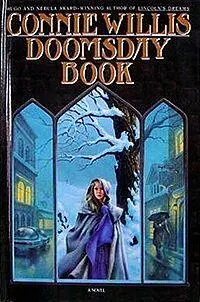
- Название:Doomsday Book
- Автор:
- Издательство:Bantam Books
- Жанр:
- Год:1992
- ISBN:ISBN 0-553-35167-2
- Рейтинг книги:3 / 5. Голосов: 1
-
Избранное:Добавить в избранное
- Отзывы:
-
Ваша оценка:
Doomsday Book: краткое содержание, описание и аннотация
Предлагаем к чтению аннотацию, описание, краткое содержание или предисловие (зависит от того, что написал сам автор книги «Doomsday Book»). Если вы не нашли необходимую информацию о книге — напишите в комментариях, мы постараемся отыскать её.
is an intelligent and satisfying blend of classic science fiction and historical reconstruction. Kivrin, a history student at Oxford in 2048, travels back in time to a 14th-century English village, despite a host of misgivings on the part of her unofficial tutor. When the technician responsible for the procedure falls prey to a 21st-century epidemic, he accidentally sends Kivrin back not to 1320 but to 1348 — right into the path of the Black Death. Unaware at first of the error, Kivrin becomes deeply involved in the life of the family that takes her in. But before long she learns the truth and comes face to face with the horrible, unending suffering of the plague that would wipe out half the population of Europe. Meanwhile, back in the future, modern science shows itself infinitely superior in its response to epidemics, but human nature evidences no similar evolution, and scapegoating is still alive and well in a campaign against "infected foreigners." This book finds villains and heroes in all ages, and love, too, which Kivrin hears in the revealing and quietly touching deathbed confession of a village priest. Won Nebula Award for Best Novel in 1992
Won Hugo Award for Best Novel in 1993
Doomsday Book — читать онлайн бесплатно полную книгу (весь текст) целиком
Ниже представлен текст книги, разбитый по страницам. Система сохранения места последней прочитанной страницы, позволяет с удобством читать онлайн бесплатно книгу «Doomsday Book», без необходимости каждый раз заново искать на чём Вы остановились. Поставьте закладку, и сможете в любой момент перейти на страницу, на которой закончили чтение.
Интервал:
Закладка:
The bell in the southwest began again. She wondered what it meant. Eliwys and Imeyne had talked about it, but that was before she could understand what they were saying, and when it began again yesterday, Eliwys hadn't even acted like she heard it. Perhaps it was something to do with Advent. The bells were supposed to ring at twilight on Christmas Eve and then for an hour before midnight, Kivrin knew. Perhaps they rang at other times during Advent as well.
The track was muddy and rutted. Kivrin's chest was beginning to hurt. She pressed her hand tighter against it and went on, trying to hurry. She could see movement out beyond the fields. They would be the peasants coming back with the Yule log, or getting in the animals. She couldn't make them out. It looked as if it were already snowing out there. She must hurry.
The wind whipped her cloak around her and swirled dead leaves past her. The cow moved off the green, its head down, into the shelter of the huts. Which were no shelter at all. They seemed hardly taller than Kivrin and as if they had been bundled together out of sticks and propped in place, and they didn't stop the wind at all.
The bell continued to ring, a slow, steady tolling, and Kivrin realized she had slowed her tread to match it. She mustn't do that. She must hurry. It might start snowing any minute. But hurrying made the pain stab so sharply she began to cough. She stopped, bent double with the coughing.
She was not going to make it. Don't be foolish, she told herself, you have to find the drop. You're ill. You have to get back home. Go as far as the church and you can rest inside for a minute.
She started on again, willing herself not to cough, but it was no use. She couldn't breathe. She couldn't make it to the church, let alone the drop. You have to make it, she shouted to herself over the pain. You have to will yourself to make it.
She stopped again, bending over against the pain. She had been worried that a peasant would come out of one of the huts, but now she wished someone would so they could help her back to the manor. They wouldn't. They were all out in this freezing wind, getting in the last of the potatoes and gathering up the animals. She looked out toward the fields. The distant figures who had been out there were gone.
She was opposite the last hut. Beyond it was a scattering of ramshackle sheds she hoped no one lived in, and surely nobody did. They must be outbuildings — cowbyres and granaries-and beyond them, surely not that far away, the church. Perhaps if I take it slowly, she thought, and started toward the church again. Her whole chest jarred at every step. She stopped, swaying a little, thinking, I mustn't faint. No one knows where I am.
She turned and looked back at the manor house. She couldn't even get back to the hall. I have to sit down, she thought, but there was nowhere to sit in the muddy track. Lady Eliwys was tending the cottar, Lady Imeyne and the girls and the entire village were out cutting the Yule log. No one knows where I am.
The wind was picking up, coming now not in gusts but in a straight, determined push across the fields. I must try to get back to the house, Kivrin thought, but she couldn't do that either. Even standing was too much of an effort. If there were anywhere to sit she would sit down, but the space between the huts, right up to their fences, was all mud. She would have to go into the hut.
It had a rickety wattle fence around it, made by weaving green branches between stakes. The fence was scarcely knee-high and wouldn't have kept a cat out, let alone the sheep and cows it was intended against. Only the gate had supports even waist- high, and Kivrin leaned gratefully against one of them. "Hello," she shouted into the wind, "is anyone there?"
The front door of the hut was only a few steps from the gate, and the hut couldn't be soundproof. It wasn't even windproof. She could see a hole in the wall where the daubed clay and chopped straw had cracked and fallen away from the matted branches underneath. They could surely hear her. She lifted the loop of leather that held the gate shut, went in, and knocked on the low, planked door.
There was no answer, and Kivrin hadn't expected any. She shouted again, "Is anyone home?" not even bothering to listen to how the interpreter translated it, and tried to lift the wooden bar that lay across it. It was too heavy. She tried to slide it out of the notches cut in the protruding lintels, but she couldn't. The hut looked like it could blow away at any minute, and she couldn't get the door open. She would have to tell Mr. Dunworthy mediaeval huts weren't as flimsy as they looked. She leaned against the door, holding her chest.
Something made a sound behind her, and she turned, already saying, "I'm sorry I intruded into your garden." It was the cow, leaning casually over the fence and browsing among the brown leaves, hardly reaching at all.
She would have to go back to the manor. She used the gate for support, making sure she shut it behind her and looped the leather back over the stake, and then the cow's bony back. The cow followed with her a few steps, as if she thought Kivrin was leading her in to be milked, and then went back to the garden.
The door of one of the sheds that nobody could possibly live in opened, and a barefoot boy came out. He stopped, looking frightened.
Kivrin tried to straighten up. "Please," she said, breathing hard between the words, "may I rest awhile in your house?"
The boy stared dumbly at her, his mouth hanging open. He was hideously thin, his arms and legs no thicker than the twigs in the hut fences.
"Please, run to the manor and tell the men in the stable come. Tell them I'm ill."
He can no more run than I can, she thought as soon as she said it. The boy's feet were blue with cold. His mouth looked sore, and his cheeks and upper lip were smeared with dried blood from a nosebleed. He's got scurvy, Kivrin thought, he's worse off than I am, but she said again, "Run to the manor and bid them come."
The boy crossed himself with a chapped, bony hand. " Bighaull emeurdroud ooghattund enblastbardey ," he said, backing into the hut.
Oh, no, Kivrin thought despairingly. He can't understand me, and I don't have the strength to try to make him. "Please help me," she said, and the boy looked almost like he understood that. He took a step toward her and then darted suddenly away in the direction of the church.
"Wait!" Kivrin called.
He darted past the cow and around the fence and disappeared behind the hut. Kivrin looked at the shed. It could hardly even be called that. It looked more like a haystack — grass and pieces of thatch wadded into the spaces between the poles, but its door was a mat of sticks tied together with blackish rope, the kind of door you could blow down with one good breath, and the boy had left it open. She stepped over the raised doorstep and went into the hut.
It was dark inside and so smoky Kivrin couldn't see anything. It smelled terrible. Like a stable. Worse than a stable. Mingled with the barnyard smells were smoke and mildew and the nasty odor of rats. Kivrin had had to bend over almost double to get through the door. She straightened, and hit her head on the sticks that served as crossbeams.
There was nowhere to sit in the hut, if that was really what it was. The floor was as covered with sacks and tools as if it was a shed after all, and there was no furniture except an uneven table whose rough legs splayed unevenly from the center. But the table had a wooden bowl and a heel of bread on it, and in the center of the hut, in the only cleared space, a little fire was burning in a shallow, dug-out hole.
It was apparently the source of all the smoke even though there was a hole in the ceiling above it for a draft. It was a little fire, only a few sticks, but the other holes in the unevenly stuffed walls and roof drew the smoke, too, and the wind, coming in from everywhere, gusted it around the cramped hut. Kivrin started to cough, which was a terrible mistake. Her chest felt as if it would break apart with every spasm.
Читать дальшеИнтервал:
Закладка:
Похожие книги на «Doomsday Book»
Представляем Вашему вниманию похожие книги на «Doomsday Book» списком для выбора. Мы отобрали схожую по названию и смыслу литературу в надежде предоставить читателям больше вариантов отыскать новые, интересные, ещё непрочитанные произведения.






Обсуждение, отзывы о книге «Doomsday Book» и просто собственные мнения читателей. Оставьте ваши комментарии, напишите, что Вы думаете о произведении, его смысле или главных героях. Укажите что конкретно понравилось, а что нет, и почему Вы так считаете.