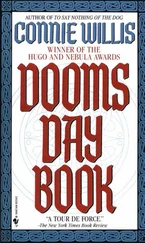
Connie Willis - Doomsday Book
Здесь есть возможность читать онлайн «Connie Willis - Doomsday Book» весь текст электронной книги совершенно бесплатно (целиком полную версию без сокращений). В некоторых случаях можно слушать аудио, скачать через торрент в формате fb2 и присутствует краткое содержание. Год выпуска: 1992, ISBN: 1992, Издательство: Bantam Books, Жанр: Фантастика и фэнтези, Социально-психологическая фантастика, на английском языке. Описание произведения, (предисловие) а так же отзывы посетителей доступны на портале библиотеки ЛибКат.
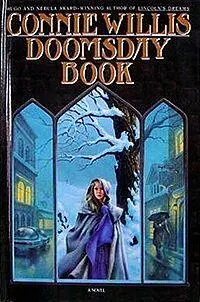
- Название:Doomsday Book
- Автор:
- Издательство:Bantam Books
- Жанр:
- Год:1992
- ISBN:ISBN 0-553-35167-2
- Рейтинг книги:3 / 5. Голосов: 1
-
Избранное:Добавить в избранное
- Отзывы:
-
Ваша оценка:
Doomsday Book: краткое содержание, описание и аннотация
Предлагаем к чтению аннотацию, описание, краткое содержание или предисловие (зависит от того, что написал сам автор книги «Doomsday Book»). Если вы не нашли необходимую информацию о книге — напишите в комментариях, мы постараемся отыскать её.
is an intelligent and satisfying blend of classic science fiction and historical reconstruction. Kivrin, a history student at Oxford in 2048, travels back in time to a 14th-century English village, despite a host of misgivings on the part of her unofficial tutor. When the technician responsible for the procedure falls prey to a 21st-century epidemic, he accidentally sends Kivrin back not to 1320 but to 1348 — right into the path of the Black Death. Unaware at first of the error, Kivrin becomes deeply involved in the life of the family that takes her in. But before long she learns the truth and comes face to face with the horrible, unending suffering of the plague that would wipe out half the population of Europe. Meanwhile, back in the future, modern science shows itself infinitely superior in its response to epidemics, but human nature evidences no similar evolution, and scapegoating is still alive and well in a campaign against "infected foreigners." This book finds villains and heroes in all ages, and love, too, which Kivrin hears in the revealing and quietly touching deathbed confession of a village priest. Won Nebula Award for Best Novel in 1992
Won Hugo Award for Best Novel in 1993
Doomsday Book — читать онлайн бесплатно полную книгу (весь текст) целиком
Ниже представлен текст книги, разбитый по страницам. Система сохранения места последней прочитанной страницы, позволяет с удобством читать онлайн бесплатно книгу «Doomsday Book», без необходимости каждый раз заново искать на чём Вы остановились. Поставьте закладку, и сможете в любой момент перейти на страницу, на которой закончили чтение.
Интервал:
Закладка:
It had been made by a soft-soled shoe with no heel, and the foot that had made it was large, larger even than hers. A man's foot, but men in the 1300's had been smaller, shorter, with feet not even as big as hers. A giant's foot.
Maybe it's an old footprint, she thought wildly. Maybe it's the footprint of a woodcutter, or a peasant looking for a lost sheep. Maybe this is one of the king's woodlands, and they've been through here hunting. But it wasn't the footprint of someone chasing a deer. It was the print of someone who had stood there for a long time, watching her. I heard him, she thought, and a little flutter of panic forced itself up into her throat. I heard him standing there.
She was still kneeling, holding onto the wheel for balance. If the man, whoever it was, and it had to be a man, a giant, were still here in this glade, watching, he must know that she had found the footprint. She stood up. "Hello!" she called, and frightened the birds to death again. They flapped and squawked themselves into hushed silence. "Is someone there?"
She waited, listening, and it seemed to her that in the silence she could hear the breathing again. " Speke. I am in distresse an my servauntes fled ."
Lovely, she thought even as she said it. Tell him you're helpless and all alone.
"Halloo!" she called again and began a cautious circuit of the glade, peering out into the trees. If he was still standing there, it was so dark she wouldn't be able to see him. She couldn't make out anything past the edges of the glade. She couldn't even tell for sure which way the thicket and the road lay. If she waited any longer, it would be completely dark, and she would never be able to get the wagon to the road.
But she couldn't move the wagon. Whoever had stood there between the two oaks, watching her, knew that the wagon was here. Maybe he had even seen it come through, bursting on the sparkling air like something conjured by an alchemist. If that were the case, he had probably run off to get the stake Dunworthy was so sure the populace kept in readiness. But surely if that were the case he would have said something, even if it was only, "Yoicks!" or "Heavenly Father!" and she would have heard him crashing through the underbrush as he ran way.
He hadn't run away, though, which meant he hadn't seen her come through. He had come upon her afterwards, lying inexplicably in the middle of the woods beside a smashed wagon, and thought what? That she had been attacked on the road and then dragged here to hide the evidence?
Then why hadn't he tried to help her? Why had he stood there, silent as an oak, long enough to leave a deep footprint, and then gone away again? Maybe he had thought she was dead. He would have been frightened of her unshriven body. People as late as the fifteenth century had believed that evil spirits took immediate possession of any body not properly buried.
Or maybe he had gone for help, to one of those villages that Kivrin had heard, maybe even Skendgate, and was even now on his way back with half the town, all of them carrying lanterns.
In that case, she should stay where she was and wait for him to come back. She should even lie down again. When the townspeople arrived, they could speculate about her and then bear her to the village, giving her examples of the language, the way her plan had been intended to work in the first place. But what if he came back alone, or with friends who had no intention of helping her?
She couldn't think. Her headache had spread out from her temple to behind her eyes. As she rubbed her forehead, it began to throb. And she was so cold! This cloak, in spite of its rabbit-fur lining, wasn't warm at all. How had people survived the Little Ice Age dressed only in cloaks like this? How had the rabbits survived?
At least she could do something about the cold. She could gather some wood and start a fire, and then if the footprint person came back with evil intentions, she could hold him off with a flaming brand. And if he had gone off for help and not been able to find his way back in the dark, the fire would lead him to her.
She made the circuit of the glade again, looking for wood. Dunworthy had insisted she learn to build a fire without tinder or flint. "Gilchrist expects you to wander around the Middle Ages in the dead of winter without knowing how to build a fire?" he had said, outraged, and she had defended him, told him Mediaeval didn't expect her to spend that much time out of doors. But they should have realized how cold it could get.
The sticks made her hands cold, and every time she bent over to pick up a stick, her head hurt. Eventually she stopped bending over altogether and simply stooped and grabbed for the broken-off twigs, keeping her head straight. That helped a little, but not much. Maybe she was feeling this way because she was so cold. Maybe the headache, the breathlessness, were coming from being so cold. She had to get the fire started.
The wood felt icy-cold and wet. It would never burn. And the leaves would be damp, too, far too damp to use for tinder. She had to have dry kindling and a sharp stick to start a fire. She laid the wood down in a little bundle by the roots of a tree, careful to keep her head straight, and went back to the wagon.
The bashed-in side of the wagon had several broken pieces of wood she could use for kindling. She got two splinters in her hand before she managed to pull them free, but the wood at least felt dry, though it was cold, too. There was a large, sharp spur of wood just above the wheel. She bent over to grab it and nearly fell, gasping with the sudden nauseating dizziness.
"You'd better lie down," she said out loud.
She eased herself to sitting, holding onto the ribs of the wagon for support. "Dr. Ahrens," she said a little breathlessly, "you ought to come up with something to prevent time-lag. This is awful."
If she could just lie down for a bit, perhaps the dizziness would go away and she could build the fire. She couldn't do it without bending over, though, and just the thought of doing that brought the nausea back.
She pulled her hood up over her head and closed her eyes, and even that hurt, the action seeming to focus the pain in her head. Something was wrong. This could not possibly be a reaction to time-lag. She was supposed to have a few minor symptoms that would fade within an hour or two of her arrival, not get worse. A little headache, Dr. Ahrens had said, some fatigue. She hadn't said anything about nausea, about being racked with cold.
She was so cold. She pulled the skirts of her cloak around her like a blanket, but the action seemed to make her even colder. Her teeth began to chatter, the way they had up on the hill, and great, convulsive shudders shook her shoulders.
I'm going to freeze to death, she thought. But it can't be helped. I can't get up and start the fire. I can't. I'm too cold. It's too bad you were wrong about the contemps, Mr. Dunworthy, she thought, and even the thought was dizzy. Being burned at the stake sounds lovely.
She would not have believed that she could have fallen asleep, huddled there on the cold ground. She had not noticed any spreading warmth, and if she had she would have been afraid it was the creeping numbness of hypothermia and tried to fight it. But she must have slept because when she opened her eyes again it was night in the glade, full night with frosty stars in the net of branches overhead, and she was on the ground looking up at them.
She had slid down as she slept, so that the top of her head was against the wheel. She was still shivering with cold, though her teeth had stopped chattering. Her head had begun to throb, tolling like a bell, and her whole body ached, especially her chest, where she had held the wood against her while she gathered sticks for the fire.
Читать дальшеИнтервал:
Закладка:
Похожие книги на «Doomsday Book»
Представляем Вашему вниманию похожие книги на «Doomsday Book» списком для выбора. Мы отобрали схожую по названию и смыслу литературу в надежде предоставить читателям больше вариантов отыскать новые, интересные, ещё непрочитанные произведения.




Обсуждение, отзывы о книге «Doomsday Book» и просто собственные мнения читателей. Оставьте ваши комментарии, напишите, что Вы думаете о произведении, его смысле или главных героях. Укажите что конкретно понравилось, а что нет, и почему Вы так считаете.