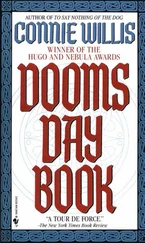
Connie Willis - Doomsday Book
Здесь есть возможность читать онлайн «Connie Willis - Doomsday Book» весь текст электронной книги совершенно бесплатно (целиком полную версию без сокращений). В некоторых случаях можно слушать аудио, скачать через торрент в формате fb2 и присутствует краткое содержание. Год выпуска: 1992, ISBN: 1992, Издательство: Bantam Books, Жанр: Фантастика и фэнтези, Социально-психологическая фантастика, на английском языке. Описание произведения, (предисловие) а так же отзывы посетителей доступны на портале библиотеки ЛибКат.
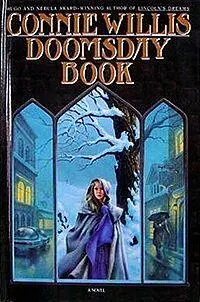
- Название:Doomsday Book
- Автор:
- Издательство:Bantam Books
- Жанр:
- Год:1992
- ISBN:ISBN 0-553-35167-2
- Рейтинг книги:3 / 5. Голосов: 1
-
Избранное:Добавить в избранное
- Отзывы:
-
Ваша оценка:
Doomsday Book: краткое содержание, описание и аннотация
Предлагаем к чтению аннотацию, описание, краткое содержание или предисловие (зависит от того, что написал сам автор книги «Doomsday Book»). Если вы не нашли необходимую информацию о книге — напишите в комментариях, мы постараемся отыскать её.
is an intelligent and satisfying blend of classic science fiction and historical reconstruction. Kivrin, a history student at Oxford in 2048, travels back in time to a 14th-century English village, despite a host of misgivings on the part of her unofficial tutor. When the technician responsible for the procedure falls prey to a 21st-century epidemic, he accidentally sends Kivrin back not to 1320 but to 1348 — right into the path of the Black Death. Unaware at first of the error, Kivrin becomes deeply involved in the life of the family that takes her in. But before long she learns the truth and comes face to face with the horrible, unending suffering of the plague that would wipe out half the population of Europe. Meanwhile, back in the future, modern science shows itself infinitely superior in its response to epidemics, but human nature evidences no similar evolution, and scapegoating is still alive and well in a campaign against "infected foreigners." This book finds villains and heroes in all ages, and love, too, which Kivrin hears in the revealing and quietly touching deathbed confession of a village priest. Won Nebula Award for Best Novel in 1992
Won Hugo Award for Best Novel in 1993
Doomsday Book — читать онлайн бесплатно полную книгу (весь текст) целиком
Ниже представлен текст книги, разбитый по страницам. Система сохранения места последней прочитанной страницы, позволяет с удобством читать онлайн бесплатно книгу «Doomsday Book», без необходимости каждый раз заново искать на чём Вы остановились. Поставьте закладку, и сможете в любой момент перейти на страницу, на которой закончили чтение.
Интервал:
Закладка:
"Call the proctor," Gilchrist said to the porter. "I want them thrown out."
The screen was not only blank but dark, and so were the function lights above it on the console. The power switch was turned to off. "You've switched off the power," Dunworthy said, and his voice sounded as old as Badri's had. "You've shut down the net."
"Yes," Gilchrist said, "and a good thing, too, since you feel you have the right to barge in without authorization."
He put a hand out blindly toward the blank screen, staggering a little. "You've shut down the net," he repeated.
"Are you all right, Mr. Dunworthy?" Colin said, taking a step forward.
"I thought you might attempt to break in and open the net," Gilchrist said, "since you seem to have no respect for Mediaeval's authority. I cut off the power to prevent that happening, and it appears I did the right thing."
Dunworthy had heard of people being struck down by bad news. When Badri had told him Kivrin was in 1348, he had not been able to absorb what it meant, but this news seemed to strike him with a physical force, knocking the wind out of him so that he couldn't catch his breath. "You shut the net down," he said. "You've lost the fix."
"Lost the fix?" Gilchrist said. "Nonsense. There are backups and things surely. When the power's switched on again — "
"Does this mean we don't know where Kivrin is?" Colin asked.
"Yes," Dunworthy said, and thought as he fell, I am going to hit the console like Badri did, but he didn't. He fell almost gently, like a man with the wind knocked out of him, and collapsed like a lover into Gilchrist's outstretched arms.
"I knew it," he heard Colin say. "This is because you didn't get your enhancement. Great-Aunt Mary's going to kill me."
CHAPTER TWENTY-SIX
"That's impossible," Kivrin said. "It can't be 1348," but it all made sense, Imeyne's chaplain dying, and their not having any servants, Eliwys's not wanting to send Gawyn to Oxford to find out who Kivrin was. "There is much illness there," Lady Yvolde had said, and the Black Death had hit Oxford at Christmas in 1348. "What happened?" she said, and her voice rose out of control. "What happened ? I was supposed to go to 1320. 1320! Mr. Dunworthy told me I shouldn't come, he said Mediaeval didn't know what they were doing, but they couldn't have sent me to the wrong year !" She stopped. "You must get out of here! It's the Black Death!"
They all looked at her so uncomprehendingly that she thought the interpreter must have lapsed into English again. "It's the Black Death," she said again. "The blue sickness!"
"Nay," Eliwys said softly, and Kivrin said, "Lady Eliwys, you must take Lady Imeyne and Father Roche down to the hall."
"It cannot be," she said, but she took Lady Imeyne's arm and led her out, Imeyne clutching the poultice as if it were her reliquary. Maisry darted after them, her hands clutched to her ears.
"You must go, too," Kivrin said to Roche. "I will stay with the clerk."
"Thruuuu…" the clerk murmured from the bed, and Roche turned to look at him. The clerk struggled to rise, and Roche started toward him.
"No!" Kivrin said, and grabbed his sleeve. "You mustn't go near him." She interposed herself between him and the bed. "The clerk's illness is contagious," she said, willing the interpreter to translate. "Infectious. It is spread by fleas and by…" she hesitated, trying to think how to describe droplet infection, "by the humours and exhalations of the ill. It is a deadly disease, which kills nearly all who come near it."
She watched him anxiously, wondering if he had understood anything she'd said, if he could understand it. There had been no knowledge of germs in the 1300's, no knowledge of how diseases spread. The contemps had believed the Black Death was a judgment from God. They had thought it was spread by poisonous mists which floated across the countryside, by a dead person's glance, by magic.
"Father," the clerk said, and Roche tried to step past Kivrin, but she barred his way.
"We cannot leave them to die," he said.
They did, though, she thought. They ran away and left them. People abandoned their own children, and doctors refused to come, and all the priests fled.
She stooped and picked up one of the strips of cloth Lady Imeyne had torn for her poultice. "You must cover your mouth and nose with this," she said.
She handed it to him and he looked at it, frowning, and then folded it into a flat packet and held it to his face.
"Tie it," Kivrin said, picking up another one. She folded it diagonally and put it over her nose and mouth like a bandit's mask and tied it in a knot in the back. "Like this."
Roche obeyed, fumbling with the knot, and looked at Kivrin. She moved aside, and he bent over the clerk and put his hand on his chest.
"Don't — "she said, and he looked up at her. "Don't touch him any more than you have to."
She held her breath as Roche examined him, afraid that he would start up suddenly again and grab at Roche, but he didn't move at all. The bubo under his arm had begun to ooze blood and a slow greenish pus.
Kivrin put a restraining hand on Roche's arm. "Don't touch it," she said. "He must have broken it when we were struggling with him." She wiped the blood and pus away with one of Imeyne's cloth strips and bound up the wound with the last one, tying it tightly at the shoulder. The clerk did not wince or cry out, and when she looked at him she saw he was staring straight ahead, unmoving.
"Is he dead?" she asked.
"Nay," Roche said, his hand on his chest again, and she could see the faint rise and fall. "I must bring the sacraments," he said through the mask, and his words were almost as blurred as the clerk's.
No, Kivrin thought, the panic rising again. Don't go. What if he dies? What if he rises up again?
Roche straightened. "Do not fear," he said. "I will come again."
He went out rapidly, without shutting the door, and Kivrin went over to close it. She could hear sounds from below — Eliwys's and Roche's voices. She should have told him not to speak to anyone. Agnes said, "I wish to stay with Kivrin," and began to howl and Rosemund answered her angrily, shouting over the crying.
"I will tell Kivrin," Agnes said outraged, and Kivrin shoved the door to and barred it.
Agnes must not come in here, nor Rosemund, nor anyone. They must not be exposed. There was no cure for the Black Death. The only way to protect them was to keep them from catching it. She tried frantically to remember what she knew about the plague. She had studied it in Fourteenth Century, and Dr. Ahrens had talked about it when she'd given Kivrin her inoculations.
There were two distinct types, no, three — one went directly into the bloodstream and killed the victim within hours. Bubonic plague was spread by rat fleas, and that was the kind that produced the buboes. The other kind was pneumonic, and it didn't have buboes. The victim coughed and vomited up blood, and that was spread by droplet infection and was horribly contagious. But the clerk had the bubonic, and that wasn't as contagious. Simply being near the patient wouldn't do it — the flea had to jump from one person to another.
She had a sudden vivid image of the clerk falling on Rosemund, bearing her down to the floor. What if she gets it? she thought. She can't, she can't get it. There isn't any cure.
The clerk stirred in the bed, and Kivrin went over to him.
"Thirsty," he said, licking his lips with his swollen tongue. She brought him a cup of water, and he drank a few gulps greedily and then choked and spewed it over her.
She backed away, yanking off the drenched mask. It's the bubonic, she told herself, wiping frantically at her chest. This kind isn't spread by droplet. And you can't get the plague, you've had your inoculation. But she had had her antivirals and her T-cell enhancement, too. She should not have been able to get the virus either. She should not have landed in 1348.
Читать дальшеИнтервал:
Закладка:
Похожие книги на «Doomsday Book»
Представляем Вашему вниманию похожие книги на «Doomsday Book» списком для выбора. Мы отобрали схожую по названию и смыслу литературу в надежде предоставить читателям больше вариантов отыскать новые, интересные, ещё непрочитанные произведения.



Обсуждение, отзывы о книге «Doomsday Book» и просто собственные мнения читателей. Оставьте ваши комментарии, напишите, что Вы думаете о произведении, его смысле или главных героях. Укажите что конкретно понравилось, а что нет, и почему Вы так считаете.