Larry Niven - Footfall
Здесь есть возможность читать онлайн «Larry Niven - Footfall» весь текст электронной книги совершенно бесплатно (целиком полную версию без сокращений). В некоторых случаях можно слушать аудио, скачать через торрент в формате fb2 и присутствует краткое содержание. Год выпуска: 1985, ISBN: 1985, Издательство: Del Rey Books, Жанр: Фантастика и фэнтези, на английском языке. Описание произведения, (предисловие) а так же отзывы посетителей доступны на портале библиотеки ЛибКат.
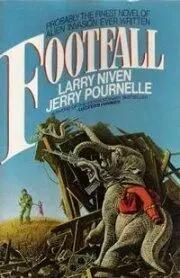
- Название:Footfall
- Автор:
- Издательство:Del Rey Books
- Жанр:
- Год:1985
- ISBN:0-345-32347-5
- Рейтинг книги:3 / 5. Голосов: 1
-
Избранное:Добавить в избранное
- Отзывы:
-
Ваша оценка:
Footfall: краткое содержание, описание и аннотация
Предлагаем к чтению аннотацию, описание, краткое содержание или предисловие (зависит от того, что написал сам автор книги «Footfall»). Если вы не нашли необходимую информацию о книге — напишите в комментариях, мы постараемся отыскать её.
Physically, the Fithp resemble man-sized, quadrupedal elephants with multiple trunks. They possess more advanced technology than humans, but have developed none of it themselves. In the distant past on their planet, another species was dominant, with the Fithp existing as animals, perhaps even as pets. This predecessor species badly damaged the environment, rendering themselves and many other species extinct, but left behind their knowledge inscribed on large stone cubes (called
, plural of
in the Fithp language), from which the Fithp have gained their technology. The study of Thuktun is the only science the Fithp possess. The Fithp are armed with a technology that is superior rather than incomprehensible: laser cannon, projectile rifles, controlled meteorite strikes to bombard surface targets, lightcraft surface-to-orbit shuttles the size of warships, etc.
Nominated for Hugo and Locus awards in 1986.
Footfall — читать онлайн бесплатно полную книгу (весь текст) целиком
Ниже представлен текст книги, разбитый по страницам. Система сохранения места последней прочитанной страницы, позволяет с удобством читать онлайн бесплатно книгу «Footfall», без необходимости каждый раз заново искать на чём Вы остановились. Поставьте закладку, и сможете в любой момент перейти на страницу, на которой закончили чтение.
Интервал:
Закладка:
The corner of Roger’s eye had caught light brighter than sunlight. He braked without looking. “What is it?”
“They `it hitting us again!”
He eased the Rabbit over to the dirt rim of the highway before he dared look. One glance was enough. “Don’t look.” He opened the door and slid out, low. “Follow me. Rosalee, wake up and get out on my side! Stay low!”
The blast came, not as bad as he had expected, followed by a wind, followed by another blast and more wind. The Rabbit’s windows rattled. By then all three were crouched on the highway side of the car. There were more bright lights high overhead, and another to the north. When the light died a little, Roger peeked over the hood.
Fiery mushrooms bloomed amidst the Kansas wheat fields.
“Mushrooms. I think this is the real thing,” he said. “Not meteors. Atomic bombs, and that’s occupied territory. Those are ours.”
“Bombing Kansas?”
Roger laughed, and meant it. “If you’ve got a better idea, you should have been in the helicopter. At least we’re fighting back!” He peeked again. There were four fire-mushrooms in view, all a good distance north
A thread of actinic green light rose from hundreds of miles away… something was blocking it at the skyward end, something rising… another fireball winked near the base of the beam. Roger ducked fast, waited, looked again. Fireball rising. No laser beam. An orange point high up, drifting down. What was that all about?
Whatever. Lasers were aliens, atomic bombs were men, and the bomb had interrupted something. “Come on, guys,” Roger gloated. “Ruin their whole morning!”
Part 3 FOOTFALL
23. CLEANUP
The destiny of mankind is not decided by material computation. When great causes am on the move, we learn that we ate spirits, not animals, and that something is going on in space and time, and beyond space and time, which, whether we like it or not, spells duty.
—WINSTON CHURCHIlL, Rochester, New York, 1941Western Kansas was a black, dimpled land.
The army pilot gave the craters a wide berth, flying carefully upwind. A stutter tried to surface when he spoke, and he spoke seldom. His motions were jerky. He couldn’t have seen films of death-beams spiraling in on other helicopters, but rumors must have spread. Jenny guessed that he was waiting to be speared by green light.
Sifting beside her, Jack Clybourne was as calm as an oyster.
Jenny saw reports from the observatories as they came in, and she kept no secrets from Jack. Earth’s most recent moons still included more than a score of destroyer-sized spacecraft; but the mother ship had disappeared into interplanetary space with half its retinue, and the remaining ships seemed to be doing nothing. Waiting? If the pilot had known what Jenny knew, he might be calmer. But the vivid green death was still possible. Jenny wasn’t as calm as she looked. Jack Clybourne was Jenny’s own true love, but he was not about to out-macho her.
From time to time, at Jenny’s orders, the pilot skimmed low over burned cornfields and along broken roads. The roads were strewn with hundreds of what might have been gigantic tablecloths in neon-bright colors, and thousands of dinner-plate-sized pieces of flattened foam plastic. The hang-glider fabric would become clothing, come winter, for refugees who would be glad to have it. But the alien landing shoes would be indestructible litter. A hundred years from now farmers would still be digging them up in the cornfields. Would those farmers have hands, or bifurcated trunks?
There were black skeletons of automobiles, and corpses: enough half-burned human and alien corpses to satisfy anybody.
The helicopter circled a village, and Jenny couldn’t find a single unburned structure. The inhabitants had fled ahead of the aliens, and the aliens had fled from fission bombs, and nobody remained to fight the fires.
Rarely, bands of refugees looked up to watch the helicopter pass. Few tried to wave it down.
Jenny’s eyes kept straying to the alien ship.
It had been in sight for nearly an hour. Less than ten miles away now, it dominated the flat black landscape. It had fallen several miles. It was foreshortened, its hull split, like a Navy battleship dropped on its nose. It must have loomed large in the refugees’ eyes.
Like a coyote on a freeway, a fi’ corpse lay in the road, flattened to a pancake silhouette and rotted almost to its crushed bones. Its hang glider hadn’t opened. She’d seen dead snouts here and there. They stripped their dead, but often left them where they lay. Cremation would have been easy enough: stack the bodies, and one blast of a fithp laser would do it.
The helicopter settled near the stern. Jenny and Jack got out.
They walked alongside the ruined hull. Only the warship’s tail, an outsize rocket-nozzle-shape with jet scoops facing forward, had survived the crash intact. The hull had split halfway along its length. Jack chinned himself on the edge of the rip. “Nothing. A fuel tank.”
Forward of the tank wall, the hull had wrinkled and torn again. From the bent nose a glassless window winked, the opening squeezed almost shut. Where ripped metal gaped conveniently wide, they climbed inside, Jack leading the way.
They came out faster than they went in. Jenny took off the gas mask and waited. Jack Clybourne ran into the cornfield. After a few moments she heard sounds of gagging. She tried not to notice.
“Sorry,” he said when he came back.
“Sure. I almost lost my lunch too.”
“First assignment I get Outside—”
“You haven’t done any harm,” Jenny said. “We’re not likely to do any good here, either. The ship’s a mess, it’s a job for experts.”
“Experts.” He looked at the wreckage. “You’d send your dreamers-for-hire into that?”
“It’s their job.”
Jack shook his head. He said. “Well, it’s for sure there weren’t any survivors.”
“Yes. Too bad.”
“Damn straight. Jeez, you’d think they’d have left some of their troops behind.”
“They must have been ready to evacuate. Just in case,” Jenny said.
“Maybe they planned it that way. Maybe they did just what they came for. Kansas is gone. This place is a wound, a cemetery. We’ve got no dams, no highways, no railroads, and we’re afraid to fly. And we’ve got one prisoner. How many of our people did they get?’
Jenny shook her head. “I don’t know. A lot, from the missing persons reports. But we can’t rely on those.” We’re stalling, she thought. “Look, I’ve got to go back in. Alone. No need for both of us to get sick.”
“No. I wanted to come. I wasn’t doing any good inside the Hole.” Clybourne put on the gas mask. “Rrready.” His voice sounded hollow from inside the mask.
They reentered the rip in the life support system.
The interior was twisted and bent. Crumpled walls showed crumpled machinery and torn wiring buried inside. Alien bodies lay in the corridors. They stank. Too many days had passed since the combined U.S. and Soviet bombardment had driven the aliens back to space. Alien bodies had bloated and/or ruptured. Jenny tried to ignore them; they were someone else’s job. She hoped the biologists would come soon to remove them.
Not that I know what I’m looking for. She went deeper into the ship. Her flashlight picked out the remains of equipment; wherever she pointed, Jack took photographs. The whine of the recharger for his electronic flash sounded loud in the dead ship.
Nothing was intact. There can’t be anything here, or they’d have melted it from space. Wouldn’t they? How do they regard their dead? I’ll have to ask Harpanet. Get Reynolds to ask him, she cotrected herself. The science-fiction writers seemed to spend all their time with the captured alien; and Jenny couldn’t face one, not after this.
Читать дальшеИнтервал:
Закладка:
Похожие книги на «Footfall»
Представляем Вашему вниманию похожие книги на «Footfall» списком для выбора. Мы отобрали схожую по названию и смыслу литературу в надежде предоставить читателям больше вариантов отыскать новые, интересные, ещё непрочитанные произведения.
Обсуждение, отзывы о книге «Footfall» и просто собственные мнения читателей. Оставьте ваши комментарии, напишите, что Вы думаете о произведении, его смысле или главных героях. Укажите что конкретно понравилось, а что нет, и почему Вы так считаете.