Larry Niven - Footfall
Здесь есть возможность читать онлайн «Larry Niven - Footfall» весь текст электронной книги совершенно бесплатно (целиком полную версию без сокращений). В некоторых случаях можно слушать аудио, скачать через торрент в формате fb2 и присутствует краткое содержание. Год выпуска: 1985, ISBN: 1985, Издательство: Del Rey Books, Жанр: Фантастика и фэнтези, на английском языке. Описание произведения, (предисловие) а так же отзывы посетителей доступны на портале библиотеки ЛибКат.
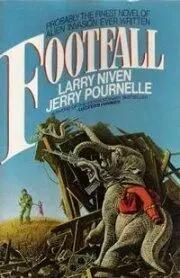
- Название:Footfall
- Автор:
- Издательство:Del Rey Books
- Жанр:
- Год:1985
- ISBN:0-345-32347-5
- Рейтинг книги:3 / 5. Голосов: 1
-
Избранное:Добавить в избранное
- Отзывы:
-
Ваша оценка:
Footfall: краткое содержание, описание и аннотация
Предлагаем к чтению аннотацию, описание, краткое содержание или предисловие (зависит от того, что написал сам автор книги «Footfall»). Если вы не нашли необходимую информацию о книге — напишите в комментариях, мы постараемся отыскать её.
Physically, the Fithp resemble man-sized, quadrupedal elephants with multiple trunks. They possess more advanced technology than humans, but have developed none of it themselves. In the distant past on their planet, another species was dominant, with the Fithp existing as animals, perhaps even as pets. This predecessor species badly damaged the environment, rendering themselves and many other species extinct, but left behind their knowledge inscribed on large stone cubes (called
, plural of
in the Fithp language), from which the Fithp have gained their technology. The study of Thuktun is the only science the Fithp possess. The Fithp are armed with a technology that is superior rather than incomprehensible: laser cannon, projectile rifles, controlled meteorite strikes to bombard surface targets, lightcraft surface-to-orbit shuttles the size of warships, etc.
Nominated for Hugo and Locus awards in 1986.
Footfall — читать онлайн бесплатно полную книгу (весь текст) целиком
Ниже представлен текст книги, разбитый по страницам. Система сохранения места последней прочитанной страницы, позволяет с удобством читать онлайн бесплатно книгу «Footfall», без необходимости каждый раз заново искать на чём Вы остановились. Поставьте закладку, и сможете в любой момент перейти на страницу, на которой закончили чтение.
Интервал:
Закладка:
the wings were five inches across, suited to fi’ digits. Wes was talking to himself before he realized that the screws turned the wrong way. Takpusseh must have wondered if the humans would be reduced to screaming for help through the grills.
He called to two passing warriors. “Take me to Raztupisp-minz.”
One stopped. “Wes-Dawson? You are to go to a restraint room.” Wes paused to refasten the grill, then moved away between the warriors.
Lorena brought the teapot. “More tea. Comrade Marshal?” she asked.
“Thank you, no,” Marshal Shavyrin said. He glanced at the clock on the wall, then at Lorena.
Pavel Bondarev saw, and made a tiny gesture of dismissal. Lorena left the room. Bondarev thought she closed the door heavily, but if so, Marshal Shavyrin did not notice it.
“It is fantastic,” Shavyrin said. A hastily assembled report with bright red coven lay on Bondarev’s desk next to Bondarev’s ancient brass telescope. Shavyrin lifted the report and idly thumbed through the pages. “Fantastic,” he repeated.
“I agree,” Bondarev said. “Yet we must believe—”
The telephone chirped. Bondarev touched a button to put the telephone on amplifier. “Bondarev.”
“Petrovskiy.”
“Da, Comrade Chairman!” Bondarev said. “We have prepared the report you ordered. Marshal Shavyrin is here.
“Good. You are well, Leonid Edmundovich?”
“Da, Comrade Chairman.”
“Very well. General Bondarev, you have spoken with the American generals?”
“Da. What they ask is barely possible, Comrade Chainnan.”
“Will it succeed?”
Bondarev looked helplessly at Shavyrin. The Marshal was silent for a moment, then said, “Comrade Chairman, who can know? Yet it may be the only possible plan. The timing, however, is very critical.”
“And your recommendation? Do we do this?”
Shavyrin was silent.
“Well?” the Chairman demanded.
“It is very critical,” Shavyrin said finally. “Part of their plan depends on their Pershing missiles. They are to fire them from Germany, to attack the alien spacecraft. Many of those missiles will come toward the Soviet Union. There will be no way to know their real targets-which might be Moscow or Kiev or our remaining missile bases.
“There is more,” Shavyrin continued. “Whenever we have launched missiles, the aliens have bombarded the base from which they came. They will attack our remaining bases. Few strategic rocket forces will remain after this battle. If the Americans do not use their missiles, we will be disarmed and nearly helpless, and they will retain their strategic striking power. Suppose they do not launch their Pershing missiles, but keep them. They could destroy us within minutes, whenever they wanted, and we would be unable to retaliate.”
Narovchatov’s voice came onto the line. “Is it your recommendation that we do not cooperate with the Americans?”
“No, Comrade First Secretary,” Shavyrin said. “But it is my duty to make you and the Chairman aware of all the implications.”
“We have very little time,” Chairman Petrovskiy said. “The American President is waiting for my answer. He says the situation is desperate. I am inclined to agree. I must give him our decision now.”
“All depends on the Pershing missiles,” Shavyrin said. “If the Americans do not launch them-for any reason-then it is unlikely that our missiles will get through the enemy defenses. If the Americans are successful, then some of our missiles will reach their targets.”
“Bondarev?” the Chairman demanded.
“I believe this may be our last chance. If we do not aid the Americans now, then the Americans will be defeated, and how long will it be before Russia falls to the aliens?”
“Your recommendation?”
This is recorded. Not only the Chairman. The KGB will listen. If we fail — “Comrade Chairman, I recommend that we aid the Americans, provided that they use their Pershing missiles, all of their Pershing missiles, in both England and Germany, to assist our penetration.”
“You agree, Marshal Shavyrin?”
“Da, with those conditions, Comrade Chainnan.”
There was a long silence. Then the Chairman said, “Very well. I will inform the American President, and we will soon tell you the time for this attack.” There was another pause, then the Chairman’s voice came on again. “Academician and General of the Army Pavel Aleksandrovich Bondarev, and Marshal Leonid Edmundovich Shavyrin, I instruct you to take command of all strategic forces of the Soviet Union, including the submarine forces, and to employ them in aid of the battle plan code-named WHIRLWIND. If you jointly agree, you are authorized to use all of the forces in your command in aid of the American effort to drive the aliens from the planet. Is this understood?”
“Da, Comrade Chairman,” Shavyrin said.
Pavel Bondarev gulped hard. “Da.”
22. SOMETHING IN THE AIR
The enemy of my enemy is my friend.
—ARAB PROVERBPavel Bondarev looked up at the big clock on his wall. “Ten minutes,” he said.
Marshal Shavyrin grinned. “Da. You are nervous, Comrade!”
“Of course,” Bondarev said with irritation. “We are about to make the most important decision in Russian history. Should I not be nervous?”
“Certainly, but you will permit that I do not openly join you? I have known for five years that I might be faced with this moment.”
“True,” Bondarev said. He looked at the twin electronics consoles installed against one wall of his underground office. Lights winked in complex patterns. In the lower right corner of each console was a switch. Bondarev patted his throat, to feel the key on its silver chain. “Does it make it easier?”
“The peasants say you can become accustomed to anything, even hanging, if you hang long enough-what was that?”
There were sharp sounds from outside. Bondarev went to the door.
“No! Do not open that door!” Shavyrin commanded. He lifted his telephone. “Colonel! What is the situation?” He listened for a few moments. “They must not enter,” he snapped: “The cost does not matter. Our orders come from Chairman Petrovskiy himself! Do what you can. What you must,” he said. He put down the phone.
Bondarev looked the question at him.
“KGB,” Shavyrin said. “They have sent soldiers as well as their agents. My security forces are resisting them.”
“But—” Pavel lifted the telephone. “Get me Chairman Petrovshy—”
Shavyrin shook his head. “Colonel Polivanov has already reported that the KGB has cut the telephone lines. We no longer have communications with Moscow.”
Bondamv looked up in horror. “But—”
Before he could speak, the door opened. Lorena came in.
“What are you doing here?” Bondarev demanded.
She hesitated for a moment, then showed what was in her hand. She held a small automatic pistol. “You are both under arrest, in the name of State Security,” she said.
“No!” Bdndarev shouted. “Not you!”
“The KGB is everywhere,” Shavyrin said. He reached for the telephone—
“Stop that!” Lorena shouted. Hysteria tinged her voice.
“Comrade, I must speak to the rocket forces,” Shavyrin said.
“To order them to aid the Americans,” she said. “Never! The aliens will destroy the Soviet Union—”
“Then they will do it anyway,” Shavyrin said. “Understand this. The Americans are to launch” — he glanced at the clock on the wall — “even now are launching their Pershing missiles. Those missiles will come toward us. They are supposed to provide a diversion to allow our missiles to penetrate, but there is always the chance that the Americans will use this as an opportunity to attack us. With that in mind I have given orders that if the rocket forces do not hear from us, they will attack the United States. Not attack Kansas, but all of the United States!”
Читать дальшеИнтервал:
Закладка:
Похожие книги на «Footfall»
Представляем Вашему вниманию похожие книги на «Footfall» списком для выбора. Мы отобрали схожую по названию и смыслу литературу в надежде предоставить читателям больше вариантов отыскать новые, интересные, ещё непрочитанные произведения.








Обсуждение, отзывы о книге «Footfall» и просто собственные мнения читателей. Оставьте ваши комментарии, напишите, что Вы думаете о произведении, его смысле или главных героях. Укажите что конкретно понравилось, а что нет, и почему Вы так считаете.