James White - Code Blue Emergency
Здесь есть возможность читать онлайн «James White - Code Blue Emergency» — ознакомительный отрывок электронной книги совершенно бесплатно, а после прочтения отрывка купить полную версию. В некоторых случаях можно слушать аудио, скачать через торрент в формате fb2 и присутствует краткое содержание. Год выпуска: 1987, Жанр: Фантастика и фэнтези, на английском языке. Описание произведения, (предисловие) а так же отзывы посетителей доступны на портале библиотеки ЛибКат.
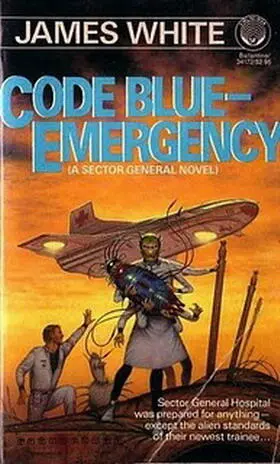
- Название:Code Blue Emergency
- Автор:
- Жанр:
- Год:1987
- ISBN:нет данных
- Рейтинг книги:5 / 5. Голосов: 1
-
Избранное:Добавить в избранное
- Отзывы:
-
Ваша оценка:
Code Blue Emergency: краткое содержание, описание и аннотация
Предлагаем к чтению аннотацию, описание, краткое содержание или предисловие (зависит от того, что написал сам автор книги «Code Blue Emergency»). Если вы не нашли необходимую информацию о книге — напишите в комментариях, мы постараемся отыскать её.
White said in an interview that originally he intended to end the series with
(1985), by which time the central characters had reached the top levels in their careers. However Ballantine Books persuaded him to continue, and he extended the stories’ range by introducing new central characters beginning with
.
The protagonist of the story is Sommaradvan healer Cha Thrat. She bravely saved a human pilot who crashlanded on her planet, despite a complete lack of knowledge about his physiology. Contact with her species was established by the accident, so knowledge of their social customs is still virtually non-existent. However, she is invited to join the Sector General staff.
Cha Thrat innocently wreaks havoc by following her instincts and social customs. First she befriends a hypochondriac Chalder. Next, she is invited to assist at a therapeutic surgery operation to amputate the limb of a Hudlar, which will prolong its life (see Star Healer.) When given the honor of cutting the limb, she obliges — and then deliberately cuts her own arm off as well, in accordance with the custom of her people. Next she saves the untouchable patient Khone (see Star Healer), and then finds a weird parasite species on a derelict spaceship. Due to the chaos she causes, every department in the hospital now refuses to allow her near their patients. O’Mara values her unusual approaches, and decides to add her to his staff.
Code Blue Emergency — читать онлайн ознакомительный отрывок
Ниже представлен текст книги, разбитый по страницам. Система сохранения места последней прочитанной страницы, позволяет с удобством читать онлайн бесплатно книгу «Code Blue Emergency», без необходимости каждый раз заново искать на чём Вы остановились. Поставьте закладку, и сможете в любой момент перейти на страницу, на которой закончили чтение.
Интервал:
Закладка:
It laughed suddenly and went on. “Now we know how wrong Timmins was. But we still intend to keep you busy. You have four times as many hands as I have, and I can’t think of a better tool-carrier. Do I offend you,Technician?”
The question had been asked of the trainee technician and not the proud warrior-surgeon she had been, so the answer had to be “No.”
“That’s good,” Chen said. “Now, close and seal your helmet, and double-check your safety-line attachments. The Captain’s on his way.”
And then she was outside, festooned with equipment and drifting with the two Earth-humans across the short distance to the distressed vessel, which was now held by the rigid, nonmaterial beams of Rhabwar’s tractors. While immobilizing the other ship, their own had acquired a proportion of its spin. But the countless stars that wheeled endlessly around the apparently motionless vessels aroused a feeling not of nausea butwonder.
Prilicla was already there when they arrived, having exited by the casualty deck’s airlock, and was patrolling along the hull in its careful search for the emotional radiation that would indicate the presence of survivors.
CHAPTER 16
As soon as they were standing upright and held to the gray, unpainted hull plating by their boot magnets, and with the bulk of Rhabwar hanging above them like a shining and convoluted white ceiling, the Captain began to speak.
It said, “There are only so many ways for a door to open. It can hinge in or outward, slide vertically or laterally, unscrew clockwise or anticlockwise or, if the builders are sufficiently advanced in the field of molecular engineering, an opening could be dilated in an area of solid metal. We have yet to encounter a species capable of the latter and, if we ever do, we’ll have to be very careful indeed, and remember to call them, sir.”
Before it had joined the Monitor Corps, she had learned, Fletcher had been a ruler-academic and one of Earth’s foremost, and certainly most youthful, authorities on Extraterrestrial Comparative Technology, and the old habits died hard. Even on the hull of an alien ship that might apply thrust at any moment, it was lecturing — and remembering to include the occasional dry little joke. It was also speaking for the benefit of the recorders, in case something sudden and melodramatic happened.
“We are standing on a large door or hatch that is rectangular in shape with rounded corners,” it went on, “sothe probability is that it will open in or out. Below us, according to the sensors, is a large, empty compartment, which means that it has to be a cargo or personnel lock rather than an equipment access or inspection panel. The hatch is featureless, so the external actuator mechanism should be behind one of the small panels in the door surround. Technician, the scanner, please.”
Because this particular scanner was designed to see into the vital organs of metal-encased machines rather than the softer structures of flesh and blood, it was much larger and heavier than its medical counterpart. In her eagerness to appear fast and efficient, Cha Thrat miscalculated the inertia and sent it crashing into the hatch cover, where it left a long, shallow dent before the Captain brought it to a halt.
“Thank you,” Fletcher said drily, and added, “We are, of course, making no secret of our presence. A covert entry and our sudden appearance inside their ship might frighten the survivors, if there are any.”
Chen made an untranslatable noise and said, “Whacking the hull with a sledgehammer would have been even better.”
“Sorry,” Cha Thrat said.
Two of the small panels concealed retractable lighting fixtures and the remaining one turned out to be a large rocker switch set flush with the hull plating. Fletcher warned them to stand clear, then pressed with its palm on both ends of the switch in turn. It had to press very hard, so hard that it had pushed its leg and arm magnets away from the hull, before anything happened.
A sudden rush of air from the edge of the slowly opening hatch sent Fletcher spinning away. Cha Thrat, who had the advantage of four foot-magnets holding her down, grabbed it by one leg and brought the Captain into contact with the hull again.
“Thank you,” Fletcher said, as the fog of escaping air cleared, then went on. “Everyone inside. Doctor Prilicia, come quickly. The opening of the lock is sure to register on their control deck. If there are any survivors up there, now is the most likely time for them to get nervous and apply thrust …”
“There are survivors, friend Fletcher,” the empath broke in. “One of them is forward, probably on the control deck, and several groups of them’ farther aft, but none in your immediate area. Out here I am too far from the sources to be able to detect individual emotional radiation, but the predominant feelings are of fear, pain, and anger. It is the intensity of the anger that worries me, friend Fletcher, so go carefully. I am returning to Rhabwar for the rest of the medical team.”
With the scanner they were able to identify and trace the actuator wiring to a set of two rocker switches. The first one was locked in position, and when they pressed the second, the lock’s outer seal closed behind them, after which the first one moved freely and opened the inner seal, simultaneously turning on the lighting.
Fletcher said a few words for the recorders about the intense greenish-yellow lighting that would, on later analysis, give useful information about the crew’s visual organs and an indication of the type and proximity of their sun to the home planet. Then it led the way from the lock chamber into the corridor.
“The corridor is about four meters high, square in cross-section, well lit, unpainted, and gravity-free,” the Captain went on. “We assume an artificial gravity system, currently malfunctioning or possibly switched off, because the inner surfaces are bare of ladders, climbing nets, or handholds that the crew would need to get about in the weightless condition. At this level the section of corridor visible to us follows the lateral curvature of theinner hull, and opposite the lock entrance there is a wide opening through which we can see two ramps, one ascending and the other descending, which lead, presumably, to other decks. We are taking the ascending one.”
Consulting the analyzer strapped to its arm, the Captain went on. “Nothing toxic in the air, pressure low but still breathable, temperature normal. Open your visors so we can talk together without tying up the suit frequencies.”
Fletcher and Chen launched themselves into the air above the ascending ramp. Less expertly, Cha Thrat did likewise and was halfway to the top when the others arrived — and dropped suddenly onto the deck with a muffled crash of equipment and a much less quiet burst of strong language. She had enough warning to be able to land on her feet.
“The artificial gravity system,” the Captain said, when it had picked itself up again, “is still operating in this area. Move quickly, please, we’re looking for survivors.”
Large inward-opening doors with simple latch fastenings lined the corridor, and under Fletcher’s direction, the search became a routine process. First unlatch the door, push it wide open while standing well back in case something nasty came through it, then search the compartment quickly for crew members. But the compartments held only racks of equipment or containers of various shapes and sizes whose labels they could not read, and nothing that in any way resembled furniture, wall decorations, or clothing.
So far, Fletcher reported, the ship’s interior seemed incredibly spartan and utilitarian, and it was beginning to worry about the kind of people who would build and crew such a vessel.
Читать дальшеИнтервал:
Закладка:
Похожие книги на «Code Blue Emergency»
Представляем Вашему вниманию похожие книги на «Code Blue Emergency» списком для выбора. Мы отобрали схожую по названию и смыслу литературу в надежде предоставить читателям больше вариантов отыскать новые, интересные, ещё непрочитанные произведения.











Обсуждение, отзывы о книге «Code Blue Emergency» и просто собственные мнения читателей. Оставьте ваши комментарии, напишите, что Вы думаете о произведении, его смысле или главных героях. Укажите что конкретно понравилось, а что нет, и почему Вы так считаете.