Connie Willis - Fire Watch
Здесь есть возможность читать онлайн «Connie Willis - Fire Watch» весь текст электронной книги совершенно бесплатно (целиком полную версию без сокращений). В некоторых случаях можно слушать аудио, скачать через торрент в формате fb2 и присутствует краткое содержание. Город: New York, Год выпуска: 1998, ISBN: 1998, Издательство: Bantam Spectra, Жанр: Фантастика и фэнтези, на английском языке. Описание произведения, (предисловие) а так же отзывы посетителей доступны на портале библиотеки ЛибКат.
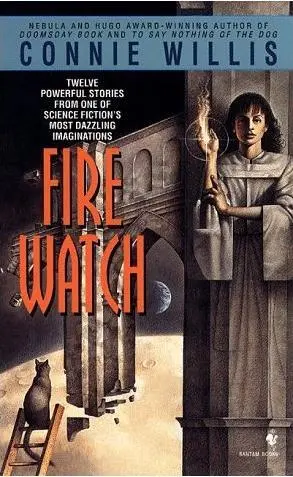
- Название:Fire Watch
- Автор:
- Издательство:Bantam Spectra
- Жанр:
- Год:1998
- Город:New York
- ISBN:978-0-307-57342-1
- Рейтинг книги:4 / 5. Голосов: 1
-
Избранное:Добавить в избранное
- Отзывы:
-
Ваша оценка:
Fire Watch: краткое содержание, описание и аннотация
Предлагаем к чтению аннотацию, описание, краткое содержание или предисловие (зависит от того, что написал сам автор книги «Fire Watch»). Если вы не нашли необходимую информацию о книге — напишите в комментариях, мы постараемся отыскать её.
In “Service for the Burial of the Dead,” a young woman mourning her lover comes upon a surprising funeral guest.
Biblical prophecies turn out to have unexpected meanings as the End Times approach in “Lost and Found.”
The dangers of ordering merchandise from the back pages of pulp magazines become apparent in “Mail-Order Clone.”
In “Blued Moon,” a young man uncovers a scientific property of coincidence—and falls in love.
As a tourist attraction, a total eclipse draws an even wider audience than (almost) anyone realizes in “And Come from Miles Around.”
In “Samaritan,” an enthusiastic young assistant pastor plunges the entire church hierarchy into a firestorm of controversy when she brings forward an orangutan to be baptized.
Parental abuse is all the rage in an institute of higher learning—for those who have no parents… and for those who have no children, in “All My Darling Daughters.”
Fire Watch — читать онлайн бесплатно полную книгу (весь текст) целиком
Ниже представлен текст книги, разбитый по страницам. Система сохранения места последней прочитанной страницы, позволяет с удобством читать онлайн бесплатно книгу «Fire Watch», без необходимости каждый раз заново искать на чём Вы остановились. Поставьте закладку, и сможете в любой момент перейти на страницу, на которой закончили чтение.
Интервал:
Закладка:
Again Daisy felt the faint pull of fear. Her period had started months ago, dark and bloody as she had imagined. She had not told anyone. “I won’t worry,” she said.
“Oh, my Daisy,” her mother said suddenly. “My Daisy in the sun,” and seemed to shrink back into the darkness. But as they pulled out of the station, she came out into the direct sun and waved goodbye to them.
It was wonderful on the train. The few passengers stayed in their cabins with the shades drawn. There were no shades in the dining car, no people to tell Daisy to get out of the sunlight. She sat in the deserted dining car and looked out the wide windows. The train flew through forests, thin branchy forests of spindly pines and aspens. The sun flickered in on Daisy—sun and then shadows and then sun, running across her face. She and her brother ordered an orgy of milkshakes and desserts and nobody said anything to them.
Her brother read his books about the sun out loud to her. “Do you know what it’s like in the middle of the sun?” he asked her. Yes. You stand with a bucket and a shovel and your bare toes digging into the sand, a child again, not afraid, squinting up into the yellow light.
“No,” she said.
“Atoms can’t even hold together in the middle of the sun. It’s so crowded they bump into each other all the time, bump bump bump, like that, and their electrons fly off and run around free. Sometimes when there’s a collision, it lets off an X-ray that goes whoosh, all the way out at the speed of light, like a ball in a pinball machine. Bing-hang-bing, all the way to the surface.”
“Why do you read those books anyway? To scare yourself?”
“No. To scare Mom.” That was a daring piece of honesty, suitable not even for the freedom of Grandma’s, suitable only for the train. She smiled at him.
“You’re not even scared, are you?”
She felt obliged to answer him with equal honesty “No,” she said, “not at all.”
“Why not?”
Because it won’t hurt. Because I won’t remember afterwards. Because I’ll stand in the sun with my bucket and shovel and look up and not be frightened. “I don’t know,” Daisy said. “I’m just not.”
“I am. I dream about burning all the time. I think about how much it hurts when I burn my finger and then I dream about it hurting like that all over forever.” He had been lying to their mother about his dreams, too.
“It won’t be like that,” Daisy said. “We won’t even know it’s happened. We won’t remember a thing.”
“When the sun goes nova, it’ll start using itself up. The core will start filling up with atomic ash, and that’ll make the sun start using up all its own fuel. Do you know it’s pitch-dark in the middle of the sun? See, the radiations are X-rays, and they’re too short to see. They’re invisible. Pitch-dark and ashes falling around you. Can you imagine that?”
“It doesn’t matter.” They were passing a meadow and Daisy’s face was full in the sun. “We won’t be there. We’ll be dead. We won’t remember anything.”
Daisy had not realized how relieved she would be to see her grandmother, narrow face sunburned, arms bare. She was not even wearing a hat. “Daisy dear, you’re growing up,” she said. She did not make it sound like a death sentence. “And David, you still have your nose in a book, I see.”
It was nearly dark when they got to her little house. “What’s that?” David asked, standing on the porch.
Her grandmother’s voice did not rise dangerously at all. “The aurora borealis. I tell you, we’ve had some shows up here lately. It’s like the Fourth of July.”
Daisy had not realized how hungry she had been to hear someone who was not afraid. She looked up. Great red curtains of light billowed almost to the zenith, fluttering in some solar wind. “It’s beautiful,” Daisy whispered, but her grandmother was holding the door open for her to go in, and so happy was she to see the clear light in her grandmother’s eyes, she followed her into the little kitchen with its red linoleum table and the red curtains hanging at the windows.
“It is so nice to have company,” her grandmother said, climbing-onto a chair. “Daisy, hold this end, will you?” She dangled the long end of a yellow plastic ribbon down to Daisy. Daisy took it, looking anxiously at her grandmother. “What are you doing?” she asked.
“Measuring for new curtains, dear,” she said, reaching into her pocket for a slip of paper and a pencil. “What’s the length, Daisy?”
“Why do you need new curtains?” Daisy asked. “These look fine to me.”
“They don’t keep the sun out,” her grandmother said. Her eyes had gone coal-black with fear. Her voice was rising with every word. “We have to have new curtains, Daisy, and there’s no cloth. Not in the whole town, Daisy. Can you imagine that? We had to send to Ottawa. They bought up all the cloth in town. Can you imagine that, Daisy?”
“Yes,” Daisy said, and wished she could be afraid.
Ron still held her hands tightly. She looked steadily at him. “Wanner, Daisy,” he said. “Almost here.”
“Yes,” she said.
He untwined their fingers and rose from the couch. He walked through the crowd in the blue living room and went out the door into the snow. She did not try to go to her room. She watched them all, the strangers in their endless, random movement, her brother walking while he read, her grandmother standing on a chair, and the memory came quite easily and without pain.
“You wanna see something?” her brother asked.
Daisy was looking out the window. All day long the lights had been flickering, even though it was calm and silent outside. Their grandmother had gone to town to see if the fabric for the curtains had come in. Daisy did not answer him.
He shoved the book in front of her face. “That’s a prominence,” he said. The pictures were in black and white, like old-fashioned snapshots, only under them instead of her mother’s scrawled white ink, it said, “High Altitude Observatory, Boulder, Colorado.”
“That’s an eruption of hot gas hundreds of thousands of feet high.”
“No,” Daisy said, taking the book into her own lap. “That’s my golden hoop. I saw it in my dream.”
She turned the page.
David leaned over her shoulder and pointed. “That was the big eruption in 1946 when it first started to go wrong only they didn’t know it yet. It weighed a billion tons. The gas went out a million miles.”
Daisy held the book like a snapshot of a loved one.
“It just went bash, and knocked all this gas out into space. There were all kinds of—”
“It’s my golden bear,” she said. The great paw of flame reached lazily out from the suns black surface in the picture, the wild silky paw of flaming gas.
“This is the stuff you’ve been dreaming?” her brother asked. “This is the stuff you’ve been telling me about?” His voice went higher and higher. “I thought you said the dreams were nice.”
“They were,” Daisy said.
He pulled the book away from her and flipped angrily through the pages to a colored diagram on a black ground. It showed a glowing red ball with concentric circles drawn inside it. “There,” he said, shoving it at Daisy. “That’s what’s going to happen to us.” He jabbed angrily at one of the circles inside the red ball. “That’s us. That’s us! Inside the sun! Dream about that, why don’t you?”
He slammed the book shut.
“But we’ll all be dead, so it won’t matter,” Daisy said. “It won’t hurt. We won’t remember anything.”
“That’s what you think! You think you know everything. Well, you don’t know what anything is. I read a book about it, and you know what it said? They don’t even know what memory is. They think maybe it isn’t even in the brain cells. That it’s in the atoms somewhere, and even if we’re blown apart, that memory stays. What if we do get burned by the sun and we still remember? What if we go on burning and burning and remembering and remembering forever?”
Читать дальшеИнтервал:
Закладка:
Похожие книги на «Fire Watch»
Представляем Вашему вниманию похожие книги на «Fire Watch» списком для выбора. Мы отобрали схожую по названию и смыслу литературу в надежде предоставить читателям больше вариантов отыскать новые, интересные, ещё непрочитанные произведения.





Обсуждение, отзывы о книге «Fire Watch» и просто собственные мнения читателей. Оставьте ваши комментарии, напишите, что Вы думаете о произведении, его смысле или главных героях. Укажите что конкретно понравилось, а что нет, и почему Вы так считаете.