Connie Willis - Fire Watch
Здесь есть возможность читать онлайн «Connie Willis - Fire Watch» весь текст электронной книги совершенно бесплатно (целиком полную версию без сокращений). В некоторых случаях можно слушать аудио, скачать через торрент в формате fb2 и присутствует краткое содержание. Город: New York, Год выпуска: 1998, ISBN: 1998, Издательство: Bantam Spectra, Жанр: Фантастика и фэнтези, на английском языке. Описание произведения, (предисловие) а так же отзывы посетителей доступны на портале библиотеки ЛибКат.
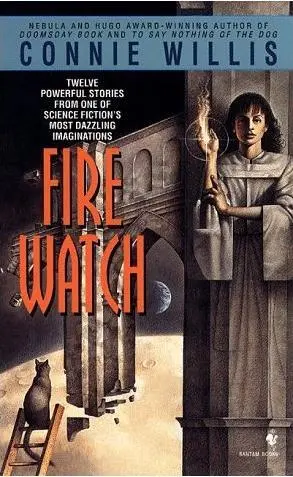
- Название:Fire Watch
- Автор:
- Издательство:Bantam Spectra
- Жанр:
- Год:1998
- Город:New York
- ISBN:978-0-307-57342-1
- Рейтинг книги:4 / 5. Голосов: 1
-
Избранное:Добавить в избранное
- Отзывы:
-
Ваша оценка:
Fire Watch: краткое содержание, описание и аннотация
Предлагаем к чтению аннотацию, описание, краткое содержание или предисловие (зависит от того, что написал сам автор книги «Fire Watch»). Если вы не нашли необходимую информацию о книге — напишите в комментариях, мы постараемся отыскать её.
In “Service for the Burial of the Dead,” a young woman mourning her lover comes upon a surprising funeral guest.
Biblical prophecies turn out to have unexpected meanings as the End Times approach in “Lost and Found.”
The dangers of ordering merchandise from the back pages of pulp magazines become apparent in “Mail-Order Clone.”
In “Blued Moon,” a young man uncovers a scientific property of coincidence—and falls in love.
As a tourist attraction, a total eclipse draws an even wider audience than (almost) anyone realizes in “And Come from Miles Around.”
In “Samaritan,” an enthusiastic young assistant pastor plunges the entire church hierarchy into a firestorm of controversy when she brings forward an orangutan to be baptized.
Parental abuse is all the rage in an institute of higher learning—for those who have no parents… and for those who have no children, in “All My Darling Daughters.”
Fire Watch — читать онлайн бесплатно полную книгу (весь текст) целиком
Ниже представлен текст книги, разбитый по страницам. Система сохранения места последней прочитанной страницы, позволяет с удобством читать онлайн бесплатно книгу «Fire Watch», без необходимости каждый раз заново искать на чём Вы остановились. Поставьте закладку, и сможете в любой момент перейти на страницу, на которой закончили чтение.
Интервал:
Закладка:
“You are old-fashioned,” he said. “Turn around.”
The coat is too short. I am cold all the time. “Where are the servants?” I say to my wife. “I want a fire.”
She looks up from her sewing as if she knows the answer will grieve me. “Gone,” she says. “We are getting new ones from the town.”
“Gone? Where?” I say, but I know already. Hardly awake, the cooks have run off to be bakers; the chamberlains, burghers; the pages, soldiers. “I shall catch my death of cold in this coat.”
“The pedlars have medicines for chills,” she says, and looks sideways at me to make me smile.
“It is all so changed,” I say, frowning instead. “There is nothing about this world that I like.”
“Our daughter has a husband and a kingdom,” she says. “She did not prick her finger on a spindle and die that terrible day.”
“No,” I say, and have to smile after all. She is so beautiful, so happy with her prince. She would not have minded sleeping a thousand years so long as he kissed her awake. She thinks the forest parted when he rode to find her, and I do not tell her it was not she he came to find, but land for his fields, land for his new town, land to clear and settle and tax. He was as surprised as any of his woodsmen to find us drowsing here. But he seems to love her, and there is no denying he is a brave young man. He moves through this strange time as if it held no terrors. Perhaps the forest does part for him. Or perhaps he has only chopped it down.
Only a little of the forest remains to the east, and even it is not so dark as before, so full of guarding briars. I went into it one day, looking, or so I said to myself, for the good fairy who saved my daughter, though she had never lived in that part of the forest. I found myself instead near the tower of the old fairy, who by her spite brought us all to this pass.
“I have come to ask a question,” I shouted into the silence of the trees. “Why did you hate us so? What had we done to you that you should have come to our christening bearing curses?” There was no answer. “Had you outlived your time so that you hated all things new, even my infant daughter?” Silence. “Do you hate us still?”
In the answering silence I thought I could hear the town, builders and rumbling wheels. As I came nearer, I saw that the tower had been knocked down, the stones heaped into piles and carted away. I followed the tracks of the wheels and came to a sunny clearing and to men in a holy habit I did not recognize. They told me they are Cistercians (are there new saints as well? Is everything new?) and that they are using the stones to build a church.
“Are you not afraid of the fairy who lived in this tower?” I asked them.
“Old man,” said one of them, clapping his hand to my shoulder, “there are no fairies. Only God and his angels.”
So I came away with the answer to my questions after all. We have outlived our old enemy, and the only curse upon us is the cruel spell of time.
“We have lived through the worst of our days,” my wife says, trying to comfort me.
“I hope so,” I say, looking out the window of my castle onto the town, the fields beyond, the sea, onto a world without forests or wolves or fairies, a world with who knows what terrors to replace them? “I hope so.”
“There is not a spinning wheel in all the kingdom,” she says tearfully “Not even in the town.” She has pricked her finger on her embroidery. There are drops of blood on the linen. “I have not seen a single spinning wheel.”
“Of course not,” I say, and pat her shoulder.
There is at least no danger from that direction. What need have we of spinning wheels when every ship brings velvets, silks, cloth of gold? And perhaps other cargoes, not so welcome. English soldiers from the west. And from the east, tales of a black spell that kills men where they stand and moves like a curse toward France. Perhaps the old fairy is not dead after all but only biding her time in some darker forest to the east.
I have dozed off. My wife comes to wake me for yet another feast. I grumble and turn on my side. “You’re tired,” she says kindly “Go back to sleep.”
Would that I could.
A LETTER FROM THE CLEARYS
Of all the joys of reading, the best is the surprise. The awful moment when you realize who really killed Gatsby, the almost funny moment in Murder on the Orient Express when, having announced, “They can’t all have done it!” you think, Good Lord, and then sit back to try and figure out exactly how you were set up, the silly-grin moments when heroines from Jane Austen’s to Mary Stewart’s finally recognize their true loves, and all the unlooked-for moments when you realize suddenly who the villain is or what the mysterious woman was trying to tell you.
I could not wait to become a writer and learn to do that-trick and mislead and hold back information and make one thing look like another and hide the clues and leave the red herrings out in plain sight and feed out the line little by little till the reader’s hooked, and then land him! And I did learn all those things, with the inevitable result that I rendered myself incapable of ever being surprised again. But I can still do the surprising. I can still be the one who makes the reader lean back and try to figure out how he was set up.
There was a letter from the Clearys at the post office. I put it in my backpack along with Mrs. Talbot’s magazine and went outside to untie Stitch.
He had pulled his leash out as far as it would go and was sitting around the corner, half strangled, watching a robin. Stitch never barks, not even at birds. He didn’t even yip when Dad stitched up his paw. He just sat there the way we found him on the front porch, shivering a little and holding his paw up for Dad to look at. Mrs. Talbot says he’s a terrible watchdog, but I’m glad he doesn’t bark. Rusty barked all the time and look where it got him.
I had to pull Stitch back around the corner to where I could get enough slack to untie him. That took some doing because he really liked that robin. “It’s a sign of spring, isn’t it, fella?” I said, trying to get at the knot with my fingernails. I didn’t loosen the knot, but I managed to break one of my fingernails off to the quick. Great. Mom will demand to know if I’ve noticed any other fingernails breaking.
My hands are a real mess. This winter I’ve gotten about a hundred burns on the back of my hands from that stupid wood stove of ours. One spot, just above my wrist, I keep burning over and over so it never has a chance to heal. The stove isn’t big enough and when I try to jam a log in that’s too long the same spot hits the inside of the stove every time. My stupid brother David won’t saw them off to the right length. I’ve asked him and asked him to please cut them shorter, but he doesn’t pay any attention to me.
I asked Mom if she would please tell him not to saw the logs so long, but she didn’t. She never criticizes David. As far as she’s concerned he can’t do anything wrong just because he’s twenty-three and was married.
“He does it on purpose,” I told her. “He’s hoping I’ll burn to death.”
“Paranoia is the number one killer of fourteen-year-old girls,” Mom said. She always says that. It makes me so mad I feel like killing her. “He doesn’t do it on purpose. You need to be more careful with the stove, that’s all,” but all the time she was holding my hand and looking at the big burn that won’t heal like it was a time bomb set to go off.
“We need a bigger stove,” I said, and yanked my hand away. We do need a bigger one. Dad closed up the fireplace and put the woodstove in when the gas bill was getting out of sight, but it’s just a little one because Mom didn’t want one that would stick way out in the living room. Anyway we were only going to use it in the evenings.
Читать дальшеИнтервал:
Закладка:
Похожие книги на «Fire Watch»
Представляем Вашему вниманию похожие книги на «Fire Watch» списком для выбора. Мы отобрали схожую по названию и смыслу литературу в надежде предоставить читателям больше вариантов отыскать новые, интересные, ещё непрочитанные произведения.



Обсуждение, отзывы о книге «Fire Watch» и просто собственные мнения читателей. Оставьте ваши комментарии, напишите, что Вы думаете о произведении, его смысле или главных героях. Укажите что конкретно понравилось, а что нет, и почему Вы так считаете.