Charles Stross - Singularity Sky
Здесь есть возможность читать онлайн «Charles Stross - Singularity Sky» весь текст электронной книги совершенно бесплатно (целиком полную версию без сокращений). В некоторых случаях можно слушать аудио, скачать через торрент в формате fb2 и присутствует краткое содержание. ISBN: , Жанр: Фантастика и фэнтези, на английском языке. Описание произведения, (предисловие) а так же отзывы посетителей доступны на портале библиотеки ЛибКат.
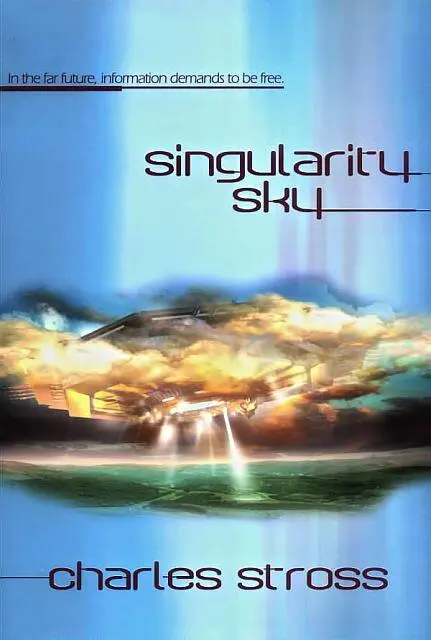
- Название:Singularity Sky
- Автор:
- Жанр:
- Год:неизвестен
- ISBN:9788495024121
- Рейтинг книги:5 / 5. Голосов: 1
-
Избранное:Добавить в избранное
- Отзывы:
-
Ваша оценка:
Singularity Sky: краткое содержание, описание и аннотация
Предлагаем к чтению аннотацию, описание, краткое содержание или предисловие (зависит от того, что написал сам автор книги «Singularity Sky»). Если вы не нашли необходимую информацию о книге — напишите в комментариях, мы постараемся отыскать её.
Singularity Sky
Singularity Sky — читать онлайн бесплатно полную книгу (весь текст) целиком
Ниже представлен текст книги, разбитый по страницам. Система сохранения места последней прочитанной страницы, позволяет с удобством читать онлайн бесплатно книгу «Singularity Sky», без необходимости каждый раз заново искать на чём Вы остановились. Поставьте закладку, и сможете в любой момент перейти на страницу, на которой закончили чтение.
Интервал:
Закладка:
“One-zero seconds.”
“All posts switch to plan two,” said Captain Mirsky. “Nav, pass that contact info on to Kamchatka and Ekaterina . Get anything you can off them.” He picked up the phone to notify his squadron captains of the impending change of plan.
“Aye aye, sir. Plan two burn commencing in five … two, one, now.” There was no change evident in the ops room, no shaking or shuddering or sudden leaden-limbed feeling of acceleration, but inside the guts of the starship, the extremal black hole twisted in sudden torment; the Lord Vanek fell forward at full military acceleration, four hundred meters per second squared, more than forty gees.
Another alarm trilled. Nav: “Full scan running.” Twenty gigawatts of laser light beamed out in all directions, a merciless glare bright enough to melt steel at a range of kilometers. Down in the bowels of the ship, heat exchanges glowed red-hot, flashing water into saturated high-pressure steam and venting it astern; this close to combat, running out the huge, vulnerable heat exchangers would be suicidal.
Guns: “Track beta launch commencing.” This time a real bump-and-grind made the ship shudder; the two missiles Helsingus had preloaded back when they’d been on the track alpha heading. As they hurtled ahead of the ship, a tenth of its total laser output focused up their tails, energizing their reaction mass.
This was the time of maximum danger, and Mirsky did his best to maintain a confident demeanor for the benefit of his crew. As the Commodore had put it in the privacy of his staff briefing room: “If they’re smart, they’ll send out just enough assets to make us reveal ourselves, then use whatever they’ve got in orbit to dump a snowstorm of mines in our path. They know where we’re going; that’s half the problem of pinpointing us. When we start radiating they’ll get their solution — and it’ll be a question of how much pounding they can hand out, and how much we can take.”
Attacking a fixed point — in this case, the low-orbit installations around a planet — was traditionally reputed to be the hardest task in deep-space warfare. The defenders could concentrate forces around it and rapidly bring defensive missile and laser screens to bear on anyone approaching; and if the attackers wanted to know just what they were attacking, they’d have to hang out high-energy signposts for the defenders to take aim on.
Seconds later, Mirsky breathed a quiet sigh of relief. “Point defense reports all quiet, sir. We’re inside their envelope, but they don’t seem to have dropped a minefield.” Drifting mines wouldn’t follow the deceleration curve of the enemy ships; they’d come slamming in way ahead of the warships that had dropped them overboard at peak velocity.
“That’s good,” Mirsky murmured. His eyes focused on the two red points on the main plotting screen.
They were still decelerating, painfully fast; almost as if they were aiming for a zero-relative-velocity slugging match. The Lord Vanek’s two missiles crawled toward them — in reality, boosting at a savage thousand gees, already over 1000 k.p.s. Presently, they shut down and coasted, retaining only enough reaction mass for terminal maneuvering when they got within ten seconds of the enemy. Ahead of the Lord Vanek , the glinting purple crosses of the unpowered torpedoes fell forward toward the enemy.
A minute later, Gunnery Two spoke up. “I’ve lost missile one, sir. I can ping it, but it doesn’t respond.”
“Odd—” Mirsky’s brow furrowed; he glanced at the doomsday clock. The battlecruiser was closing on the destination at a crawl, just 40 k.p.s. The enemy was heading toward them at better than 200 k.p.s., decelerating, but their thrust was dropping off — if this continued, closing unpowered at 250 k.p.s., their paths would intersect in about 500 seconds, and they’d be within missile-powered flight range 200
seconds before that. These long, ballistic shots weren’t expected to cause real damage, but if they came close, they would force the enemy to respond. But missile one had been more than 50,000 kilometers from the target—
“Humbly reporting, I’ve lost missile two as well, sir.”
“That doesn’t make sense,” muttered Helsingus. He glanced at the plot: a flurry of six more missiles, all fired from the Kamchatka , was closing in on their target: ranging shots all, with little chance of doing any damage, but—
Point Defense: “Sir, problem on deck one. Looks like— humbly report a debris impact, sir, lost a scattering of eyeballs on the lidar grid but nothing broke the inner pressure hull.”
“Looks like they’ve got bad dandruff,” Mirsky commented. “But their point defense is working.
Torpedoes?”
“Not yet, sir,” said Helsingus. “They’ve only got about five-zero-zero k.p.s. of delta-vee. Won’t be in position to light off for, ah, eight-zero more seconds.” Drifting toward the enemy almost 100 k.p.s. faster than the warship that had launched them, the torpedoes nevertheless had relatively short legs. Unlike the missiles, they had their own power plant, radar, and battle control computers, which made them valuable assets in event of an engagement — but they accelerated more slowly and had a lower total acceleration budget.
Radar Two: “Humbly report I think I spotted something, sir. About one-zero-zero milliseconds after missile two dropped off, detector three trapped a neutrino pulse; impossible to say for sure whether it came from the target or the missile, but it looked fairly energetic. Ah, no sign of any other radiation.”
“Most peculiar,” Mirsky murmured under his breath: an extreme understatement. “What’s our range profile?”
“Torpedo range in six-zero seconds. Active gunnery range in one-five-zero seconds; contact range in four-zero-zero seconds. Closest pass two-zero K-kilometers, speed on the order of two-six-zero k.p.s.
assuming no maneuvering. Range to target is one-zero-five K-kilometers on my mark, now.”
“Hah.” Mirsky nodded. “Gentlemen, this may look preposterous, but I have a problem with the way things are going. Helsingus, your two torpedoes — torch ’em off straight at bogey one.”
“But they’ll go ballistic short of—”
Mirsky raised a warning hand. “Just do it. Helm, option three-two. Signal all ships.” Once again, he picked up the phone to the Commodore’s battle room to confer with his flag officer.
“Aye aye, sir.” The display centered on Rochard’s World shifted, rolling; the orange line representing Lord Vanek’s course, hitherto straight in toward the planet, began to bend, curving away from the planet. The red lines showing the course of the two incoming enemy ships were also bending, moving to intercept the Lord Vanek and her five sister ships; meanwhile the twelve dots of blue, representing the torpedoes the squadron had dropped overboard almost two minutes earlier, began to grow outward.
Live torpedoes were not something any starship captain wanted to get too close to. Unlike a missile — essentially a tube full of reaction mass with a laser mirror in its tail and a warhead at the other end — a torpedo was a spacecraft with its own power plant, an incredibly dirty fission rocket, little more than a slow-burning atom bomb, barely under control as it spewed a horribly radioactive exhaust stream behind it. It was also the most efficient storable-fuel rocket motor available, without the complexity of fusion reactors or curved-space generators. Before the newer technologies came along, early-twenty-first-century pioneers had used it for the first crewed interplanetary missions.
“Fish are both running, sir. Ours are making nine-six and one-one-two gees respectively; general squadron broadside averages ninety-eight. They should burn out and switch to sustainer in one-zero-zero seconds and intersect bogeys one and two if they stay on current course in about one-five-zero seconds.
Читать дальшеИнтервал:
Закладка:
Похожие книги на «Singularity Sky»
Представляем Вашему вниманию похожие книги на «Singularity Sky» списком для выбора. Мы отобрали схожую по названию и смыслу литературу в надежде предоставить читателям больше вариантов отыскать новые, интересные, ещё непрочитанные произведения.









Обсуждение, отзывы о книге «Singularity Sky» и просто собственные мнения читателей. Оставьте ваши комментарии, напишите, что Вы думаете о произведении, его смысле или главных героях. Укажите что конкретно понравилось, а что нет, и почему Вы так считаете.