Charles Stross - Singularity Sky
Здесь есть возможность читать онлайн «Charles Stross - Singularity Sky» весь текст электронной книги совершенно бесплатно (целиком полную версию без сокращений). В некоторых случаях можно слушать аудио, скачать через торрент в формате fb2 и присутствует краткое содержание. ISBN: , Жанр: Фантастика и фэнтези, на английском языке. Описание произведения, (предисловие) а так же отзывы посетителей доступны на портале библиотеки ЛибКат.
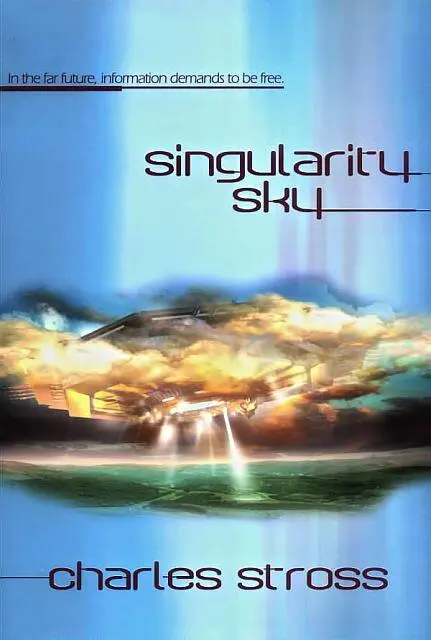
- Название:Singularity Sky
- Автор:
- Жанр:
- Год:неизвестен
- ISBN:9788495024121
- Рейтинг книги:5 / 5. Голосов: 1
-
Избранное:Добавить в избранное
- Отзывы:
-
Ваша оценка:
Singularity Sky: краткое содержание, описание и аннотация
Предлагаем к чтению аннотацию, описание, краткое содержание или предисловие (зависит от того, что написал сам автор книги «Singularity Sky»). Если вы не нашли необходимую информацию о книге — напишите в комментариях, мы постараемся отыскать её.
Singularity Sky
Singularity Sky — читать онлайн бесплатно полную книгу (весь текст) целиком
Ниже представлен текст книги, разбитый по страницам. Система сохранения места последней прочитанной страницы, позволяет с удобством читать онлайн бесплатно книгу «Singularity Sky», без необходимости каждый раз заново искать на чём Вы остановились. Поставьте закладку, и сможете в любой момент перейти на страницу, на которой закончили чтение.
Интервал:
Закладка:
He tried to think of happier times, but it was difficult. School? He’d been bullied mercilessly, mocked because of who and what his father was — and was not. Any boy who bore his mother’s name was an object of mockery, but to have a criminal for a father as well, a notorious criminal, made him too easy a target. Eventually he’d pounded one bully’s face into pulp, and been caned for it, and they’d learned to avoid him, but it hadn’t stopped the whispering and sniggering in quiet corners. He’d learned to listen for that, to lie in wait after classes and beat the grins off their faces, but it hadn’t gained him friends.
Basic training? That was a joke. A continuation of school, only with sterner taskmasters. Then police training, and the cadet’s college. Apprenticeship to the Citizen, whom he strived to impress because he admired the stern inspector vastly; a man of blood and iron, unquestionably loyal to the Republic and everything it stood for, a spiritual father whom he’d now managed to disappoint twice.
Vassily yawned. His bladder ached, but he didn’t dare piss — not in this suit of interconnected bubbles.
The thought of drowning was somehow more terrifying than the idea of running out of air. Besides, when the air went — wasn’t this how they executed mutinous spacers, instead of hanging?
A curious horror overtook him, then. His skin crawled; the back of his neck turned damp and cold. I can’t go yet , he thought. It’s not fair ! He shuddered. The void seemed to speak to him. Fairness has nothing to do with it. This will happen, and your wishes are meaningless . His eyes stung; he squeezed them tightly shut against the whirling daggers of night and tried to regain control of his breathing.
And when he opened them again, as if in answer to his prayers, he saw that he was not alone in the deep.
Jokers
High in orbit above Rochard’s World, the Bouncers were stirring.
Two kilometers long, sleek and gray, each of them dwarfed the incoming naval task force. They’d been among the first artifacts the newly arrived Festival manufactured. Most of the Bouncers drifted in parking orbits deep in the Oort cloud, awaiting enemies closing along timelike attack paths deep in the future of the Festival’s world line; but a small detachment had accompanied the Festival itself, as it plunged deep into the inner system and arrived above the destination world.
Bouncers didn’t dream. Bouncers were barely sentient special units, tasked with the defense of the Festival against certain crude physical threats. For denial of service, decoherence attacks, and general spoofing, the more sophisticated antibodies could be relied on; for true causality-violation attacks, the Festival’s reality-maintenance crew would be awakened. But sometimes, the best defense is a big stick and a nasty smile— and that was what the Bouncers were for.
The arrival of the New Republican task force had been noted four days earlier. The steady acceleration profiles of the incoming warships stuck out like a sore thumb; while His Majesty’s Navy thought in terms of lidar and radar and active sensors, the Festival used more subtle instruments. Localized minima in the outer system’s entropy had been noted, spoor of naked singularities, echoes of the tunneling effect that let the conventional starships jump from system to system. The failure of the incoming fleet to signal told its own story; bouncers knew what to do without being told.
The orbiting Bouncer division began to accelerate. There were no fragile life-forms aboard these craft — just solid slabs of impure diamond and ceramic superconductors, tanks of metallic hydrogen held under pressures that would make the core of a gas giant planet seem like vacuum, and high-energy muon generators to catalyze the exotic fusion reactions that drove the ships. Also, of course, the fractal bushes that were the Bouncers’ cargo: millions of them clinging like strange vines to the long spines of the ships.
Fusion torches providing thrust in accordance with Newtonian laws might seem quaint to the New Republican Admiralty, who had insisted on nothing but the most modern drive singularities and curved-space engines for their fleet; but unlike the Admiralty, the Festival’s Bouncers had some actual combat experience. Reaction motors had important advantages for space-to-space combat, advantages that gave an unfair edge to a canny defender; a sensible thrust-to-mass ratio for one thing, and a low degree of observability for another. Ten-billion-tonne virtual masses made singularity-drive ships incredibly ponderous: although able to accelerate at a respectable clip, they couldn’t change direction rapidly, and to the Festival, they were detectable almost out to interstellar ranges. In contrast, a gimbaled reaction motor could change thrust vector fast enough to invite structural breakup if the ship wasn’t built to withstand the stresses. And while a fusion torch seen from astern was enough to burn out sensors at a million kilometers, the exhaust stream was very directional, with little more than a vague hot spot visible from in front of a ship.
With the much larger infrared emitter of the planet behind them, the Bouncers accelerated toward the New Republican first squadron at a bone-crushing hundred gees. Able to triangulate on the enemy by monitoring their drive emissions, the Bouncers peaked at 800 k.p.s., then shut down their torches and drifted silently, waiting for the moment of closest approach.
The operations room of the Lord Vanek was tense and quiet.
“Gunnery Two, ready a batch of six SEM-20s. Dial them all to one-zero-zero kilotonnes, time the first two for maximum EMP, next three for spallation debris along main axis. Gunnery One, I want two D-4
torpedoes armed for passive launch with a one-minute motor-on delay inlined into them.” Captain Mirsky sat back in his chair. “Prediction?” he muttered in the direction of Commander Vulpis.
“Holding ready, sir. A bit disturbing that we haven’t seen anything yet, but I can give you full maneuvering power within forty seconds of getting a drive signal.”
“Good. Radar. Anything new?”
“Humbly report nothing’s new on passive, sir.”
“Deep joy.” They were two hours out from perigee. Mirsky had to fight to control his impatience.
Tapping his fingers on the arm of his chair, he sat and waited for a sign, anything to indicate that there was life elsewhere in this empty cosmos. The fatal ping of a lidar illuminator glancing off the Lord Vanek’s stealthed hull, or the ripple of gravitomagnetic waves; anything to show that the enemy was out there, somewhere between the battle ship squadron and its destination.
“Any thoughts, Commander Vulpis?”
Vulpis’s eyes flickered around the fully manned stations in front of him. “I’d be a lot happier if they were making the effort to paint us. Either we’ve taken ’em completely by surprise, or …”
“Thank you for that thought,” Mirsky commented under his breath. “Marek!”
“Sir!”
“You’ve got a rifle. It’s loaded. Don’t shoot till you see the whites of their eyes.”
“Sir?” Vulpis stared at his Captain.
“I will be in my cabin if anything happens,” Mirsky said lightly. “You have the helm, pending Commander Murametz’s or my own return. Call me at once if there’s any news.” Down in his stateroom, directly under the ops room, Mirsky collapsed into his chair. He sighed deeply, then poked at the dial of his phone. “Switchboard. My compliments to the Commodore and if he has a spare moment? Jolly good.” A minute later, the phonescreen dinged. “Sir!”
“Captain.” Commodore Bauer wore the expression of a very busy, very tired manager.
Читать дальшеИнтервал:
Закладка:
Похожие книги на «Singularity Sky»
Представляем Вашему вниманию похожие книги на «Singularity Sky» списком для выбора. Мы отобрали схожую по названию и смыслу литературу в надежде предоставить читателям больше вариантов отыскать новые, интересные, ещё непрочитанные произведения.






Обсуждение, отзывы о книге «Singularity Sky» и просто собственные мнения читателей. Оставьте ваши комментарии, напишите, что Вы думаете о произведении, его смысле или главных героях. Укажите что конкретно понравилось, а что нет, и почему Вы так считаете.