Walter Tevis - Mockingbird
Здесь есть возможность читать онлайн «Walter Tevis - Mockingbird» весь текст электронной книги совершенно бесплатно (целиком полную версию без сокращений). В некоторых случаях можно слушать аудио, скачать через торрент в формате fb2 и присутствует краткое содержание. Город: London, Год выпуска: 2007, ISBN: 2007, Издательство: Gollancz, Жанр: Фантастика и фэнтези, на английском языке. Описание произведения, (предисловие) а так же отзывы посетителей доступны на портале библиотеки ЛибКат.
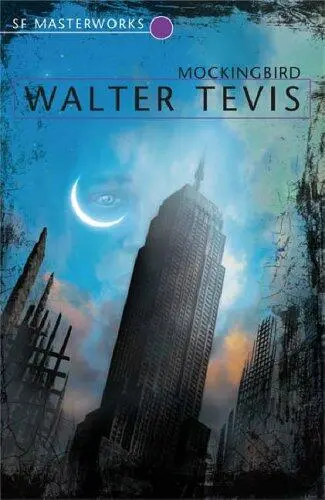
- Название:Mockingbird
- Автор:
- Издательство:Gollancz
- Жанр:
- Год:2007
- Город:London
- ISBN:978-0575079151
- Рейтинг книги:5 / 5. Голосов: 1
-
Избранное:Добавить в избранное
- Отзывы:
-
Ваша оценка:
Mockingbird: краткое содержание, описание и аннотация
Предлагаем к чтению аннотацию, описание, краткое содержание или предисловие (зависит от того, что написал сам автор книги «Mockingbird»). Если вы не нашли необходимую информацию о книге — напишите в комментариях, мы постараемся отыскать её.
Mockingbird
Review
From the Inside Flap “A moral tale that has elements of Aldous Huxley’s
,
, and
.”
—
“Set in a far future in which robots run a world with a small and declining human population, this novel could be considered an unofficial sequel to
, for its central event and symbol is the rediscovery of reading.”
—
“Because of its affirmation of such persistent human values as curiosity, courage, and compassion, along with its undeniable narrative power,
will become one of those books that coming generations will periodically rediscover with wonder and delight.”
—
“I’ve read other novels extrapolating the dangers of computerization but Mockingbird stings me, the writer, the hardest. The notion, the possibility, that people might indeed lose the ability, and worse, the desire to read, is made acutely probable.”
—
bestselling author ANNE MCCAFFREY “Walter Tevis is science fiction’s great neglected master, one of the definitive bridges between sf and literature. For those who know his work only through the movies, the lucid prose and literary vision of
and
will come as a revelation.”
—AL SARRANTONIO, Author of
saga
Mockingbird — читать онлайн бесплатно полную книгу (весь текст) целиком
Ниже представлен текст книги, разбитый по страницам. Система сохранения места последней прочитанной страницы, позволяет с удобством читать онлайн бесплатно книгу «Mockingbird», без необходимости каждый раз заново искать на чём Вы остановились. Поставьте закладку, и сможете в любой момент перейти на страницу, на которой закончили чтение.
Интервал:
Закладка:
“Because you did,” the voice said affably. “I am programmed to reply in kind. I am a D 773 Intelligence, programmed to have personality.”
Spofforth nearly laughed. “How old are you?” he said.
“I was programmed four hundred ninety goddamn yellows ago. In years, two hundred forty-five.”
“Quit saying ‘goddamn,’” Spofforth said. And then, “Do you have a name?”
“No.”
“Do you have feelings?”
“Repeat the question please.”
“You say you have personality. Do you have emotions too?”
“No. Goodness, no,” the computer said.
Spofforth smiled wearily. “Are you ever bored?”
“No.”
“All right,” Spofforth said. “Now get my question right this time. And no cute answers.” He looked around the empty room, noticing now the rotting plaster walls, the sagging ceiling. Then he said, “I want the available statistics on a human woman named Mary Lou Borne, from the Eastern New Mexico Dormitory. She is now about thirty years old. Sixty yellows.”
Immediately the computer began to answer, its voice more mechanical, less bouncy than before. “Mary Lou Borne. Weight at birth seven pounds four ounces. Blood type seven. DNA code alpha delta niner oh oh six three seven four eight. High genetic indeterminacy. Candidate for Extinction at birth. Extinction not carried out. Reason unknown. Left-handed. Intelligence thirty-four. Eyesight…”
“Repeat the intelligence,” Spofforth said.
“Thirty-four, sir.”
“On the Charles scale of intelligence?”
“Yes, sir. Thirty-four Charles.”
That was surprising. He had never heard of a human being that intelligent before. Why hadn’t she been destroyed before puberty? Probably for the same reason that pants in St. Louis didn’t have zippers: malfunction.
“Tell me,” Spofforth said. “When was she sterilized and when was her dormitory graduation?”
There was a long wait this time, as though the computer had been embarrassed by the question. Finally the voice said, “I have no record of sterilization, nor of supplementary birth control through sopors. I have no record of dormitory graduation.”
“I thought so,” Spofforth said grimly. “Search your memory. Do you have a record of any other female in North America without sterilization, birth control, and dormitory graduation? From either Thinker or Worker dormitories?”
The voice was silent for over a minute, making the search. Then it said, “No.”
“What about the rest of the world?” Spofforth said. “What about the dormitories in China…?”
“I will call Peking,” the voice said.
“Don’t bother,” Spofforth said. “I don’t want to think about it.”
He turned the switch to red, consigning the World Population Record to whatever limbo its garrulous intelligence lived in, without feelings and without boredom, between its rare evocations into speech.
Downstairs the mayor of New York was slumped in his plastic armchair with a blank smile on his face. Spofforth did not disturb him.
Outside the sun had began to shine. On his way back to his university office Spofforth walked through a small, robot-operated park and picked himself a yellow rose.
Bentley
DAY FIFTY-SEVEN
It is nine days since I have written in this journal: nine days. I have learned to add and subtract numbers. From one of the books. But it was boring to learn what is called Arithmetic for Boys and Girls , so we stopped after adding and subtracting. If you have seven peaches and take away three you will have four left. But what is a peach?
Mary Lou is learning very fast—so much faster than I did that it is astonishing. But she has me to help her, and I had no one.
I found some easy books with big print and pictures and I would read slowly aloud to Mary Lou and have her say words after me. And on the third day we made a discovery. It was in the Arithmetic for Boys and Girls book. One problem began: “There are twenty-six letters in the alphabet…” Mary Lou said, “What’s ‘alphabet’?” and I decided to try to find it in Dictionary . And I did. And Dictionary said: “Alphabet: the letters of a given language, arranged in the order fixed by custom. See facing page.” I puzzled for a moment over what a “given” language might be, and a “facing” page, and then I looked at the page on the other side of the book and it was a chart, with the letter “A” at the top and the letter “Z” at the bottom. They were all familiar, and their order seemed familiar too. I counted them, and there were twenty-six, just as Arithmetic for Boys and Girls had said. “The order fixed by custom” seemed to mean the way people arranged them, like plants in a row. But people didn’t arrange letters. Mary Lou and I were, as far as I knew, the only people who knew what a letter was. But of course people—perhaps everybody—had once known letters, and they must have put them into an order that was called an alphabet.
I looked at them and said them aloud: “A, B, C, D, E, F, G, H, I, J…” And then it struck me. That was the way the words were put into Dictionary ! The “A” words were first, and then the “B” words!
I explained it to Mary Lou and she seemed to understand immediately. She took the book and leafed through it. I noticed that she had already become expert at handling books; her awkwardness with them was gone. After a minute she said, “We should memorize the alphabet.”
Memorize. To learn by heart . “Why?” I said.
She looked up at my face. She was sitting cross-legged on the floor, in her yellow Synlon dress that I had bought her, and I was sitting at my bed-and-desk, with books piled on it in front of me. “I’m not sure,” she said. She looked back down at the book in her lap. “Maybe it would help us use this book, if we could say the alphabet?”
I thought about that a moment. “All right,” I said.
So we memorized it. And I was embarrassed because she could say it long before I could. But she helped me learn to say it, and I finally did learn. It was difficult—especially the last part that went “W, X, Y, Z”—but I finally got it straight and said the whole twenty-six letters exactly right twice. When I finished Mary Lou laughed and said, “Now we know something together,” and I laughed too. I didn’t know why. It wasn’t really funny.
She looked at my face a moment, smiling. Then she said, “Come here and sit by me.” And I found myself doing it, sitting on the rug next to her.
Then she said, “Let’s say it one after the other,” and she squeezed my arm and said, “A.”
This time the touch of her did not embarrass me or make me self-conscious. Not at all. I said, “B.”
She said, “C,” and turned herself around to face me.
I said, “D,” and watched her mouth, waiting for her to say her letter. She moistened her lips with her tongue, and said it softly. “E.” It sounded like a sigh.
I said, “F,” quickly. My heart was beginning to beat fast.
She turned her face and put her mouth next to my ear and said, “G.” Then she giggled softly. And I felt something that almost made me jump. It was warm and wet, on my ear, and I realized it was her tongue. My heart almost stopped.
I did not know what to do, so I said, “H.”
This time her tongue was actually in my ear. It made a shudder, a soft shudder, pass through my body, and something seemed to go loose in my stomach. And in my mind. With her tongue still in my ear she breathed, “I”—stretching it out so that it sounded: “aaaaiiiiiieeeeeeeee.”
Frankly I had not had a sexual experience for blues and yellows. And what I was feeling now was something altogether new to me, and so exciting, so overwhelming, so shaking to my body and my imagination that I found myself sitting on the floor with her face against mine and I was crying. My face was becoming wet with tears.
Читать дальшеИнтервал:
Закладка:
Похожие книги на «Mockingbird»
Представляем Вашему вниманию похожие книги на «Mockingbird» списком для выбора. Мы отобрали схожую по названию и смыслу литературу в надежде предоставить читателям больше вариантов отыскать новые, интересные, ещё непрочитанные произведения.





Обсуждение, отзывы о книге «Mockingbird» и просто собственные мнения читателей. Оставьте ваши комментарии, напишите, что Вы думаете о произведении, его смысле или главных героях. Укажите что конкретно понравилось, а что нет, и почему Вы так считаете.