Connie Willis - Passage
Здесь есть возможность читать онлайн «Connie Willis - Passage» весь текст электронной книги совершенно бесплатно (целиком полную версию без сокращений). В некоторых случаях можно слушать аудио, скачать через торрент в формате fb2 и присутствует краткое содержание. Год выпуска: 2001, ISBN: 2001, Издательство: Bantam Books, Жанр: Фантастика и фэнтези, на английском языке. Описание произведения, (предисловие) а так же отзывы посетителей доступны на портале библиотеки ЛибКат.
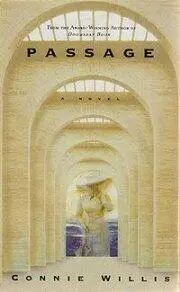
- Название:Passage
- Автор:
- Издательство:Bantam Books
- Жанр:
- Год:2001
- ISBN:0-553-11124-8
- Рейтинг книги:3 / 5. Голосов: 1
-
Избранное:Добавить в избранное
- Отзывы:
-
Ваша оценка:
Passage: краткое содержание, описание и аннотация
Предлагаем к чтению аннотацию, описание, краткое содержание или предисловие (зависит от того, что написал сам автор книги «Passage»). Если вы не нашли необходимую информацию о книге — напишите в комментариях, мы постараемся отыскать её.
Nominated for Nebula Award for Best Novel in 2001, Hugo, Campbell, and Clark awards in 2002.
Passage — читать онлайн бесплатно полную книгу (весь текст) целиком
Ниже представлен текст книги, разбитый по страницам. Система сохранения места последней прочитанной страницы, позволяет с удобством читать онлайн бесплатно книгу «Passage», без необходимости каждый раз заново искать на чём Вы остановились. Поставьте закладку, и сможете в любой момент перейти на страницу, на которой закончили чтение.
Интервал:
Закладка:
But it wasn’t evening—it was night. And no matter how late they had been allowed to stay up, it had never gotten completely dark like this. There had always been a bluish-purple cast to the sky, and even after the stars came out, you could still see the outlines of the houses, of the arching cottonwoods, against it. You could still see the grownups on the dark porch, and each other.
She could not see the grass that she was sitting on, or the house, or her own hand, which she held up in front of her face. It was utterly black, in spite of the fireflies. “The moon did not shine,” she said out loud, “and the stars gave no light.”
The stars. They were stars, shining clearly, steadily, in the black sky, and why had she thought they were fireflies? They were obviously stars, and they came down all the way, sharp and sparkling, to the horizon. The survivors of the Titanic had all remarked on that, how the stars hadn’t dimmed near the horizon, but had shone all the way down to the water.
The water. I have survived the sinking, she thought. I am floating on something from the Titanic, a deck chair. But deck chairs were slatted. The surface below her was wide and smooth. A piano. The grand piano in the A La Carte Restaurant.
But pianos didn’t float. In the movie The Piano, it had sunk like a stone, dragging her down with it into the cold, disintegrating water. Maybe it’s the aluminum piano on the Hindenburg, she thought. That only weighed 397 pounds.
It would still sink, she thought. And maybe it was sinking. “All ships sink sooner or later,” Mr. Wojakowski had said, and maybe this was sinking very slowly, because the ocean was so still. The survivors had all said the water was as smooth as glass that night, so still the stars’ reflections had been scarcely distorted at all.
Joanna reached her hand down over the edge of the piano, feeling for the keyboard and then for the water below it, and as she did, she realized she was holding onto something with her other hand, holding it tight against her in the crook of her arm.
The little French bulldog, she thought, I must have held onto it when I fell, though she remembered letting go of everything, everything in the water, though she remembered her open hands drifting emptily in the darkness.
The lifejacket, she thought, and felt for its dangling ties but could not find them. She bent over the little dog, trying to see it. It was too dark, but she could feel its silky head, feel its small body against her side. It did not move. “Are you all right, little dog?” she asked, bending closer to hear the sound of its panting, the beating of its little heart, but she could not hear anything.
Maybe it drowned, she thought anxiously, but as she thought that, it pressed itself closer against her side. “You’re all right,” she said. “Maisie will be so glad.”
Maisie, she thought, and remembered struggling up through the obliterating darkness, struggling to keep from forgetting until the message was sent. “As soon as we’re rescued,” she said to the little bulldog, “I have to send Richard a message.”
She looked out at the darkness. The Carpathia would be here in two hours. She scanned the horizon, looking for its lights, but there were only stars. She looked up at them, trying to find the Big Dipper. The Carpathia had come up from the southwest. If she could find the Big Dipper, she could follow the handle to the North Star and tell which direction it would come from.
They had looked for the Big Dipper, those summer nights in Kansas. They had run around in the cool grass, trying to catch fireflies in their cupped hands, and when a car turned down the street, they had called out, “Automobile!” and flopped down flat on their backs in the grass, motionless in the sweep of its headlights. Playing dead. And even after the car had passed, they had lain there, looking up at the stars, pointing out the constellations. “There’s the Big Dipper,” they had said, pointing. “There’s the Milky Way. There’s the Dog Star.”
There were no constellations. Joanna craned her neck, trying to find the pattern of the Archer, the long spilled splash of the Milky Way down the center of the sky. But there were only stars. And they sparkled brightly, clearly, all the way down to the water, which was so still she couldn’t hear it lapping against the sides of the piano, so still the stars’ reflections were not distorted at all. They sparkled steadily, clearly, as if they were not reflections at all, as if there were sky below her instead of water.
She hugged the dog to her. “I don’t think we’re in Kansas anymore, Toto,” she said, and pulled her feet up under her, away from the edge.
They were not in the Atlantic, and the thing they huddled on was not a piano. It was something else, an examining table, or a drawer in the morgue. Or a metaphor for the shipwrecked survivors of her consciousness, floating on the wreckage of her body, for her final synapses flickering out like stars, like fireflies.
And the Atlantic was a metaphor for someplace else. The River Styx or the River Jordan or Mr. Mandrake’s Other Side. No, not an Other Side, Joanna thought. It’s someplace else altogether, with no connection to the world.
“The far country,” she thought, but that was not right either. It was not a country. It was a place so far away it was not even a place. A place so far away the Carpathia could not ever come, so far away there was no possibility of being rescued, of getting back. And from which nothing was ever heard, in spite of what Maurice Mandrake said, in spite of the messages he claimed he had had from the dead.
And even the last words of the dying were not messages at all, but only useless echoes of the living. Useless lies. “I will never leave you,” they said, and left forever. “I won’t forget you,” they said, and then forgot everything in the dark, disintegrating water. “We will be together again,” and that was the biggest lie of all. There were no fathers waiting on the shining shore. No prophets, no elders, no Angels of Light. No light at all. And they would never be together. She would never see them again, or be able to tell them where she had gone.
I left without saying good-bye, she thought, and felt a stab of pain, like a knife in the ribs. “Good-bye!” she shouted, but her voice didn’t carry across the water. “Good-bye, Vielle!” she shouted, “Good-bye, Kit! Good-bye, Richard!” trying to make them out, but they were too far away. Too far even for her to remember Richard’s face, or Maisie’s—
Maisie, she thought, and knew why she had thought the stars were fireflies. Morse-code bugs, they had called them back in Kansas. Winking on, winking off, sending coded messages in the dark. “I have to get the message to Richard,” she said, and stood up on the piano, setting it rocking wildly. “Richard!” she called, cupping her hands to her mouth like a megaphone, “the NDE’s the brain’s way of signaling for help!”
It was too far. It would never reach him. Houdini, calling out, “Rosabelle, answer, tell, pray!” to his wife across the void, could not make himself heard. And neither could she. “It’s an SOS!” Joanna called, but softly. “An SOS.”
The little French bulldog was whimpering at her feet, frightened at being left alone. Joanna sat back down and reached for it, unable to find it at first in the dark, putting both arms around it, pulling it close. “It’s no use,” she said, stroking the silky head she could not see. “It will never reach them.”
The little dog whimpered, heartbroken, a sound like a child’s crying. “It’s all right,” Joanna said, even though it wasn’t. “Don’t cry, I’m here. I’m here.”
Читать дальшеИнтервал:
Закладка:
Похожие книги на «Passage»
Представляем Вашему вниманию похожие книги на «Passage» списком для выбора. Мы отобрали схожую по названию и смыслу литературу в надежде предоставить читателям больше вариантов отыскать новые, интересные, ещё непрочитанные произведения.



Обсуждение, отзывы о книге «Passage» и просто собственные мнения читателей. Оставьте ваши комментарии, напишите, что Вы думаете о произведении, его смысле или главных героях. Укажите что конкретно понравилось, а что нет, и почему Вы так считаете.