Connie Willis - Passage
Здесь есть возможность читать онлайн «Connie Willis - Passage» весь текст электронной книги совершенно бесплатно (целиком полную версию без сокращений). В некоторых случаях можно слушать аудио, скачать через торрент в формате fb2 и присутствует краткое содержание. Год выпуска: 2001, ISBN: 2001, Издательство: Bantam Books, Жанр: Фантастика и фэнтези, на английском языке. Описание произведения, (предисловие) а так же отзывы посетителей доступны на портале библиотеки ЛибКат.
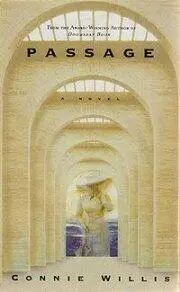
- Название:Passage
- Автор:
- Издательство:Bantam Books
- Жанр:
- Год:2001
- ISBN:0-553-11124-8
- Рейтинг книги:3 / 5. Голосов: 1
-
Избранное:Добавить в избранное
- Отзывы:
-
Ваша оценка:
Passage: краткое содержание, описание и аннотация
Предлагаем к чтению аннотацию, описание, краткое содержание или предисловие (зависит от того, что написал сам автор книги «Passage»). Если вы не нашли необходимую информацию о книге — напишите в комментариях, мы постараемся отыскать её.
Nominated for Nebula Award for Best Novel in 2001, Hugo, Campbell, and Clark awards in 2002.
Passage — читать онлайн бесплатно полную книгу (весь текст) целиком
Ниже представлен текст книги, разбитый по страницам. Система сохранения места последней прочитанной страницы, позволяет с удобством читать онлайн бесплатно книгу «Passage», без необходимости каждый раз заново искать на чём Вы остановились. Поставьте закладку, и сможете в любой момент перейти на страницу, на которой закончили чтение.
Интервал:
Закладка:
“That’s hardly anything,” Maisie protested. “It’ll take me about five minutes. Don’t you have anything else you want me to find out?”
It was tempting to ask her about the Morse lamp. She’d have the answer more promptly even than Kit, and Joanna knew Maisie could keep a secret. She was a master at it. But she also wouldn’t be able to resist saying, “Did you know…?” “I need to know about the Carpathia,” Joanna said, deciding. The Carpathia hadn’t shown up on the scene until well after the Titanic had gone down, so information about it couldn’t contaminate her NDEs, and there was a ton of information on the Carpathia. It should keep Maisie occupied for days.
“Car-pa-thia,” Maisie said, writing it down. “What do you need to know?”
“Everything,” Joanna told her. “Where it was, when it found out the Titanic was in trouble and what it did, and how it picked up the survivors.”
“And who they were,” Maisie said, writing busily. “I know who one of them was. Mr. Ismay.” Her tone conveyed contempt. “He was the owner guy, but he didn’t even try to save people, he just climbed in one of the lifeboats even though the men weren’t supposed to, it was supposed to be women and children first, and saved himself, the big coward. Everybody else was really brave, though, like—”
“Maisie,” Joanna warned. “Only the answers I asked for.”
“Okay,” Maisie said. “Can I tell you what Molly Brown said to Mr. Ismay? She was on the Carpathia when she said it.”
“All right,” Joanna said, thinking, Maybe I should have picked the Californian. It didn’t have any contact with the Titanic at all. “What did Molly Brown say?”
“She went up to Mr. Ismay,” Maisie said, putting her hands on her hips, “and said, ‘Where I come from, we’d string you up on the nearest pine tree.’ And I think they should’ve. The big coward.”
“Maybe he was afraid,” Joanna said, thinking of her own panicked flight down the slanting stairs and into the passage.
“Well, of course he was afraid,” Maisie said. “He still should have tried to save Lorrai—” She bit off the word. “I was going to say somebody’s name,” she said virtuously, “but you said just the answer, so I didn’t.”
“Good girl,” Joanna said, looking at her watch. It was nearly two. “I have to go.” She stood up.
“I’ll page you when I find out stuff,” Maisie said, pulling The Child’s Titanic out from under the covers.
“No,” Joanna said, envisioning Maisie paging her every fifteen minutes. “Don’t page me till you know all the ships.”
“Okay,” Maisie said, opening her book, and, amazingly, didn’t try to stop Joanna from leaving.
I need to get down to see Mr. Ortiz, she thought, going through Peds, but instead she went back down to the hearing center. The group of volunteers had dwindled to four, but Mr. Wojakowski was still there. Joanna had the feeling he stayed for the company even when he was no longer needed.
“Well, hiya, Doc,” he said when he saw her, sounding genuinely surprised and pleased, and she wondered, ashamed, if he realized how she tried to avoid him.
I have no business asking him a favor, she thought, but this was for Maisie, and if he didn’t know, he could just say so. And how can he know? she thought. He probably wasn’t even in the navy. He made all this up, remember?
“Ed, you were in the navy. Do you know where I could get a set of dog tags made? It’s for a friend of mine.”
“Well, now, that’s a tough one,” he said, taking off his baseball cap and scratching his head. “During the war you got ’em when you signed up. They stamped ’em out with a hand press, looked like a cross between a typewriter and a credit card machine, and hung ’em around your neck straight out of the showers, before they even issued you your uniform. I says to the CO, ‘Don’t we need pants more’n dog tags?’ and he says, ‘You might get killed before you get your pants on and we’d need to know who you are,’ and Fritz Krauthammer says, ‘Hell, if I’m killed without pants on, I don’t want anybody to know who I am!’ Fritz was a card. One time—”
“Do you know where I could get dog tags nowadays? They wouldn’t have to be real ones.”
“You used to be able to get ’em made at the dime store or the train station.” He scratched his head again. “I’ll have to give it some thought. What would you want on ’em?”
“Just a name,” she said, taking her notebook out of her cardigan pocket. “And it wouldn’t have to look like dog tags. Just a name tag on a chain that goes around the neck. Metal,” she added. She printed Maisie’s name, tore the sheet out of the notebook, and handed it to Mr. Wojakowski.
“I’ll ask around,” he said doubtfully. “You sometimes can find stuff you never thought you could. Did I ever tell you about the time I had to ditch my Wildcat and ended up on Malakula?”
Yes, Joanna thought, but she had just asked him a favor. She owed him one, and she knew what it was like when no one would listen to your stories, or believe you. So she sat down on one of the plastic chairs and listened to the whole thing: the escape in a dugout canoe, the drifting at sea for days, the Yorktown steaming up, flags flying, sailors hallooing, to save him, “just like Jesus Christ Himself, raised from the dead,” and she had to admit that, true or not, it was a great story.
Mr. Wojakowski walked Joanna to the elevator. “I’ll see what I can do about these dog tags. How soon do you need ’em?”
“Soon,” Joanna said, thinking of Maisie’s thin wrist, her blue lips.
“It’s too bad Chick Upchurch isn’t still around. Did I ever tell you about Chick? Machinist’s mate on the Old Yorky, and he could make anything, and I do mean anything,” Mr. Wojakowski said, and she had to practically shut his hand in the elevator to get away from him, though he didn’t seem put out.
Neither did Mr. Ortiz, even though he had three drains in him, two of which had already had to be replaced. “I don’t care. I feel better than I have in two years,” he said. “They should’ve thought of this before.”
He was happy to talk to Joanna. “It’s still as real to me today as it was two years ago,” he said, and described it for her in detail: floating near the ceiling of the operating room, tunnel, light, the Virgin Mary radiating light, dead relatives waiting to welcome him to heaven.
Maybe Mr. Mandrake’s right, Joanna thought, listening to him describe his life review, and what I’m seeing isn’t a real NDE at all. Certainly no one else has seen a postal clerk dragging a sack of wet mail up a carpeted staircase.
“And then I had this feeling like it was time to go back,” Mr. Ortiz said, “and I went back down the tunnel, and at the end of it was the operating room.”
“Can you be more specific?” Joanna said. “About the feeling?”
“It was like a tug,” he said, but the gesture he made with his hand was of a shove. “I can’t describe it.”
Joanna consulted her notes. “Can you tell me how the Virgin Mary looked?”
“She was dressed in white. She had this light radiating from her,” he said, and this time the gesture matched his words, “like diamonds.” She asked him several more questions and then shut off the recorder and thanked him for his time.
“I’m not really all that interested in near-death experiences,” he said. “My real interest is in dreams. Is your project involved with dream imagery at all?”
“No,” Joanna said and stood up.
Mr. Ortiz nodded. “Most scientists are too hidebound and narrow-minded to believe in dreams. Analyzing the images in your dreams can cure cancer, did you know that?”
Читать дальшеИнтервал:
Закладка:
Похожие книги на «Passage»
Представляем Вашему вниманию похожие книги на «Passage» списком для выбора. Мы отобрали схожую по названию и смыслу литературу в надежде предоставить читателям больше вариантов отыскать новые, интересные, ещё непрочитанные произведения.




Обсуждение, отзывы о книге «Passage» и просто собственные мнения читателей. Оставьте ваши комментарии, напишите, что Вы думаете о произведении, его смысле или главных героях. Укажите что конкретно понравилось, а что нет, и почему Вы так считаете.