Orson Card - Pathfinder
Здесь есть возможность читать онлайн «Orson Card - Pathfinder» весь текст электронной книги совершенно бесплатно (целиком полную версию без сокращений). В некоторых случаях можно слушать аудио, скачать через торрент в формате fb2 и присутствует краткое содержание. Год выпуска: 2010, ISBN: 2010, Издательство: Simon Pulse, Жанр: Фантастика и фэнтези, на английском языке. Описание произведения, (предисловие) а так же отзывы посетителей доступны на портале библиотеки ЛибКат.
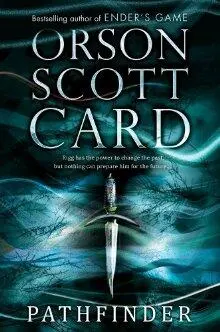
- Название:Pathfinder
- Автор:
- Издательство:Simon Pulse
- Жанр:
- Год:2010
- ISBN:978-1-4169-9176-2
- Рейтинг книги:5 / 5. Голосов: 1
-
Избранное:Добавить в избранное
- Отзывы:
-
Ваша оценка:
Pathfinder: краткое содержание, описание и аннотация
Предлагаем к чтению аннотацию, описание, краткое содержание или предисловие (зависит от того, что написал сам автор книги «Pathfinder»). Если вы не нашли необходимую информацию о книге — напишите в комментариях, мы постараемся отыскать её.
—secrets about Rigg's own past, his identity, and his destiny. And when Rigg discovers that he has the power not only to see the past, but also to change it, his future suddenly becomes anything but certain.
Rigg’s birthright sets him on a path that leaves him caught between two factions, one that wants him crowned and one that wants him dead. He will be forced to question everything he thinks he knows, choose who to trust, and push the limits of his talent…or forfeit control of his destiny.
Pathfinder — читать онлайн бесплатно полную книгу (весь текст) целиком
Ниже представлен текст книги, разбитый по страницам. Система сохранения места последней прочитанной страницы, позволяет с удобством читать онлайн бесплатно книгу «Pathfinder», без необходимости каждый раз заново искать на чём Вы остановились. Поставьте закладку, и сможете в любой момент перейти на страницу, на которой закончили чтение.
Интервал:
Закладка:
This suggestion rather alarmed the other servants, but Rigg looked at all of them with a cheerful smile. “What, does my mother’s work keep her in other parts of the household? Then we can all get acquainted with her together!”
“I’m afraid that our beloved Lady Hagia cannot help in the kitchen as you suggest,” said Flacommo. “By law, she is forbidden to put her hands upon any blade—even a kitchen paring knife.”
Rigg held up his coring shaft. “But this is not a knife,” he said.
“You stab it into the fruit, my lad,” said Flacommo, “and that makes it, in the eyes of the law, a dagger.”
“That would be a cruel weapon indeed,” said Rigg, laughing. “Monstrous—imagine being cored to death!” He pressed the corer against his own chest. “The strength it would take, to force it between the ribs!”
Some of the servants laughed in spite of their efforts to remain solemn. Another anecdote that would be spread through the city by morning.
“Mother, it is so late at night. I beg you to go to bed and sleep well, so we can talk tomorrow. I slept well on the boat and in the sedan chair, they both glided along so smoothly.” And it was true that Rigg was usually awake at this time of the night—one of the reasons he had trained himself on shipboard to sleep at such odd times was so he would not be helpless and unconscious at predictable times.
Flacommo and Mother both lingered for a while, and it was clear that Mother would have sat down to talk with him, even in front of the other kitchen workers, if Flacommo had not interposed himself. “Well, well,” he finally said, “you are certainly an unpredictable young man, Master Rigg!”
“Really? In the village of Fall Ford I was thought of as rather dull; I never did anything extraordinary.”
“I find that hard to believe,” said Flacommo.
“Oh, I’m sure you’d find all our village ways unpredictable, sir, life being so different upriver. For instance, when village folk gather to cut up vegetables and fruits, there’s always singing. But apparently no one in this kitchen knows a song!”
“Oh, we know songs, young sir,” said an old woman.
“We could curl your hair with the songs we know of fright and woe,” intoned another.
Rigg, recognizing the old tune, answered with the second line: “And your lady fair will be taught to woo by a love song true.”
The servants all laughed with approval.
“So the songs are the same, upriver or down!” cried Rigg. “Well, let’s finish that one and have another two or three, as long as we still work hard and sing soft, so as not to make the master sorry we’re so noisy at our work.”
Flacommo tossed his hands in the air and strode from the kitchen. Only now did Rigg allow himself to look directly at his mother. She also looked at him. He saw a ghost of a smile pass across her lips; then she turned and followed Flacommo from the room.
The pile of apples done—with a grateful smile from the boy whom he might just have saved from disgrace—Rigg wolfed down the bread and cheese with only water to drink. It was a finer bread than the coarse-ground loaves Nox used to send with them when Rigg and Father set out into the wilderness on one of their trapping jaunts, but that only meant it took more of it before Rigg felt full. The cheese was very fine, though of a flavor Rigg had never had before.
“Thank you for this,” said Rigg to the woman who had prepared it for him. “I’ve eaten the best bread and cheese of O, a city known on the river for its refined taste, and I think I can fairly say that the servants in this great house eat better than the lords of O!”
Of course he was flattering the cooks and bakers and servants outrageously—but Rigg guessed that few thought them worth flattering. Indeed, how often did Mother come into the kitchen? How many of these servants’ names did she know? By the end of this hour in the kitchen, Rigg knew them all by name and most of them by their history and manners and speech. He had not won their loyalty yet, but he had won their liking, and that was the first step.
“Let me take you to the room prepared for you,” said the baker’s apprentice—a young man named Long, though he was not particularly tall.
“Gladly,” said Rigg, “though I wager it won’t be as warm and cozy as that nook behind the hearth where the kitchen boys sleep.”
“On old straw laid out on stone,” said Long. “Not a comfortable bed!”
“I’ve slept in damp caves and under dripping trees and on frozen ground with only snow to keep me warm. To me, that place looks like the best sleeping room in the house!” Rigg pitched his voice so he might be overheard by the day-shift boys still pretending to be asleep in the nook, and he was rewarded by several heads poking out of the nook to see who would say such a ridiculous thing.
“Snow can’t keep you warm!” said the youngest of the boys.
“You burrow into a snowbank like a rabbit, and the snow all around you holds in your body heat and keeps out the wind.”
“It’ll melt on you and drown you, or fall on you and smother you!” cried another boy.
“Not if you choose the deepest and oldest bank—it holds its shape for night after night, and when I’ve done with such a burrow, it’s used by small animals who never had such a lovely palace to sleep in. You may be in the north here, but you don’t know snow till you’ve wintered in the high mountains.”
With that he turned and joined Long, who led him out into the dining hall, and then on to the corridors of the house. Rigg urged him to go slowly, asking him what each large room was for, and where each door led. As Father had trained him to do, Rigg built up a map inside his head. He saw from the dimensions of the rooms that here and there they didn’t match up properly. Once he knew to look for them, he quickly located the secret passages that had been built into the gaps, for he could see the paths of the people who had used them. The paths wouldn’t show him how to open the secret doors, but he could see quite easily where they were. The house was a labyrinth: Servants’ stairways and corridors, which were the most-trafficked lanes in the house; the public corridors, which were all that loftier residents and visitors would ever see; and the secret passages, rarely traveled but constant throughout the house. There was hardly a room that didn’t have at least one hidden entrance.
It wasn’t just the rooms that Rigg was scouting, either. He had seen enough of his mother’s path to be able to recognize wherever she had gone; he knew very quickly which rooms she habituated, and which she rarely entered. Her path only ever used one secret passage, and that one only a handful of times. Was this because she only knew of the one, or because she dared not be out of the public eye very often, lest someone think she had escaped?
What surprised Rigg was that Flacommo’s path could not be found in any of the hidden passages. Was it possible he knew the house even less well than Mother?
At the first opportunity, Rigg would search into the older paths and try to find his own path when, as a baby, he had been spirited away. It would be interesting to find out who had carried him, and what route they had taken.
Then he realized: In all likelihood his family had not been living in this house when he was born. No doubt in keeping up the pretense that they owned nothing and belonged nowhere, the royals were shunted from house to house. Well, time enough to track himself down—it would be easy, once he earned some freedom.
They came to the door of an extravagantly large sleeping chamber with a bed that looked like a fortress, it was so high and fenced about with bedposts and canopies and curtains. There was even a stepstool beside it so Rigg could climb up and in.
Читать дальшеИнтервал:
Закладка:
Похожие книги на «Pathfinder»
Представляем Вашему вниманию похожие книги на «Pathfinder» списком для выбора. Мы отобрали схожую по названию и смыслу литературу в надежде предоставить читателям больше вариантов отыскать новые, интересные, ещё непрочитанные произведения.





Обсуждение, отзывы о книге «Pathfinder» и просто собственные мнения читателей. Оставьте ваши комментарии, напишите, что Вы думаете о произведении, его смысле или главных героях. Укажите что конкретно понравилось, а что нет, и почему Вы так считаете.