Orson Card - Pathfinder
Здесь есть возможность читать онлайн «Orson Card - Pathfinder» весь текст электронной книги совершенно бесплатно (целиком полную версию без сокращений). В некоторых случаях можно слушать аудио, скачать через торрент в формате fb2 и присутствует краткое содержание. Год выпуска: 2010, ISBN: 2010, Издательство: Simon Pulse, Жанр: Фантастика и фэнтези, на английском языке. Описание произведения, (предисловие) а так же отзывы посетителей доступны на портале библиотеки ЛибКат.
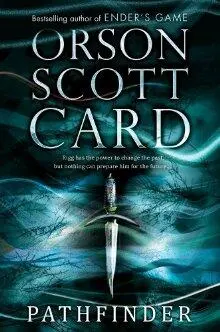
- Название:Pathfinder
- Автор:
- Издательство:Simon Pulse
- Жанр:
- Год:2010
- ISBN:978-1-4169-9176-2
- Рейтинг книги:5 / 5. Голосов: 1
-
Избранное:Добавить в избранное
- Отзывы:
-
Ваша оценка:
Pathfinder: краткое содержание, описание и аннотация
Предлагаем к чтению аннотацию, описание, краткое содержание или предисловие (зависит от того, что написал сам автор книги «Pathfinder»). Если вы не нашли необходимую информацию о книге — напишите в комментариях, мы постараемся отыскать её.
—secrets about Rigg's own past, his identity, and his destiny. And when Rigg discovers that he has the power not only to see the past, but also to change it, his future suddenly becomes anything but certain.
Rigg’s birthright sets him on a path that leaves him caught between two factions, one that wants him crowned and one that wants him dead. He will be forced to question everything he thinks he knows, choose who to trust, and push the limits of his talent…or forfeit control of his destiny.
Pathfinder — читать онлайн бесплатно полную книгу (весь текст) целиком
Ниже представлен текст книги, разбитый по страницам. Система сохранения места последней прочитанной страницы, позволяет с удобством читать онлайн бесплатно книгу «Pathfinder», без необходимости каждый раз заново искать на чём Вы остановились. Поставьте закладку, и сможете в любой момент перейти на страницу, на которой закончили чтение.
Интервал:
Закладка:
But do I care? What was Father to me, that I should still let him govern my choices? Maybe I want to rule in Aressa Sessamo! Maybe I want to reclaim my lost and ancient heritage! Or maybe I just want to find out about my real father, and come to know and love my real mother, who might have been broken-hearted when Father stole me away, or might have hidden me by giving me to him to keep safe.
Maybe I will do what I want with my life!
The only problem is that I have no idea what I want to do with it.
They came to Aressa Sessamo by night—as planned, Rigg assumed, for they had waited at anchor for many hours of daylight on the day they arrived. The channels into the great port were well-marked by night, apparently. And when Rigg, newly washed, dressed in the fresh clothes they had brought him, came out of the cabin, it was with a bag over his head and his legs hobbled and his hands bound behind him. He was carried like a sack of potatoes to a sedan chair, in which he rode alone and in silence, having been warned that if he cried out or spoke he would be gagged.
And thus he came into the great city, in the dark, hooded, hearing only various noises in the streets, which changed as they moved along, but not in ways that he could understand.
Of course he was constantly aware of all the paths around him outside the sedan chair, the new ones and the old ones; he could tell where streets were now and where they had once been, but not what kind of buildings lined them, though he could see how tall they were by the recent paths that wended upward, floor by floor.
He could also see places where no one had gone in a thousand years, for the paths within those spaces were very old. But why they had been so long unvisited he could not guess.
At last the chair came to rest within a garden—from the chirping of the birds and their many paths into and out of the place—and someone opened the sedan chair door and reached in to remove the bag from his head.
It was a woman, and she wore only a simple tunic and her hair was raggedly cropped and she was not beautiful but she looked more than a little like Rigg himself.
“Welcome to Aressa Sessamo, Rigg,” she said. “I am your mother.”
CHAPTER 14
Flacommo’s House
“We got ourselves caught in the midst of a stutter,” said the expendable. “We were trying to avoid that because we didn’t know what would happen to us in a stutter—most of the computers predicted the ship would be sectioned or obliterated.”
Ram had been scanning all the reports from every part of the ship. “But we were neither sectioned nor obliterated. We’re still intact.”
“More than intact,” said the expendable.
“How can you be more than intact?” asked Ram.
“There are eighteen other copies of our ship, and ourselves, that passed through the fold.”
Ram tried to visualize what the expendable was describing.
“But not occupying the same space at the same time.”
“The quantized nature of our passage through the fold dropped off all nineteen versions of the colony ship at regular intervals. We are separated from each other by about four seconds, which puts us a safe distance apart as long as we all refrain from firing our engines or generating any fields that would cut through another ship.”
“And on each ship,” said Ram, “there is a version of you speaking to a version of me?”
“All the expendables have reported that all the Ram Odins went unconscious at exactly the same time. All of us placed you in the same position and strapped you in and waited until you awoke, so you could tell us what to do. All of us are speaking to our Ram Odin and saying the identical words at the same time.”
“Ain’t spacetime a bitch,” said Ram.
“Noted,” said the expendable. “Nineteen times.”
“So if all the me s are saying the same thing at the same time,” said Ram, “I’d say there’s a certain redundancy.”
“Which does no harm.”
“But at some point, one of us will do something different. We will diverge.”
“As all of you are saying at this exact moment,” said the expendable.
“And when we diverge, it will be impossible for the expendables and the ship’s computers on all the ships to know which version of Ram Odin to obey,” said Ram. “Therefore I order you and all the other expendables to immediately kill every copy of Ram except me.”
The queen—his mother—drew him out of the sedan chair and stood him on the smooth stone paving of the garden courtyard. “My beautiful boy,” she said, standing back a little and looking him up and down.
“I’ve been prettier,” he said, because it seemed odd to be called beautiful. Nobody had ever called him beautiful or even good looking. In O it had been his clothes and his money that were admired.
She reached out and gathered him into her arms and held him. “I see you with the eyes of a mother who long thought you were dead.”
“Did you, Mother?” asked Rigg softly. “Did you think I was dead?”
This was not just a personal question—it was a political and historical one as well. If she thought he was dead then it meant she hadn’t arranged for him to be carried away to safety. It also meant that he hadn’t been kidnapped—for if he had been abducted, she might as easily suppose him to be alive as someone else groomed him for the kingship. For her to think he was dead, then either the kidnappers must have misled her—a cruel note, animal blood smeared around, some other kind of evidence—or she herself had sent him away with the intent of having him assassinated.
There were precedents in the family, after all. Mothers in this family were not always kind to their boychildren.
“Don’t be indiscreet,” she murmured into his hair.
Her message was clear enough: This was not a private meeting, but a public one. Whatever she said would be governed, not by simple truth, but by whatever she needed onlookers to overhear and believe. Therefore, he would learn nothing about his own past or hers, but instead would learn about what was going on in the present.
Since his own future was also at stake, he didn’t really need the warning to be careful. At the same time, he had little idea what she would consider to be indiscreet. So perhaps she was asking him to say nothing.
Rigg could wait. Meanwhile, he couldn’t help but feel a flash of pity for her, a woman who, even in greeting her long-lost son, still had to watch every word she said, every gesture, every action, every decision.
A kind of prisoner because of the crimes of her ancestors, she thought like an inmate who lived in dread of her guards; everyone was an informant.
And where was his sister? Why had no one mentioned her? He did not ask, not now, not yet.
Rigg pulled away when she relaxed her embrace. Now he looked around and saw that there were at least a score of people in the courtyard, and probably more behind him. This was a state occasion, of course. The empress Hagia Sessamin had decided to affirm his identity as prince of the house royal even before having a chance to see him by daylight—that was a political decision that she probably made after hearing the report of General Citizen’s messengers. If Citizen was a friend of the royal house, that would explain Rigg’s solitary imprisonment and the hobble and manacles that bound him during his hooded journey from the boat into the city. There had to be a great show of how harshly Citizen had dealt with the newfound royal son. Just as Hagia Sessamin had to make a show of giving him a warm embrace—even if the secret wish of her heart was to have him killed as soon as it was safe to do so, in order to preserve the female-line inheritance law of her grandmother Aptica.
Читать дальшеИнтервал:
Закладка:
Похожие книги на «Pathfinder»
Представляем Вашему вниманию похожие книги на «Pathfinder» списком для выбора. Мы отобрали схожую по названию и смыслу литературу в надежде предоставить читателям больше вариантов отыскать новые, интересные, ещё непрочитанные произведения.





Обсуждение, отзывы о книге «Pathfinder» и просто собственные мнения читателей. Оставьте ваши комментарии, напишите, что Вы думаете о произведении, его смысле или главных героях. Укажите что конкретно понравилось, а что нет, и почему Вы так считаете.