Orson Card - Pathfinder
Здесь есть возможность читать онлайн «Orson Card - Pathfinder» весь текст электронной книги совершенно бесплатно (целиком полную версию без сокращений). В некоторых случаях можно слушать аудио, скачать через торрент в формате fb2 и присутствует краткое содержание. Год выпуска: 2010, ISBN: 2010, Издательство: Simon Pulse, Жанр: Фантастика и фэнтези, на английском языке. Описание произведения, (предисловие) а так же отзывы посетителей доступны на портале библиотеки ЛибКат.
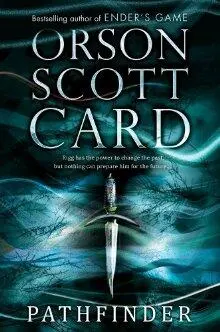
- Название:Pathfinder
- Автор:
- Издательство:Simon Pulse
- Жанр:
- Год:2010
- ISBN:978-1-4169-9176-2
- Рейтинг книги:5 / 5. Голосов: 1
-
Избранное:Добавить в избранное
- Отзывы:
-
Ваша оценка:
Pathfinder: краткое содержание, описание и аннотация
Предлагаем к чтению аннотацию, описание, краткое содержание или предисловие (зависит от того, что написал сам автор книги «Pathfinder»). Если вы не нашли необходимую информацию о книге — напишите в комментариях, мы постараемся отыскать её.
—secrets about Rigg's own past, his identity, and his destiny. And when Rigg discovers that he has the power not only to see the past, but also to change it, his future suddenly becomes anything but certain.
Rigg’s birthright sets him on a path that leaves him caught between two factions, one that wants him crowned and one that wants him dead. He will be forced to question everything he thinks he knows, choose who to trust, and push the limits of his talent…or forfeit control of his destiny.
Pathfinder — читать онлайн бесплатно полную книгу (весь текст) целиком
Ниже представлен текст книги, разбитый по страницам. Система сохранения места последней прочитанной страницы, позволяет с удобством читать онлайн бесплатно книгу «Pathfinder», без необходимости каждый раз заново искать на чём Вы остановились. Поставьте закладку, и сможете в любой момент перейти на страницу, на которой закончили чтение.
Интервал:
Закладка:
Found. The assassin had come through the gate, and it had been only a month ago. Before General Citizen’s messenger could have made it here, but not before a different messenger might have come, from some spy in O who might have investigated Rigg before Citizen even arrived.
Still, it was something of a relief to know that whoever sent the assassin was not someone who depended on General Citizen to inform them. Rigg had come to rather like, or at least respect, General Citizen, and he didn’t want him to be the type of man who resorted to assassination.
Who ushered the assassin into the house on his first visit? The normal servants who greeted everyone, and then Flacommo himself—but that meant nothing except that the party was of some lofty social standing. Most of the party went on with Flacommo to meet with Mother in a room just off the garden where her paths showed she spent most of her waking hours. But the assassin was left behind.
That suggested that he was posing as a servant, and his master had dismissed him. The assassin prowled the bedroom level of the house, exploring every room. No one challenged him, though he took at least an hour doing it.
Then he went straight to the room where the rest of his party was conversing with Mother, and the whole group left almost at once.
If only he had Umbo with him! Then he could slow down the paths to see whether Mother knew about the plan to assassinate Rigg when he showed up there.
This much was certain: Mother spent an hour talking with the people who brought the assassin along with them.
But there was no indication whether the rest of the party knew the assassin’s real mission, still less whether Mother knew about it. And just because Flacommo never encountered the assassin on either of his visits to the house said nothing about what he knew, or what the Revolutionary Council knew. Rigg’s gift told him many things that no one else could know—but it did not tell him a tenth as much as would have been useful to him.
Someone was in the garden with him.
He could see the path, and it was new—it was being created even as he watched. But it moved incredibly slowly, and faded more quickly than usual, and when he looked with his eyes, there was no one there.
There were folktales about invisible people, about saints who had the power to walk through a crowd unseen, or people who had offended a wizard and been turned invisible so they were always alone. But he had never believed them for a moment. Since Father had explained to him how vision worked—the photons of different wavelengths variously reflected or absorbed, and the retina of the eye detecting them—it seemed impossible to Rigg that someone might be able to make it so every atom of his body became transparent to photons.
But hadn’t Father said, “Only a fool says ‘impossible,’ the wise man says, ‘unlikely.’” That had become a joke between them for several months—instead of “no,” they told each other “unlikely.” Now it occurred to Rigg that Father might have had a specific example in mind when they were discussing whether invisibility was impossible or not.
Stubbornly, Rigg decided he would not yet believe in a human being transparent to photons. There must be some other explanation, and he closed his eyes and studied the slowly moving path for some kind of clue.
There was the fact that it was moving more slowly than any human being could possibly move. More important, though, was the fact that the path faded far too abruptly. The beginning of the stranger’s path into the garden was actually earlier than Rigg’s own path as he came in.
And at the head of the path, right where the person should be visible, but wasn’t, the path flickered.
Not blinking on and off, but the color of it—or flavor, or whatever sense you might want to use as a metaphor—seemed to be changing slightly in abrupt shifts.
Rigg opened his eyes again. If this was another assassin, Rigg would certainly have no problem getting away from him, his progress was so slow. Then again, he might move slowly when invisible, then turn visible and leap upon Rigg like a stooping hawk.
Still, Rigg had to learn more. So he stood up, walked directly to the head of the slow path and blocked it.
It took a few moments but the path stopped moving, and then began moving backward. But in that moment of hesitation, when the invisible one did not move forward or back, his shape became faintly visible to Rigg’s eyes. Not enough that Rigg could see him clearly, but he knew where the eyes were, could see the height. He could see the outline of the clothing and the hair, telling him that this was a woman. And in the eyes, he caught a glimpse of—what, fear? Startlement?
Rigg knew that he had revealed to the invisible person that her invisibility was not complete. But he had also learned that when the invisible person ceased moving, she became somewhat visible again.
“Who are you?” Rigg asked softly. He was so close she could not help but hear him, though no one inside the house could have. Yet there was no hint of a response. The Invisible just kept moving away, moving perhaps a little faster but not much.
Frustrated, Rigg walked up her path and did not pause, but kept moving right through the place where she had to be.
He passed right through.
Did Rigg feel anything odd during that passage? Perhaps a slight shakiness, or perhaps a little warmth. Or maybe he was just imagining the sensation because he knew he had to be passing through a living person.
When he looked back at the path, it was unchanged, except that it continued moving forward—perhaps a little more swiftly than before, if “swiftly” could be used to describe a speed that would make a snail ashamed.
Rigg had a good idea now who the Invisible might be. If he could not speak to her or force her to become more visible to him, he at least could find out where she had been and who might know who she was. Rigg stood out of the Invisible’s way and closed his eyes so he could focus on her path backward in time. Not terribly far away, the path changed—it lost its trait of rapid fading, and instead seemed quite normal as it moved through the house. Back to a bedroom where Mother lay asleep.
The Invisible had come straight from Mother’s room, and at a normal pace. But she had done so in the middle of the night, when no one was about. Rigg made the reasonable assumption: When the Invisible moved at an ordinary speed, she was completely visible, and remain unnoticed because the house was dark and everyone was asleep. As soon as the Invisible realized there was someone in the garden—Rigg—she slowed down and became invisible.
She is not “slowing down,” Rigg realized. Whatever she’s doing affects her path, and paths have to do with time. The Invisible is actually jumping forward in time, in tiny increments.
Silently in his mind, Rigg explained it all as if he were expounding his theory to Father. Suppose the Invisible moved an inch a second. Suppose that at the end of every second, she then jumped forward one second in time. To the Invisible, she is making a continuous forward movement, one second per inch. But because she is jumping forward a second at the end of every second, to an outside observer she would seem to move one inch every two seconds—but for one of those seconds she would seem to flash out of existence.
Now suppose that instead of a second per inch, it was a millionth of a second per millionth of an inch. The pace would be the same, but now she would not exist in any moment long enough for a significant number of photons to hit her.
He could almost hear Father’s voice raise an objection. If she exists in any moment for exactly as long as she does not exist between moments, then she should be half visible, for half the photons would pass through her, and half would strike her and reflect or be absorbed.
Читать дальшеИнтервал:
Закладка:
Похожие книги на «Pathfinder»
Представляем Вашему вниманию похожие книги на «Pathfinder» списком для выбора. Мы отобрали схожую по названию и смыслу литературу в надежде предоставить читателям больше вариантов отыскать новые, интересные, ещё непрочитанные произведения.





Обсуждение, отзывы о книге «Pathfinder» и просто собственные мнения читателей. Оставьте ваши комментарии, напишите, что Вы думаете о произведении, его смысле или главных героях. Укажите что конкретно понравилось, а что нет, и почему Вы так считаете.