Greg Bear - Darwin's Children
Здесь есть возможность читать онлайн «Greg Bear - Darwin's Children» — ознакомительный отрывок электронной книги совершенно бесплатно, а после прочтения отрывка купить полную версию. В некоторых случаях можно слушать аудио, скачать через торрент в формате fb2 и присутствует краткое содержание. Город: New York, Год выпуска: 2010, ISBN: 2010, Издательство: Del Rey Books, Жанр: Фантастика и фэнтези, на английском языке. Описание произведения, (предисловие) а так же отзывы посетителей доступны на портале библиотеки ЛибКат.
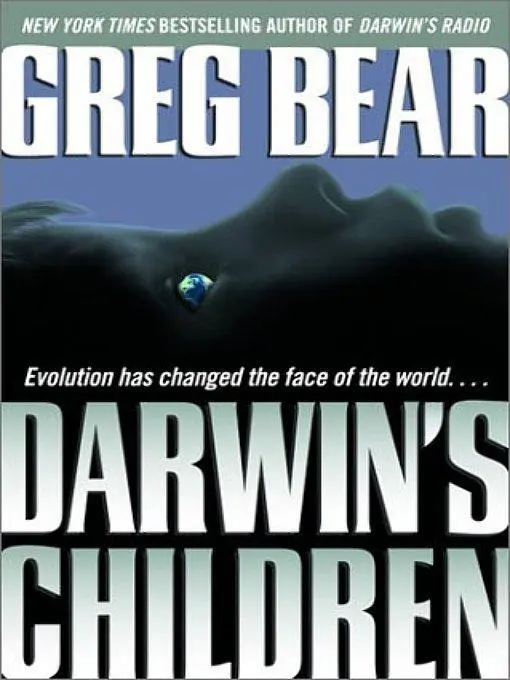
- Название:Darwin's Children
- Автор:
- Издательство:Del Rey Books
- Жанр:
- Год:2010
- Город:New York
- ISBN:9780345448361
- Рейтинг книги:3 / 5. Голосов: 1
-
Избранное:Добавить в избранное
- Отзывы:
-
Ваша оценка:
Darwin's Children: краткое содержание, описание и аннотация
Предлагаем к чтению аннотацию, описание, краткое содержание или предисловие (зависит от того, что написал сам автор книги «Darwin's Children»). Если вы не нашли необходимую информацию о книге — напишите в комментариях, мы постараемся отыскать её.
, painted a chilling portrait of humankind on the threshold of a radical leap in evolution—one that would alter our species forever. Now Bear continues his provocative tale of the human race confronted by an uncertain future, where “survival of the fittest” takes on astonishing and controversial new dimensions.
Eleven years have passed since SHEVA, an ancient retrovirus, was discovered in human DNA—a retrovirus that caused mutations in the human genome and heralded the arrival of a new wave of genetically enhanced humans. Now these changed children have reached adolescence… and face a world that is outraged about their very existence. For these special youths, possessed of remarkable, advanced traits that mark a major turning point in human development, are also ticking time bombs harboring hosts of viruses that could exterminate the “old” human race.
Fear and hatred of the virus children have made them a persecuted underclass, quarantined by the government in special “schools,” targeted by federally sanctioned bounty hunters, and demonized by hysterical segments of the population. But pockets of resistance have sprung up among those opposed to treating the children like dangerous diseases—and who fear the worst if the government’s draconian measures are carried to their extreme.
Scientists Kaye Lang and Mitch Rafelson are part of this small but determined minority. Once at the forefront of the discovery and study of the SHEVA outbreak, they now live as virtual exiles in the Virginia suburbs with their daughter, Stella—a bright, inquisitive virus child who is quickly maturing, straining to break free of the protective world her parents have built around her, and eager to seek out others of her kind.
But for all their precautions, Kaye, Mitch, and Stella have not slipped below the government’s radar. The agencies fanatically devoted to segregating and controlling the new-breed children monitor their every move—watching and waiting for the opportunity to strike the next blow in their escalating war to preserve “humankind” at any cost. DARWIN’S CHILDREN
Darwin's Children — читать онлайн ознакомительный отрывок
Ниже представлен текст книги, разбитый по страницам. Система сохранения места последней прочитанной страницы, позволяет с удобством читать онлайн бесплатно книгу «Darwin's Children», без необходимости каждый раз заново искать на чём Вы остановились. Поставьте закладку, и сможете в любой момент перейти на страницу, на которой закончили чтение.
Интервал:
Закладка:
They walked up the overgrown path to the front porch. Kaye stood on the lower step, unsure where to look or what to expect. Cross punched the doorbell. Somewhere inside the house, electronic chimes played the four opening notes from Beethoven’s Fifth. Kaye stared at a plastic tricycle with big white wheels almost lost in the grass beside the porch.
The woman who opened the door was Laura Bloch, from Senator Gianelli’s office. She smiled at Kaye and Cross. “Delighted you could be here,” she said. “Welcome to the Maryland Advisory Group on National Biological Policy. We’re an ad hoc committee, and this is an exploratory meeting.”
Kaye looked at Cross, lips downturned in dubious surprise.
“You belong here,” Cross told her. “I’m not sure I do.”
“Of course you do, Marge,” Bloch said. “Come on in, both of you.”
They entered and stood in the small foyer opposite the living room, separated by a low wall and a row of turned wooden columns. The inside of the house—brown carpet, cream-colored walls decorated with family pictures, colonial-style maple furniture and a coffee table covered with magazines and a flattop computer—could have been anywhere in the country. Typical middle-class comfort.
In the dining room, seven people sat around a maple table. Kaye was not acquainted with most of them. She did recognize one woman, however, and her face brightened.
Luella Hamilton walked across the living room. They stood apart for a moment, Kaye in her pants suit, Mrs. Hamilton in a long orange and brown caftan. She had put on a lot of weight since she and Kaye had last seen each other, and not much of it from her pregnancy.
“Dear baby Jesus,” Mrs. Hamilton let out with a small, wild-eyed laugh. “We were just on the phone . You were going to stay put. Marge, what is this all about?”
“You know each other?” Cross asked.
“We sure do,” Kaye said. But she did not explain.
“Welcome to the revolution,” Luella said, smiling sweetly. “You know Laura. Come meet the others. Quite a high-toned group we have here.” She introduced Kaye to the three women and four men seated at the table. Most were in their middle years; the youngest, a woman, appeared to be in her thirties. All were dressed in suits or stylish office work clothes. All looked like Washington insiders to Kaye, who had met plenty. She saw gratefully that they were all wearing name tags.
“Most of these folks come from the offices of key senators and representatives, eyes and ears, not necessarily proxies,” Laura Bloch explained. “We won’t connect the dots until later. Ladies and gentlemen, Kaye is both a working scientist and a mommy.”
“You’re the one who discovered SHEVA,” said one of the two gray-haired men. Kaye tried to demur, but Bloch shushed her.
“Take credit where it’s due, Kaye,” Bloch said. “We’re presenting a paper to the president within the week. Marge sent us your conclusions about genomic viruses, along with a lot of other papers. We’re still digesting them. I’m sure there are lots of questions.”
“Wow, I’ll say,” chuckled a middle-aged man named Kendall Burkett. “Worse than homework.”
Kaye remembered Burkett now. They had met at a conference on SHEVA four years ago. He was a fundraiser for legal aid for SHEVA parents.
Luella returned from the kitchen carrying a pitcher of orange juice and a plate of cookies and celery stalks with peanut butter and cream cheese fillings. “I don’t know why you folks come here,” she told the group. “I’m not much of a cook.”
Bloch put her arms around Luella’s shoulders. They made quite a contrast. Kaye could tell Luella was six months or more along, although it was only slightly apparent on her ample frame.
“Come sit,” said the younger woman. She pointed to an empty chair beside her and smiled. Her name, printed neatly on her tag, was Linda Gale. Kaye knew that name from somewhere.
“It’s our second meeting,” said Burkett. “We’re still getting acquainted.”
“Orange juice okay for you, honey?” Luella asked, and Kaye nodded. Luella filled her glass. Kaye felt overwhelmed. She did not know whether to resent Cross for not warning her in advance, or to just hug her, and then hug Luella. Instead, she walked around the table and settled into the seat beside Gale.
“Linda is assistant to the chief of staff,” Bloch said.
“At the White House? For the president?” Kaye asked, hopeful as a child looking over a Christmas package.
“The president,” Bloch confirmed.
Gale smiled up at Bloch. “Am I famous yet?”
“About time,” Luella said, passing around the plate. Gale demurred, saying she had to keep in fighting trim, but the others snatched the cookies and held out glasses for juice.
“It’s the legacy thing,” Burkett said. “The polls are going fifty-fifty. Net and media are tired of being scaremongers. Marge tells us the scientific community will come out in support of the conclusion that the SHEVA kids won’t produce disease. Do you go along with that?”
In politics, even a fragile certainty could move mountains. “I do,” Kaye said.
“The president is taking advice from all sectors of the community,” Gale said.
“They’ve had years ,” Kaye said.
“Linda is on our side, Kaye,” Bloch said softly.
“Won’t be long,” Luella said, and nodded, her eyes both angry and knowing. “Mm hmm. Not long now.”
“Dr. Rafelson, I have a question about your work,” Burkett said. “If I may…”
“First things first,” Bloch interrupted. “Marge knows already, but Kaye, you have to be absolutely clear on this. Everything said in this room is in the strictest confidence. Nobody will divulge anything to anybody outside this room, whether or not the president chooses to act. Understood?”
Kaye nodded, still in a daze.
“Good. We have some papers to sign, and then Kendall can ask his questions.”
Burkett shrugged patiently and chewed on a cookie.
Two phones rang at once—one in the kitchen, which Luella pushed through the swinging door to answer, and Laura Bloch’s cell phone in her purse.
Luella clutched an old-fashioned handset on a long cord. “Oh, my God,” she said. “Where?” Her eyes met Kaye’s. Something crossed between them. Kaye stood and clutched the back of her chair. Her knuckles turned white.
“LaShawna’s with them?” Luella asked. Then, once more, “Oh, my God.” Her face lit up with joy. “We caught a bus in New Mexico!” she cried. “John says they got our children! They have LaShawna, dear Jesus, John has my sweet, sweet girl.”
Laura Bloch finished her call and clacked her phone shut, furious. “The bastards finally did it,” she said.
38
OREGON
“You found them,” a voice said, and Mitch opened his eyes to a haze of faces in the shadows. The migraine was not done with him, but at least he could hear and think.
“The doctor says you’re going to be okay.”
“So glad,” Mitch said groggily. He was lying on an air mattress under a tent. The mattress squeaked beneath his shifting weight.
“One of your migraines?”
That was Eileen.
“Yeah.” He tried to sit up. Eileen gently pushed him down again on the mattress. Someone gave him a sip of water from a plastic cup.
“You should have told us where you were going,” a woman he did not know said disapprovingly.
Eileen interrupted her. “You didn’t know where you were going, did you?” she asked him. “Just what you wanted to find.”
“This whole camp is on the knife edge of anarchy,” the other woman said.
“Shut up, Nancy,” said Eileen’s colleague, what was her name again, Mitch liked her, she seemed smart: something Fitz. Then, it came to him, Connie Fitz, and as if in reward, the pain flowed out of his head like air from a balloon. His skull felt cold. “What did I find?”
Читать дальшеИнтервал:
Закладка:
Похожие книги на «Darwin's Children»
Представляем Вашему вниманию похожие книги на «Darwin's Children» списком для выбора. Мы отобрали схожую по названию и смыслу литературу в надежде предоставить читателям больше вариантов отыскать новые, интересные, ещё непрочитанные произведения.






Обсуждение, отзывы о книге «Darwin's Children» и просто собственные мнения читателей. Оставьте ваши комментарии, напишите, что Вы думаете о произведении, его смысле или главных героях. Укажите что конкретно понравилось, а что нет, и почему Вы так считаете.