Greg Bear - Darwin's Children
Здесь есть возможность читать онлайн «Greg Bear - Darwin's Children» — ознакомительный отрывок электронной книги совершенно бесплатно, а после прочтения отрывка купить полную версию. В некоторых случаях можно слушать аудио, скачать через торрент в формате fb2 и присутствует краткое содержание. Город: New York, Год выпуска: 2010, ISBN: 2010, Издательство: Del Rey Books, Жанр: Фантастика и фэнтези, на английском языке. Описание произведения, (предисловие) а так же отзывы посетителей доступны на портале библиотеки ЛибКат.
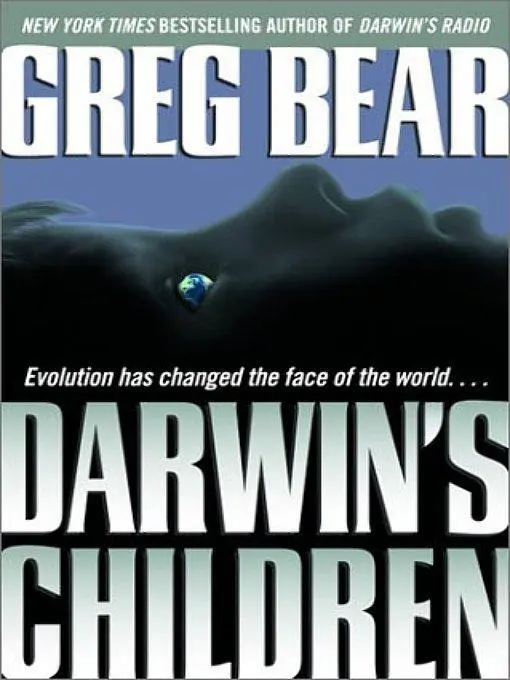
- Название:Darwin's Children
- Автор:
- Издательство:Del Rey Books
- Жанр:
- Год:2010
- Город:New York
- ISBN:9780345448361
- Рейтинг книги:3 / 5. Голосов: 1
-
Избранное:Добавить в избранное
- Отзывы:
-
Ваша оценка:
Darwin's Children: краткое содержание, описание и аннотация
Предлагаем к чтению аннотацию, описание, краткое содержание или предисловие (зависит от того, что написал сам автор книги «Darwin's Children»). Если вы не нашли необходимую информацию о книге — напишите в комментариях, мы постараемся отыскать её.
, painted a chilling portrait of humankind on the threshold of a radical leap in evolution—one that would alter our species forever. Now Bear continues his provocative tale of the human race confronted by an uncertain future, where “survival of the fittest” takes on astonishing and controversial new dimensions.
Eleven years have passed since SHEVA, an ancient retrovirus, was discovered in human DNA—a retrovirus that caused mutations in the human genome and heralded the arrival of a new wave of genetically enhanced humans. Now these changed children have reached adolescence… and face a world that is outraged about their very existence. For these special youths, possessed of remarkable, advanced traits that mark a major turning point in human development, are also ticking time bombs harboring hosts of viruses that could exterminate the “old” human race.
Fear and hatred of the virus children have made them a persecuted underclass, quarantined by the government in special “schools,” targeted by federally sanctioned bounty hunters, and demonized by hysterical segments of the population. But pockets of resistance have sprung up among those opposed to treating the children like dangerous diseases—and who fear the worst if the government’s draconian measures are carried to their extreme.
Scientists Kaye Lang and Mitch Rafelson are part of this small but determined minority. Once at the forefront of the discovery and study of the SHEVA outbreak, they now live as virtual exiles in the Virginia suburbs with their daughter, Stella—a bright, inquisitive virus child who is quickly maturing, straining to break free of the protective world her parents have built around her, and eager to seek out others of her kind.
But for all their precautions, Kaye, Mitch, and Stella have not slipped below the government’s radar. The agencies fanatically devoted to segregating and controlling the new-breed children monitor their every move—watching and waiting for the opportunity to strike the next blow in their escalating war to preserve “humankind” at any cost. DARWIN’S CHILDREN
Darwin's Children — читать онлайн ознакомительный отрывок
Ниже представлен текст книги, разбитый по страницам. Система сохранения места последней прочитанной страницы, позволяет с удобством читать онлайн бесплатно книгу «Darwin's Children», без необходимости каждый раз заново искать на чём Вы остановились. Поставьте закладку, и сможете в любой момент перейти на страницу, на которой закончили чтение.
Интервал:
Закладка:
The male guard walked to the back along the boys’ side of the plastic barrier.
“Go! Go!” Will shouted, and bounced in his seat.
“Sit down, damn it,” the first guard said.
“Why not tie us down?” Will asked. “Why not strap us in?”
“Shut up,” the guard said.
Stella felt a chill. They were being taken somewhere by a team that had had little experience with SHEVA children. She had an instinct for such things. These two, and the driver, looked even dumber than Miss Kantor. None of the humans inside or outside of the bus looked happy; they looked as if something had gone wrong.
Stella wondered what had happened to that other bus, the one they usually used.
Will was watching the guards and the driver like a hawk, eyes steady. Stella tried to keep his face in focus through the plastic, but he leaned back and got fuzzy.
The wire-reinforced plastic windows were locked shut from the outside; this was the kind of bus she had seen as a child carrying prisoners to pick up trash or cut down brush along the highways. She stared out through the window and shivered.
Her body ached. In front of her, Celia hunched forward, whispering to herself, her hands clasping the padded rail. LaShawna was yawning, pretending not to care. Felice had wrapped herself in her arms and was trying to go to sleep.
“Go, go, go!” the boys hooted, bouncing in their seats. Felice laid her head against the window. Stella wanted the boys to be quiet. She wanted everything to be quiet so she could close her eyes and pretend she was somewhere else. She felt betrayed by the school, by Miss Kantor, by Miss Kinney.
That was stupid, of course. Being at the school was a betrayal in the first place. Why would leaving be any worse? She leaned her head back to keep from feeling nauseated.
The female guard told the driver to close and lock the door. The driver started the bus and put it in gear. It lurched forward.
Celia began to throw up. The driver jerked the bus to a halt at the end of the concrete apron before the main road.
“Never mind!” the female guard shouted, her face a mask of disgust. “We’ll clean it up when we get there. Just go!”
“Go, go, go!” the boys chanted. Will glanced at Stella, straightened his lips, and began to peel another page from the paperback.
Once the bus was under way, air began to move through small vents above the windows and Stella felt better. Celia stayed quiet, and the two other girls sat stiffly in their seats. Stella was thinking over their situation and decided it was all very clumsy and badly planned, probably last-minute. They were being transported like lobsters in a tank. Time was of the essence. Someone was eager to get to them while they were still fresh.
Stella tried to make some spit to moisten her mouth. The taste on her tongue was terrible.
“This will take about an hour and ten minutes,” the driver said as they pulled out of the school parking lot. “There’s water in bottles below each seat. We’ll make one bathroom stop.”
Stella reached below the blue seat and picked up a plastic bag with a bottle of water inside. She looked down at it, wondering what it held besides water; what was going to happen at the end of the ride, their treat for being such good little boys and girls? To stay calm, she thought of Kaye, and then she thought about Mitch. Last, but not least, she remembered holding their old orange cat, Shamus, and stroking him while he purred.
If she was going to die, she could at least be as dignified as old Shamus.
30
OREGON
Mitch got up before sunrise, dressed without waking Merton, and left the tent they shared to stand at the rim of the Spent River gulley. He watched the early-morning sun try to spread light over the shaded landscape. He could clearly see Mount Hood, twenty miles away, its snows purple in the dawn.
He found a twig and stuck it between his lips, then bit it with his teeth.
Mitch had never thought he was prescient, sensitive, psychic, whatever name one gave to having second sight. Kaye had told him, years ago, that scientists and artists shared similar origins for creative thinking—but that scientists had to prove their fancies.
Mitch had never told Kaye what he had gotten out of that conversation, but in a way it had helped him put things in perspective—to see the artistic side of how he came to his own, often logically unsupportable conclusions. It wasn’t ESP.
He was just thinking like an artist.
Or a cop. Nature was the world’s most efficient serial killer. An anthropologist was a kind of detective, not so much interested in justice—that was entirely too abstract in the face of time’s immensity and so many deaths—but in figuring out how the victims had died and, more important, how they had lived.
He wiped his eyes with one finger and looked north along the gulley, to the deeper gorge that had long ago been cut through alternating layers of mud and lava and ash. Then he turned and peered at the L-shaped site with its array of canvas and plastic covers, concealed by camouflage netting.
“Shit,” he said, almost in wonder at the way his feet began to walk him along the rim of the gulley, away from the main dig.
That bear. That damned, enigmatic bear that had started it all.
The bear had come down to the river to do some fishing and had been suffocated by a fall of ash—but several days before the humans had arrived. The humans typically tracked bears, he was almost sure of it, relying on them to find good fishing. Someone had claimed the skull, but had not butchered the carcass—there were no cut marks on the bones—which meant it was probably in an unappetizing condition by the time they found it.
Salmon came back in the spring, summer, and fall to spawn and die, different groups and different species at different seasons. Nomadic bands had timed their journeys and arranged their settlements to take advantage of one or more of these returns, when the rivers ran thick with rich, red-fleshed fish.
Leaves changing color. Water running crisp and cold. Salmon wriggling over the rocky streambeds like big red pull toys. Bears waiting to march across the stream and grab them.
But most of the bears had probably left with the first ash fall, leaving behind one old male too sick to travel far, maybe chewed up in a fight, waiting to die.
Guessing . Just guessing, goddamnit.
Why would people walk up the river and ignore the ash fall? Not even hunger could have driven them into that landscape, or made them stay once there. Unless it had been raining, every step would have brought up a cloud of choking ash. Setting up a fishing camp would have been stupid in the extreme.
Like the bear, they were being followed.
He had dreamed about the bones in the night. He did not know whether artists dreamed their work—or whether detectives dreamed solutions to their cases. But the way he worked was, he often dreamed of the people he found, in their graves or where they had fallen and died.
And sometimes he was right.
Often he was right.
Hell, nine times out of ten, Mitch’s dreams turned out to be right—so long as he waited for them to evolve, to ripple through their necessary variations and reach their inevitable conclusion. That was how it had been with the Alpine mummies. He had dreamed about them for months.
But now there was not enough time. He had to rely on what amounted to a hunch.
The Australians had clued him, even more than the Homo erectus skeletons. They were very far north. Only now was anthropology accepting the many tides and clashes of peoples in the Americas—the early arrival by storm-driven boats of a few Australians in the south, the later and frequent arrivals of the Asians moving along and over the land and ice bridges in the north.
Читать дальшеИнтервал:
Закладка:
Похожие книги на «Darwin's Children»
Представляем Вашему вниманию похожие книги на «Darwin's Children» списком для выбора. Мы отобрали схожую по названию и смыслу литературу в надежде предоставить читателям больше вариантов отыскать новые, интересные, ещё непрочитанные произведения.








Обсуждение, отзывы о книге «Darwin's Children» и просто собственные мнения читателей. Оставьте ваши комментарии, напишите, что Вы думаете о произведении, его смысле или главных героях. Укажите что конкретно понравилось, а что нет, и почему Вы так считаете.