Greg Bear - Darwin's Children
Здесь есть возможность читать онлайн «Greg Bear - Darwin's Children» — ознакомительный отрывок электронной книги совершенно бесплатно, а после прочтения отрывка купить полную версию. В некоторых случаях можно слушать аудио, скачать через торрент в формате fb2 и присутствует краткое содержание. Город: New York, Год выпуска: 2010, ISBN: 2010, Издательство: Del Rey Books, Жанр: Фантастика и фэнтези, на английском языке. Описание произведения, (предисловие) а так же отзывы посетителей доступны на портале библиотеки ЛибКат.
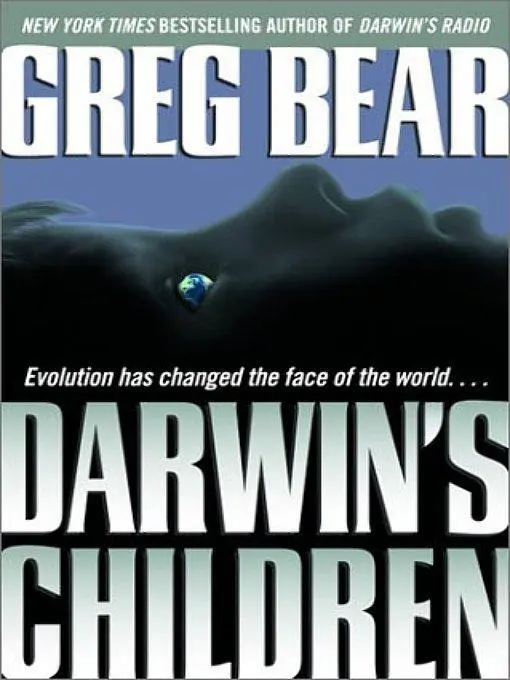
- Название:Darwin's Children
- Автор:
- Издательство:Del Rey Books
- Жанр:
- Год:2010
- Город:New York
- ISBN:9780345448361
- Рейтинг книги:3 / 5. Голосов: 1
-
Избранное:Добавить в избранное
- Отзывы:
-
Ваша оценка:
Darwin's Children: краткое содержание, описание и аннотация
Предлагаем к чтению аннотацию, описание, краткое содержание или предисловие (зависит от того, что написал сам автор книги «Darwin's Children»). Если вы не нашли необходимую информацию о книге — напишите в комментариях, мы постараемся отыскать её.
, painted a chilling portrait of humankind on the threshold of a radical leap in evolution—one that would alter our species forever. Now Bear continues his provocative tale of the human race confronted by an uncertain future, where “survival of the fittest” takes on astonishing and controversial new dimensions.
Eleven years have passed since SHEVA, an ancient retrovirus, was discovered in human DNA—a retrovirus that caused mutations in the human genome and heralded the arrival of a new wave of genetically enhanced humans. Now these changed children have reached adolescence… and face a world that is outraged about their very existence. For these special youths, possessed of remarkable, advanced traits that mark a major turning point in human development, are also ticking time bombs harboring hosts of viruses that could exterminate the “old” human race.
Fear and hatred of the virus children have made them a persecuted underclass, quarantined by the government in special “schools,” targeted by federally sanctioned bounty hunters, and demonized by hysterical segments of the population. But pockets of resistance have sprung up among those opposed to treating the children like dangerous diseases—and who fear the worst if the government’s draconian measures are carried to their extreme.
Scientists Kaye Lang and Mitch Rafelson are part of this small but determined minority. Once at the forefront of the discovery and study of the SHEVA outbreak, they now live as virtual exiles in the Virginia suburbs with their daughter, Stella—a bright, inquisitive virus child who is quickly maturing, straining to break free of the protective world her parents have built around her, and eager to seek out others of her kind.
But for all their precautions, Kaye, Mitch, and Stella have not slipped below the government’s radar. The agencies fanatically devoted to segregating and controlling the new-breed children monitor their every move—watching and waiting for the opportunity to strike the next blow in their escalating war to preserve “humankind” at any cost. DARWIN’S CHILDREN
Darwin's Children — читать онлайн ознакомительный отрывок
Ниже представлен текст книги, разбитый по страницам. Система сохранения места последней прочитанной страницы, позволяет с удобством читать онлайн бесплатно книгу «Darwin's Children», без необходимости каждый раз заново искать на чём Вы остановились. Поставьте закладку, и сможете в любой момент перейти на страницу, на которой закончили чтение.
Интервал:
Закладка:
Cross told the room what to do and two of the walls folded up, revealing electronic whiteboards. Sections of the table rose up like toy soldiers, thin personal monitors.
“If I were starting over again,” Cross said, “I’d turn this into a kindergarten classroom. Little chairs and wagons with little cartons of milk. That’s how ignorant we are. But… We do cling to our beauty and wealth. We like to feel we are in control and always will be.”
Kaye listened attentively, but did not respond.
Cross pushed another button and the whiteboards replayed long strings of scrawled notes. Kaye guessed these were a frozen record of several late-night and early-morning pacing sessions, Cross alone up here in the heights, wielding her little pen wand, moving along the boards like a sorcerous queen scattering spells on the walls of her castle.
Kaye could decipher very few of the scrawls. Cross’s handwriting was notorious.
“Nobody’s seen this,” Cross murmured. “It’s hard to read, isn’t it?” she asked Kaye. “I used to have perfect penmanship.” She held up her swollen knuckles.
Kaye wondered where Cross intended to go with this. Was it all some devious way of letting her go gracefully, with a hearty handshake?
“The secret of life,” Cross said, “lies in understanding how little things talk to each other. Correct?”
“Yes,” Kaye said.
“And you’ve maintained, from before the beginnings of SHEVA, that viruses are part of the arsenal of communications our cells and bodies use to talk.”
“That’s why you brought me to Americol.”
Cross dismissed that with a slight frown and a lift of one shoulder. “So you turned yourself into a laboratory to prove a point, and gave birth to a SHEVA child. Gutsy, and more than a little stupid.”
Kaye clenched her jaw.
Cross knew she had touched an exposed nerve. “I think the Jackson clique is right on the money. Experience biases you in favor of believing SHEVA is benign, a natural phenomenon that we’ll just have to knuckle under and accept. Don’t fight it. It’s bigger than all of us.”
“I’m fond of my daughter,” Kaye said stiffly.
“I don’t doubt it. Hear me out. I’m going somewhere with this, but I don’t know where just yet.” Cross paced along the whiteboards, arms folded, tapping one elbow with the remote. “My companies are my children. That’s a cliché, but it’s true, Kaye. I am as stupid and gutsy as you were. I have turned my companies into an experiment in politics and human history. We’re very much alike, except I had neither the opportunity—nor, frankly, the inclination—to put my body on the line. Now, we both stand to lose what we love most.”
Cross turned and flicked the whiteboards clean with the press of a button. Her face curled in disgust. “It’s all shit. This room is a waste of money. You can’t help but think that whoever built all this knew what they were doing, had all the answers. It’s an architectural lie. I hate this room. Everything I just erased was drivel. Let’s go somewhere else.” Cross was visibly angry.
Kaye folded her hands cautiously. She had no idea what was going to happen, not now. “All right,” she said. “Where?”
“No limos. Let’s lose the luxuries for a few hours. Let’s get back to little chairs and cookies and cartons of milk.” Cross smiled wickedly, revealing strong, even, but speckled teeth. “Let’s get the hell out of this building.”
A gray, drizzly light greeted them as they pushed through the glass doors to the street. Cross hailed a cab.
“Your cheeks are pinking,” she told Kaye as they climbed into the backseat. “Like they want to say something.”
“That still happens,” Kaye admitted with some embarrassment.
Cross gave the driver an address Kaye did not recognize. The gray-haired man, a Sikh wearing a white turban, looked over his shoulder.
“I will need card in advance,” he said.
Cross reached for her belt pouch.
“My treat,” Kaye said, and handed the driver her credit card. The cab pushed off through traffic.
“What was it like, having those cheeks—like signboards?” Cross asked.
“It was a revelation,” Kaye said. “When my daughter was young, we practiced cheek-flashing. It was like teaching her how to speak. I missed them when they faded.”
Cross watched her absorbedly, then gave a little start and said, “I learned I couldn’t have children when I was twenty-five. Pelvic inflammatory disease. I was a big, ungainly girl and had a hard time getting dates. I had to take my men where I found them, and one of them… Well. No children, and I decided not to reverse the scarring, because there was never a man I trusted enough to be a father. I got rich pretty early and the men I was attracted to were like pleasant toys, needy, eager to please, not very reliable.”
“I’m sorry,” Kaye said.
“Sublimation is the soul of accomplishment,” Cross said. “I can’t say I understand what it means to be a parent. I can only make comparisons with how I feel about my companies, and that probably isn’t the same.”
“Probably not,” Kaye said.
Cross clucked her tongue. “This isn’t about funding or firing you or anything so simple. We’re both explorers, Kaye. For that reason alone, we need to be open and frank.”
Kaye peered out the taxi window and shook her head, amused. “It isn’t working, Marge. You’re still rich and powerful. You’re still my boss.”
“Well, hell,” Cross said with mock disappointment, and snapped her fingers.
“But it may not matter,” Kaye said. “I’ve never been very good at concealing my true feelings. Maybe you’ve noticed.”
Cross made a sound too high-pitched to be a laugh, but it had a certain eccentric dignity, and probably wasn’t a giggle, either. “You’ve been playing me all along.”
“You knew I would,” Kaye said.
Cross patted her cheek. “Cheek-flashing.”
Kaye looked puzzled.
“How can something so wonderful be an aberration, a disease? If I could fever scent, I would be running every corporation in the country by now.”
“You wouldn’t want to,” Kaye said. “If you were one of the children . ”
“Now who’s being naÏve?” Cross asked. “Do you think they’ve left our monkey selves behind?”
“No. Do you know what a deme is?” Kaye asked.
“Social units for some of the SHEVA kids.”
“What I’m saying is a deme might be the greedy one, not an individual. And when a deme fever scents, we lesser apes don’t stand a chance.”
Cross leaned her head back and absorbed this. “I’ve heard that,” she said.
“Do you know a SHEVA child?” the driver asked, looking at them in the rearview mirror. He did not wait for an answer. “My granddaughter, a SHEVA girl, is in Peshawar, she is charmer. Real charmer. It is scary,” he added happily, proudly, with a broad grin. “Really scary.”
29
ARIZONA
Stella sat with Julianne Nicorelli in a small beige room in the hospital. Joanie had separated them from the other girls. They had been waiting for two hours. The air was still and they sat stiff as cold butter on their chairs, watching a fly crawl along the window.
The room was still thick with strawberry scent, which Stella had once loved.
“I feel awful,” Julianne said.
“So do I.”
“What are they waiting for?”
“Something’s screwy/ Made a mistake,” Stella said.
Julianne scraped her shoes on the floor. “I’m sorry you aren’t one of my deme,” she said.
“That’s okay.”
“Let’s make our own, right here. We’ll/ Like us/ join up with anyone else/ locked away/ who comes in.”
Читать дальшеИнтервал:
Закладка:
Похожие книги на «Darwin's Children»
Представляем Вашему вниманию похожие книги на «Darwin's Children» списком для выбора. Мы отобрали схожую по названию и смыслу литературу в надежде предоставить читателям больше вариантов отыскать новые, интересные, ещё непрочитанные произведения.






Обсуждение, отзывы о книге «Darwin's Children» и просто собственные мнения читателей. Оставьте ваши комментарии, напишите, что Вы думаете о произведении, его смысле или главных героях. Укажите что конкретно понравилось, а что нет, и почему Вы так считаете.