Greg Bear - Darwin's Children
Здесь есть возможность читать онлайн «Greg Bear - Darwin's Children» — ознакомительный отрывок электронной книги совершенно бесплатно, а после прочтения отрывка купить полную версию. В некоторых случаях можно слушать аудио, скачать через торрент в формате fb2 и присутствует краткое содержание. Город: New York, Год выпуска: 2010, ISBN: 2010, Издательство: Del Rey Books, Жанр: Фантастика и фэнтези, на английском языке. Описание произведения, (предисловие) а так же отзывы посетителей доступны на портале библиотеки ЛибКат.
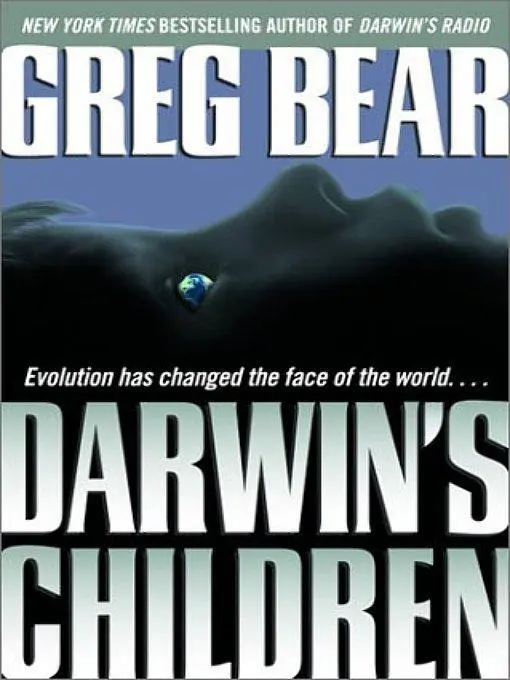
- Название:Darwin's Children
- Автор:
- Издательство:Del Rey Books
- Жанр:
- Год:2010
- Город:New York
- ISBN:9780345448361
- Рейтинг книги:3 / 5. Голосов: 1
-
Избранное:Добавить в избранное
- Отзывы:
-
Ваша оценка:
Darwin's Children: краткое содержание, описание и аннотация
Предлагаем к чтению аннотацию, описание, краткое содержание или предисловие (зависит от того, что написал сам автор книги «Darwin's Children»). Если вы не нашли необходимую информацию о книге — напишите в комментариях, мы постараемся отыскать её.
, painted a chilling portrait of humankind on the threshold of a radical leap in evolution—one that would alter our species forever. Now Bear continues his provocative tale of the human race confronted by an uncertain future, where “survival of the fittest” takes on astonishing and controversial new dimensions.
Eleven years have passed since SHEVA, an ancient retrovirus, was discovered in human DNA—a retrovirus that caused mutations in the human genome and heralded the arrival of a new wave of genetically enhanced humans. Now these changed children have reached adolescence… and face a world that is outraged about their very existence. For these special youths, possessed of remarkable, advanced traits that mark a major turning point in human development, are also ticking time bombs harboring hosts of viruses that could exterminate the “old” human race.
Fear and hatred of the virus children have made them a persecuted underclass, quarantined by the government in special “schools,” targeted by federally sanctioned bounty hunters, and demonized by hysterical segments of the population. But pockets of resistance have sprung up among those opposed to treating the children like dangerous diseases—and who fear the worst if the government’s draconian measures are carried to their extreme.
Scientists Kaye Lang and Mitch Rafelson are part of this small but determined minority. Once at the forefront of the discovery and study of the SHEVA outbreak, they now live as virtual exiles in the Virginia suburbs with their daughter, Stella—a bright, inquisitive virus child who is quickly maturing, straining to break free of the protective world her parents have built around her, and eager to seek out others of her kind.
But for all their precautions, Kaye, Mitch, and Stella have not slipped below the government’s radar. The agencies fanatically devoted to segregating and controlling the new-breed children monitor their every move—watching and waiting for the opportunity to strike the next blow in their escalating war to preserve “humankind” at any cost. DARWIN’S CHILDREN
Darwin's Children — читать онлайн ознакомительный отрывок
Ниже представлен текст книги, разбитый по страницам. Система сохранения места последней прочитанной страницы, позволяет с удобством читать онлайн бесплатно книгу «Darwin's Children», без необходимости каждый раз заново искать на чём Вы остановились. Поставьте закладку, и сможете в любой момент перейти на страницу, на которой закончили чтение.
Интервал:
Закладка:
“Obviously,” Fitz said with a sniff.
“They’ve been extinct for more than three hundred thousand years,” Mitch said.
“Apparently not,” Eileen said.
Mitch laughed and stood back with a snap as if he had been leaning over a wasp that had suddenly taken flight. “Jesus.”
“Is that it?” Eileen asked. “Is that the most you can say?” She was kidding, but her tone had an edge.
“You’ve had longer to get used to it,” Mitch said.
“Who says we’re used to it?” Eileen asked.
“What about the fetus?”
“Too early and too little detail,” Fitz said. “It’s probably a lost cause.”
“I’m thinking we should drive a tube, take a thin core sample, and PCR mitochondrial DNA from the remaining integuments,” Merton said.
“Dreamer,” Fitz said. “They’re twenty thousand years old. Besides, the lahar cooked them.”
“Not to mush,” Merton countered.
“Think like a scientist, not a journalist.”
“Shh,” Eileen said in deference to Mitch, who was still staring at the rolled-out screen, mesmerized. “Here’s what we have on the central group,” she said, and paged through another set of ghostly images. “Gertie and Charlene are outliers. These four are Hildegard, Natasha, Sonya, and Penelope. Hildegard was probably the oldest, in her late thirties and already racked with arthritis.”
Hildegard, Natasha, and Sonya were clearly Homo sapiens . Penelope was another Homo erectus . They lay entwined as if they had died hugging each other, a mandala of bones, elegant in their sad way.
“Some of the hardliners are calling this a flood deposition of unassociated remains,” Fitz said.
“How would you answer them?” Eileen challenged Mitch, reverting to his teacher of old.
Mitch was still trying to remember to breathe. “They’re fully articulated,” he said. “They have their arms around each other. They don’t lie at odd angles, tossed together. This is in no way a flood deposit.”
Mitch was startled to watch Fitz and Eileen hug each other. “These women knew each other,” Eileen agreed, tears of relief dripping down her cheeks. “They worked together, traveled together. A nomadic band, caught in camp by a burp from Mount Hood. I can feel it.”
“Are you with us?” Fitz asked, her eyes bright and suspicious.
“ Homo erectus . North America. Twenty thousand years ago,” Mitch said. Then, frowning, he asked, “Where are the males?”
“To hell with that,” Fitz fumed. “Are you with us?”
“Yeah,” Mitch said, sensing the tension and Eileen’s discomfort at his hesitation. “I’m with you.” Mitch put his good arm around Eileen’s shoulders, sharing the emotion.
Oliver Merton clasped his hands like a boy anticipating Christmas. “You realize that this could be a political bombshell,” he said.
“For the Indians?” Fitz asked.
“For us all.”
“How so?”
Merton grinned like a fiend. “Two different species, living together. It’s as if someone’s teaching us a lesson.”
23
NEW MEXICO
Dicken showed his pass at the Pathogenics main gate. The three young, burly guards there—machine pistols slung over their shoulders—waved him through. He drove the cart to the valet area and presented the pass for his car.
“Going for a drink,” he told the serious-faced middle-aged woman as she inspected his release.
“Did I ask?” She gave him a seasoned, challenging smile.
“No,” he admitted.
“Don’t tell us anything,” she advised. “We have to report every little thing. Vodka, white wine, or local beer?”
Dicken must have looked flustered.
“I’m joking,” she said. “I’ll be back in a few minutes.”
She returned driving his leased Malibu, adapted for handicapped drivers.
“Nice setup, all the stuff on the wheel,” she said. “Took me a bit to figure it out.”
He accepted the inspection pass, made sure it was completely filled out—there had been some trouble with such things yesterday—and slipped it into a special holder in the visor. The sun was lingering over the rocky gray-and-brown hills beyond the main Pathogenics complex. “Thanks,” he said.
“Enjoy,” the valet said.
He took the main road out of the complex and drove through rush hour traffic, following the familiar track into Albuquerque, then pulled into the parking lot of the Marriott. Crickets were starting up and the air was tolerable. The hotel rose over the parking lot in one graceless pillar, tan and white against the dark blue night sky, proudly illuminated by big floodlights set around stretches of deep green lawn. Dicken walked into a low-slung restaurant wing, visited the men’s room, then came out and turned left to enter the bar.
The bar was just starting to crowd. Two regulars sat at the bar—a woman in her late thirties, looking as if life and her partners had ridden her hard, and a sympathetic elderly man with a long nose and close-set eyes. The worn-down woman was laughing at something the long-nosed man had just said.
Dicken sat on a tall stool by a high, tiny table beside a fake plant in an adobe pot. He ordered a Michelob when the waitress got around to him, then sat watching the people come and go, nursing his beer and feeling miserably out of place. Nobody was smoking, but the air smelled cold and stale, with a tang of beer and liquor.
Dicken reached into his pocket and withdrew his hand, then, under the table, unfolded a red serviette. He palmed the serviette over the damp napkin on the table, also red, and left it there.
At eight, after an hour and a half, his beer almost gone and the waitress starting to look predatory, he pushed off the stool, disgusted.
Someone touched his shoulder and Dicken jumped.
“How does James Bond do it?” asked a jovial fellow in a green sport jacket and beige slacks. With his balding pate, round, red Santa nose, lime green golf shirt bulging at the belly, and belt tightened severely to reclaim some girth, the middle-aged man looked like a tourist with a snootful. He smelled like one, too.
“Do what?” Dicken asked.
“Get the babes when they all know they’re just going to die.” The balding man surveyed Dicken with a jaundiced, watery eye. “I can’t figure it.”
“Do I know you?” Dicken asked gravely.
“I’ve got friends watching every porthole. We know the local spooks, and this place is not as haunted as some.”
Dicken put down his beer. “I don’t know what you’re talking about,” he said.
“Is Dr. Jurie your peer?” the man asked softly, pulling up another stool.
Dicken knocked his stool over in his haste to get up. He left the bar quickly, on the lookout for anyone too clean-cut, too vigilant.
The balding man shrugged, reached across the table to grab a handful of peanuts, then crumpled Dicken’s red serviette and slipped it into his pocket.
Dicken drove away from the hotel and parked briefly on a side street beside a used car lot. He was breathing heavily. “Christ, Christ, Cheee-rist,” he said softly, waiting for his heart to slow.
His cell phone rang and he jumped, then flipped it open.
“Dr. Dicken?”
“Yes.” He tried to sound coldly professional.
“This is Laura Bloch. I believe we have an appointment.”
Dicken drove up behind the blue Chevrolet and switched off his engine and lights. The desert surrounding Tramway Road was quiet and the air was warm and still; city lights illuminated low, spotty cumulus clouds to the south. A door swung open on the Chevrolet and a man in a dark suit got out and walked back to peer into his open window.
“Dr. Dicken?”
Читать дальшеИнтервал:
Закладка:
Похожие книги на «Darwin's Children»
Представляем Вашему вниманию похожие книги на «Darwin's Children» списком для выбора. Мы отобрали схожую по названию и смыслу литературу в надежде предоставить читателям больше вариантов отыскать новые, интересные, ещё непрочитанные произведения.



Обсуждение, отзывы о книге «Darwin's Children» и просто собственные мнения читателей. Оставьте ваши комментарии, напишите, что Вы думаете о произведении, его смысле или главных героях. Укажите что конкретно понравилось, а что нет, и почему Вы так считаете.