Greg Bear - Darwin's Children
Здесь есть возможность читать онлайн «Greg Bear - Darwin's Children» — ознакомительный отрывок электронной книги совершенно бесплатно, а после прочтения отрывка купить полную версию. В некоторых случаях можно слушать аудио, скачать через торрент в формате fb2 и присутствует краткое содержание. Город: New York, Год выпуска: 2010, ISBN: 2010, Издательство: Del Rey Books, Жанр: Фантастика и фэнтези, на английском языке. Описание произведения, (предисловие) а так же отзывы посетителей доступны на портале библиотеки ЛибКат.
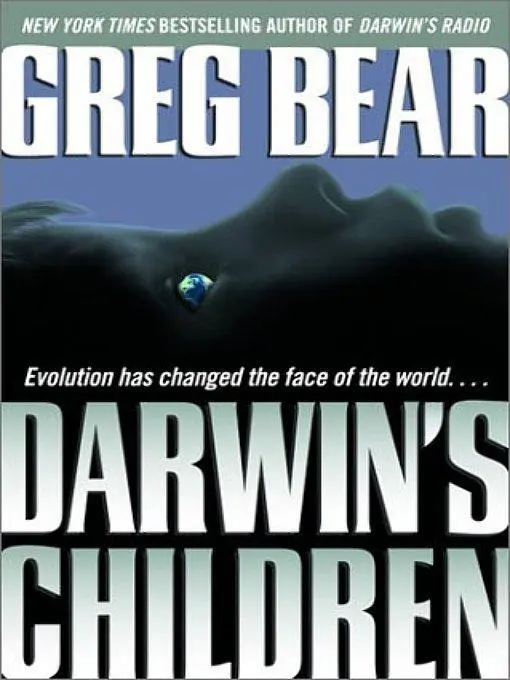
- Название:Darwin's Children
- Автор:
- Издательство:Del Rey Books
- Жанр:
- Год:2010
- Город:New York
- ISBN:9780345448361
- Рейтинг книги:3 / 5. Голосов: 1
-
Избранное:Добавить в избранное
- Отзывы:
-
Ваша оценка:
Darwin's Children: краткое содержание, описание и аннотация
Предлагаем к чтению аннотацию, описание, краткое содержание или предисловие (зависит от того, что написал сам автор книги «Darwin's Children»). Если вы не нашли необходимую информацию о книге — напишите в комментариях, мы постараемся отыскать её.
, painted a chilling portrait of humankind on the threshold of a radical leap in evolution—one that would alter our species forever. Now Bear continues his provocative tale of the human race confronted by an uncertain future, where “survival of the fittest” takes on astonishing and controversial new dimensions.
Eleven years have passed since SHEVA, an ancient retrovirus, was discovered in human DNA—a retrovirus that caused mutations in the human genome and heralded the arrival of a new wave of genetically enhanced humans. Now these changed children have reached adolescence… and face a world that is outraged about their very existence. For these special youths, possessed of remarkable, advanced traits that mark a major turning point in human development, are also ticking time bombs harboring hosts of viruses that could exterminate the “old” human race.
Fear and hatred of the virus children have made them a persecuted underclass, quarantined by the government in special “schools,” targeted by federally sanctioned bounty hunters, and demonized by hysterical segments of the population. But pockets of resistance have sprung up among those opposed to treating the children like dangerous diseases—and who fear the worst if the government’s draconian measures are carried to their extreme.
Scientists Kaye Lang and Mitch Rafelson are part of this small but determined minority. Once at the forefront of the discovery and study of the SHEVA outbreak, they now live as virtual exiles in the Virginia suburbs with their daughter, Stella—a bright, inquisitive virus child who is quickly maturing, straining to break free of the protective world her parents have built around her, and eager to seek out others of her kind.
But for all their precautions, Kaye, Mitch, and Stella have not slipped below the government’s radar. The agencies fanatically devoted to segregating and controlling the new-breed children monitor their every move—watching and waiting for the opportunity to strike the next blow in their escalating war to preserve “humankind” at any cost. DARWIN’S CHILDREN
Darwin's Children — читать онлайн ознакомительный отрывок
Ниже представлен текст книги, разбитый по страницам. Система сохранения места последней прочитанной страницы, позволяет с удобством читать онлайн бесплатно книгу «Darwin's Children», без необходимости каждый раз заново искать на чём Вы остановились. Поставьте закладку, и сможете в любой момент перейти на страницу, на которой закончили чтение.
Интервал:
Закладка:
“I don’t dare walk under these damned things,” Eileen said. “I have enough skin blotches as is.”
Mitch knelt beside the mesa to look at alternating layers of mud and tephra, capped by sand and silt. He saw an ash fall—tephra—followed by a lahar, a fast-moving slurry of hot mud made of ash, dirt, and glacier melt. The sand and silt had arrived over time. At the bottom of the mesa, he saw more alternating layers of ash, mud, and river deposits: A deep book going back far longer than recorded history.
“Computers do some really big math and show us a picture of what’s down there,” Eileen said. “We actually debated whether to dig any deeper or just cover it over again and submit the videos and sensor readings. But I guess the committee is going for a traditional invasion.”
Mitch moved his hand in a sweeping motion. “Ash came down for several days,” he said. “Then a lahar swept down the river basin. Up here, it slopped over but didn’t carry off the bodies.”
“Very good ,” Merton said, genuinely impressed.
“Want to see our etchings?” Eileen asked.
Eileen unrolled a display sheet in the conference tent and tuned it to her wrist computer. “Still getting used to all this tech,” she murmured. “It’s wonderful, when it works.”
Merton watched over Mitch’s shoulder. Two women in their thirties, dressed in jeans and short-sleeved khaki shirts, stood at the rear of the long, narrow tent, debating in soft but angry voices. Eileen did not see fit to introduce them, which clued Mitch that she was not the only high-powered anthropologist working the dig.
The screen glowed faintly in the tent’s half-light. Eileen told the computer to run a slide show.
“These are from yesterday,” she said. “We’ve done around twenty-seven complete scans. Redundancy upon redundancy, just to be sure we’re not making it up. Oliver says he’s never seen a more frightened bunch of scientists.”
“I haven’t,” Merton affirmed.
The first image showed the pale ghost of a skeleton curled in fetal position, surrounded by what looked like sheets of grass matting, a few stones, and a cloud of pebbles. “Our first. We’re calling her Charlene. As you can see, she’s fairly modern Homo sap . Prominent chin, relatively high forehead. But here’s the tomographic reconstruction from our multiple sweeps.” A second image came up and showed a dolichocephalic, or long-headed, skull. Eileen told the computer to rotate this image.
Mitch scowled. “Looks Australian,” he said.
“She probably is,” Eileen said. “About twenty years of age. Trapped and asphyxiated by hot mud. There are five other skeletons, one close to Charlene, the others clustered about four meters away. All are female. No infants. And no sign of males. The grass matting has decayed, of course. Just molds remain. We have a shadow mold around Charlene, a cast of fine silt from seepage through the mud and ash showing the outlines of her body. Here’s a tomographic image of what that cast would look like, if we could manage to pry it loose from the tephra and the rest of the overburden.”
A distorted ghost of a head, neck, and shoulders appeared and rotated smoothly on the display sheet. Mitch felt odd, standing in a tent that would have been familiar to Roy Chapman Andrews or even to Darwin himself, while staring down at the rolled-out sheet of the computer display.
He asked Eileen to rotate the image of Charlene again.
As the image swung around and around, he began to discern facial features, a closed eye, a blob of ear, hair matted and curled, a hint of cooked and distorted flesh slumped from the back of the skull.
“Pretty awful,” Merton said.
“They suffocated before the heat got to them,” Eileen said. “I hope they did, anyway.”
“Early-stage Tierra del Fuegan?” Mitch asked.
“That’s what most of us think. From the Australian migration out of South and Central America.”
Such migrations had been charted more and more often in the last fifteen years; Australian skeletons and associated artifacts found near the tip of South America had been dated to older than thirty thousand years BP, before the present.
The two other women walked around them to reach the exit, as serious and unsocial as porcupines. A plump, red-faced woman a few years younger than Eileen held the flap open for them then stepped in and stood before Mitch. “Is this the famous Mitch Rafelson?” she asked Eileen.
“Mitch, meet Connie Fitz. I told her I’d bring you here.”
“Delighted to meet you, after all these years.” Fitz wiped her hands on a dusty towel hanging from her belt before shaking hands. “Have you showed him the good stuff?”
“We’re getting there.”
“Best picture of Gertie is on sweep 21,” Fitz advised.
“I know,” Eileen said testily. “It’s my show.”
“Sorry. I’m the mother hen,” Fitz said. “The others are still arguing.”
“Spare me,” Eileen said. Another image cast their faces in a pale greenish light.
“Say hello to Gertie,” Merton said. He glanced up at Mitch, waiting to see his reaction.
Mitch poked the surface of the screen, making the light pool under his finger. He looked up, on the edge of anger. “You’re kidding me. This is a joke.”
“No joke,” Merton said.
Eileen magnified the image. Then, clearing his throat, Mitch asked, “Fraud?”
“What do you think?” Eileen asked.
“They’re in close association? Not in different layers?”
Eileen nodded. “They were buddies, probably traveling together. No infants, but as you can see, Gertie was maybe fifteen or sixteen, and she was probably gravid when the ash covered her.”
“Either that or she ate babies,” Merton said. Another twitch of the lip from Eileen.
“Oliver’s on borrowed time,” Fitz said.
“Matriarchy,” Merton accused, deadpan.
The tent suddenly seemed very stuffy. Mitch would have sat down had there been a convenient chair. “She looks early. Different from Charlene. Is she a hybrid?” he asked.
“No one’s willing to say,” Eileen replied. “You’ll like our late-night debates. A few weeks back, when I wanted you to join us, everyone shouted me down. Now, we’re all at each other’s throats, and Oliver, I’m told, convinced Daney it was time.”
“I did,” Merton said.
“Personally, I’m glad you’re here,” Eileen added.
“I’m not,” Fitz said. “If the feds find out about you, if there’s any publicity at all, we’re NAGPRA toast.”
“Tell me more, Mitch,” Eileen suggested.
Mitch massaged the back of his neck and for the ninth time watched the image of the skull grow and rotate. “Skull seems compressed. She’s long-headed, more even than the Australian. There’s a flint implement near her hand, and she’s carrying some sort of grass bag over her shoulder, if I’m not mistaken.”
“You’re not.”
“Filled with what looks like bush or small tree roots.”
“Desperation diet,” Fitz said.
“Maybe that was just her assignment, gathering roots for the stone soup.”
Merton looked puzzled. Eileen explained stone soup.
“How colonial,” Merton said.
“Ever the B-movie Brit, aren’t you?” Fitz said.
“Please, children,” Eileen warned.
“Relatively tall, taller than Charlene, maybe, and pretty robust, heavy boned,” Mitch continued, trying to talk himself out of what he was seeing. “Sloping forehead, mid-sized to small brain case, but the face is fairly flat. Impressive supraorbital torus. A bit of a sagittal keel, even an occipital torus. I’d love to get a better look at the incisors.”
“Shovel-shaped,” Eileen said.
Mitch rubbed his limp hand to still the tingling and looked at the others as if all of them might be crazy. “Gertie is much too early. She looks like Broken Hill 1. She’s Homo erectus .”
Читать дальшеИнтервал:
Закладка:
Похожие книги на «Darwin's Children»
Представляем Вашему вниманию похожие книги на «Darwin's Children» списком для выбора. Мы отобрали схожую по названию и смыслу литературу в надежде предоставить читателям больше вариантов отыскать новые, интересные, ещё непрочитанные произведения.









Обсуждение, отзывы о книге «Darwin's Children» и просто собственные мнения читателей. Оставьте ваши комментарии, напишите, что Вы думаете о произведении, его смысле или главных героях. Укажите что конкретно понравилось, а что нет, и почему Вы так считаете.