Greg Bear - Darwin's Children
Здесь есть возможность читать онлайн «Greg Bear - Darwin's Children» — ознакомительный отрывок электронной книги совершенно бесплатно, а после прочтения отрывка купить полную версию. В некоторых случаях можно слушать аудио, скачать через торрент в формате fb2 и присутствует краткое содержание. Город: New York, Год выпуска: 2010, ISBN: 2010, Издательство: Del Rey Books, Жанр: Фантастика и фэнтези, на английском языке. Описание произведения, (предисловие) а так же отзывы посетителей доступны на портале библиотеки ЛибКат.
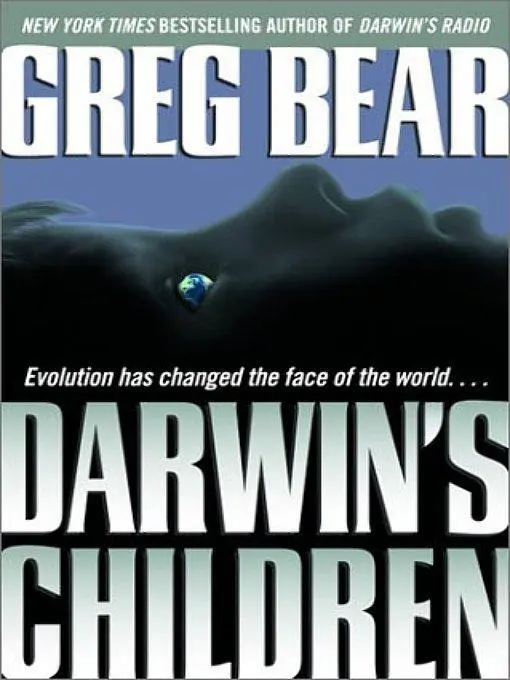
- Название:Darwin's Children
- Автор:
- Издательство:Del Rey Books
- Жанр:
- Год:2010
- Город:New York
- ISBN:9780345448361
- Рейтинг книги:3 / 5. Голосов: 1
-
Избранное:Добавить в избранное
- Отзывы:
-
Ваша оценка:
Darwin's Children: краткое содержание, описание и аннотация
Предлагаем к чтению аннотацию, описание, краткое содержание или предисловие (зависит от того, что написал сам автор книги «Darwin's Children»). Если вы не нашли необходимую информацию о книге — напишите в комментариях, мы постараемся отыскать её.
, painted a chilling portrait of humankind on the threshold of a radical leap in evolution—one that would alter our species forever. Now Bear continues his provocative tale of the human race confronted by an uncertain future, where “survival of the fittest” takes on astonishing and controversial new dimensions.
Eleven years have passed since SHEVA, an ancient retrovirus, was discovered in human DNA—a retrovirus that caused mutations in the human genome and heralded the arrival of a new wave of genetically enhanced humans. Now these changed children have reached adolescence… and face a world that is outraged about their very existence. For these special youths, possessed of remarkable, advanced traits that mark a major turning point in human development, are also ticking time bombs harboring hosts of viruses that could exterminate the “old” human race.
Fear and hatred of the virus children have made them a persecuted underclass, quarantined by the government in special “schools,” targeted by federally sanctioned bounty hunters, and demonized by hysterical segments of the population. But pockets of resistance have sprung up among those opposed to treating the children like dangerous diseases—and who fear the worst if the government’s draconian measures are carried to their extreme.
Scientists Kaye Lang and Mitch Rafelson are part of this small but determined minority. Once at the forefront of the discovery and study of the SHEVA outbreak, they now live as virtual exiles in the Virginia suburbs with their daughter, Stella—a bright, inquisitive virus child who is quickly maturing, straining to break free of the protective world her parents have built around her, and eager to seek out others of her kind.
But for all their precautions, Kaye, Mitch, and Stella have not slipped below the government’s radar. The agencies fanatically devoted to segregating and controlling the new-breed children monitor their every move—watching and waiting for the opportunity to strike the next blow in their escalating war to preserve “humankind” at any cost. DARWIN’S CHILDREN
Darwin's Children — читать онлайн ознакомительный отрывок
Ниже представлен текст книги, разбитый по страницам. Система сохранения места последней прочитанной страницы, позволяет с удобством читать онлайн бесплатно книгу «Darwin's Children», без необходимости каждый раз заново искать на чём Вы остановились. Поставьте закладку, и сможете в любой момент перейти на страницу, на которой закончили чтение.
Интервал:
Закладка:
About ten paces beyond the door, they met two of the treatment center nurses. They were sharing a cigarette and sprawling on plastic chairs in the shade at the end of a broad corridor lined with padded picnic tables. The two women were in their fifties, very large, with beefy arms and large, fat hands. They wore dark green uniforms, almost black in the overhead glare. They looked up listlessly as Dicken and DeWitt came into view.
“We done everything we could,” one of them said, eyes darting.
Dicken nodded, simply acknowledging their presence—and perhaps their courage.
“There are more out there,” said the other nurse, louder, as they walked past. “It’s damned near midnight. We needed a break!”
“I’m sure you did your best,” DeWitt said. Dicken instantly caught the contrast: DeWitt’s voice, precise and academic, educated; the nurses’, pragmatic and blue collar.
The nurses were townies.
“Fuck you,” the first nurse tried to shout, but it came out a wan croak. “Where was everybody? Where’re the doctors?”
Brave townies. They cared. They could have bolted, but they had stayed.
Dicken stood in the yard. A canvas tent had been pulled over a concrete quadrangle about fifty feet on a side and surrounded by tan, stucco-covered walls. The lighting was inadequate, just wall-mounted pathway illumination surrounding the open square. The center was a shadowy pit.
Cots and mattresses had been laid out on the concrete in rows that began with some intention of order and ended in scattered puzzles. There were at least a hundred children under the tent, most of them lying down. Four women, two men, and one child walked between the cots, carrying buckets and ladles, giving the children water if they were strong enough to sit up.
Moonlight and starry sky showed through gaps and vent flaps. The quadrangle was still almost unbearably hot. All the water coolers in the building had been carried here, and a few hoses hung out of plastic barrels surrounded by fading gray rings of water slop.
A hardy few of the children, most of them younger than ten, sat under the pathway lights with their backs against the stucco walls, staring at nothing, shoulders slumped.
A woman in a white uniform approached DeWitt. She was smaller than the others, tiny, actually, with walnut-colored skin and black almond eyes and short black hair pushed up under a baseball cap. “You’re the counselor, Miss DeWitt?” she asked with an accent. Filipino, Dicken guessed.
“Yes,” DeWitt said.
“Are the doctors coming back? Is there more medicine?” she asked.
“We’re under complete quarantine,” DeWitt said.
The woman looked at Dicken and her face creased with helpless anger. As an outsider, he had failed them all; he had brought nothing useful. “Today and last night was a horror. All my children are gone. I work in special needs. Their only fault was slow wisdom. They were my joy.”
“I’m sorry,” Dicken said. He held up his bag of specimen kits. “I’m an epidemiologist. I need samples from all of the nurses working here.”
“Why? They’re afraid it’s going to spread outside?” She shook her head defiantly. “None of us is sick. Only the children.”
“Knowing what happened here, and how it happened, is important to the children who are still alive.”
“Do you justify this , Mister… whoever the hell you are?” the walnut-colored woman hissed.
“You’ve done your best,” Dicken said. “I know that. We have to keep trying. Keep working.” He swallowed. Tonight was already stacking up to be the worst, the most awful he had ever seen. Nightmare bad.
The woman’s arms trembled. She turned away, then turned back slowly, and her eyes were as flat and dark as the windows at the entrance. “Food would help” she said as if speaking to one of her less intelligent charges. Slow wisdom. “We have to feed those who are still alive.”
“I think there’s enough food,” DeWitt said.
“How many, outside?” the woman asked, hand making a helpless, rotating gesture. “How many have died?”
Dicken had seen such a gesture years ago, at the beginning of all this; he had seen a female chimp reach out for solace and Marian Freedman, who now studied Mrs. Rhine, had grasped the hand and tried to comfort her.
DeWitt held the woman’s hand in just that way. “We don’t know, honey,” she said. “Let’s just take of care of our own.”
“I’m going to need the doors to the cells opened,” Dicken said.
The tiny woman covered her mouth with her hand. “We didn’t go in there,” she said, staring at him with huge eyes. “We couldn’t let them out. Some are violent. Oh, God, I’ve been afraid to look.”
“If they’ve had no contact with adults, then it’s all the more important that I get some specimens,” Dicken said.
The woman dropped her hand from her mouth—it shook as if with palsy—and stared at DeWitt.
“Come on,” DeWitt said, taking her elbow and guiding her. “I’ll help.”
“What if some are still alive?” the small woman asked plaintively.
Some were.
38
PENNSYLVANIA
Mitch glanced down at the digital receiver in the Mackenzies’ Jeep. Kaye leaned forward between the seats and touched his arm. “Is that what I think it is?”
“It appears to be,” Mitch said. “Webcasts. Catches everything for at least an hour back.”
“We’ve been married too long,” Kaye said. “You don’t even ask what I’m talking about.”
“Do you think?” Mitch said, with precisely Kaye’s tone and phrasing.
Stella lay quietly beside Kaye in the backseat. She had gone through one more convulsion, but her fever had not spiked again. She was resting under a thin child’s blanket, her head in Kaye’s lap.
They had caught less than an hour’s nap before leaving the Mackenzie house. Kaye had had a nightmare in which someone very important to her, someone like her father or Mitch, had told her she was a miserable mother, an awful human being, and some shadowy institution was withdrawing all support, which meant life support; she had thought she was running out of oxygen and could not breathe. She had struggled awake and sleep after that was impossible.
The sun was peeking over the highway behind them.
“Turn it on,” Kaye said.
Mitch turned on the receiver. The dashboard display showed a map with a red spot, their position, and the radio tuned automatically to a Philadelphia station, giving stock market news for the morning.
“Did he—”
“George turned off the TheftWave years ago,” Mitch said. “I checked. It’s unplugged. We’re just tracking GPS, not sending.”
“Good.” Kaye reached forward with a grunt, shifting Stella’s head, and pulled out a remote folding keypad. “Fancy,” she said.
Mitch glanced at her in the rearview mirror. She looked haggard, and her eyes were too bright. He could only see part of the gently breathing, blanketed form beside her.
“Are you all right?” he asked.
“I’m fine.” She studied the keypad, then experimented with a few buttons. “Looks like HFMD to me.”
“That’s not a radio station,” Mitch said.
“Hand, foot, and mouth disease. It’s usually a minor viral infection in infants and children. I’m sure she’s been exposed before. Something’s changed. Whatever, we need to stock up on drugs and fluids.”
“Drugstore?”
Kaye shook her head. “I’m sure by now they’ve made this a reportable illness. Every pharmacy in the country will be on the alert, and the hospitals are refusing to take cases… Let’s hear what the world is saying.” The broadband sites were full of digital music, digital advertising, Rush Limbaugh thundering and buzzing away from somewhere in Florida, Dick Richelieu on building that new home, rants by evangelicals, and then BBC World News direct from London. They caught the story in progress. Kaye worked the touch pad and backed up several minutes to the beginning.
Читать дальшеИнтервал:
Закладка:
Похожие книги на «Darwin's Children»
Представляем Вашему вниманию похожие книги на «Darwin's Children» списком для выбора. Мы отобрали схожую по названию и смыслу литературу в надежде предоставить читателям больше вариантов отыскать новые, интересные, ещё непрочитанные произведения.






Обсуждение, отзывы о книге «Darwin's Children» и просто собственные мнения читателей. Оставьте ваши комментарии, напишите, что Вы думаете о произведении, его смысле или главных героях. Укажите что конкретно понравилось, а что нет, и почему Вы так считаете.