Greg Bear - Darwin's Children
Здесь есть возможность читать онлайн «Greg Bear - Darwin's Children» — ознакомительный отрывок электронной книги совершенно бесплатно, а после прочтения отрывка купить полную версию. В некоторых случаях можно слушать аудио, скачать через торрент в формате fb2 и присутствует краткое содержание. Город: New York, Год выпуска: 2010, ISBN: 2010, Издательство: Del Rey Books, Жанр: Фантастика и фэнтези, на английском языке. Описание произведения, (предисловие) а так же отзывы посетителей доступны на портале библиотеки ЛибКат.
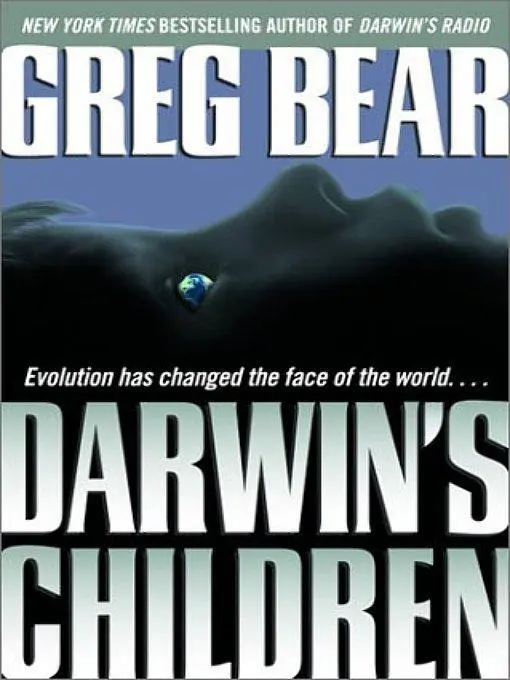
- Название:Darwin's Children
- Автор:
- Издательство:Del Rey Books
- Жанр:
- Год:2010
- Город:New York
- ISBN:9780345448361
- Рейтинг книги:3 / 5. Голосов: 1
-
Избранное:Добавить в избранное
- Отзывы:
-
Ваша оценка:
Darwin's Children: краткое содержание, описание и аннотация
Предлагаем к чтению аннотацию, описание, краткое содержание или предисловие (зависит от того, что написал сам автор книги «Darwin's Children»). Если вы не нашли необходимую информацию о книге — напишите в комментариях, мы постараемся отыскать её.
, painted a chilling portrait of humankind on the threshold of a radical leap in evolution—one that would alter our species forever. Now Bear continues his provocative tale of the human race confronted by an uncertain future, where “survival of the fittest” takes on astonishing and controversial new dimensions.
Eleven years have passed since SHEVA, an ancient retrovirus, was discovered in human DNA—a retrovirus that caused mutations in the human genome and heralded the arrival of a new wave of genetically enhanced humans. Now these changed children have reached adolescence… and face a world that is outraged about their very existence. For these special youths, possessed of remarkable, advanced traits that mark a major turning point in human development, are also ticking time bombs harboring hosts of viruses that could exterminate the “old” human race.
Fear and hatred of the virus children have made them a persecuted underclass, quarantined by the government in special “schools,” targeted by federally sanctioned bounty hunters, and demonized by hysterical segments of the population. But pockets of resistance have sprung up among those opposed to treating the children like dangerous diseases—and who fear the worst if the government’s draconian measures are carried to their extreme.
Scientists Kaye Lang and Mitch Rafelson are part of this small but determined minority. Once at the forefront of the discovery and study of the SHEVA outbreak, they now live as virtual exiles in the Virginia suburbs with their daughter, Stella—a bright, inquisitive virus child who is quickly maturing, straining to break free of the protective world her parents have built around her, and eager to seek out others of her kind.
But for all their precautions, Kaye, Mitch, and Stella have not slipped below the government’s radar. The agencies fanatically devoted to segregating and controlling the new-breed children monitor their every move—watching and waiting for the opportunity to strike the next blow in their escalating war to preserve “humankind” at any cost. DARWIN’S CHILDREN
Darwin's Children — читать онлайн ознакомительный отрывок
Ниже представлен текст книги, разбитый по страницам. Система сохранения места последней прочитанной страницы, позволяет с удобством читать онлайн бесплатно книгу «Darwin's Children», без необходимости каждый раз заново искать на чём Вы остановились. Поставьте закладку, и сможете в любой момент перейти на страницу, на которой закончили чтение.
Интервал:
Закладка:
“His home,” Kaye said. “It’s an old number. I’m not sure where he works now.”
The doctor had dialed up a sentinel CDC report page on his Web phone. “There’s no warning posted,” he said. “But I’ve never seen pediatric warnings for virus children.”
“New children,” George corrected.
“Is it a reportable disease?” Kaye asked.
“It’s not even listed,” the doctor said, but there was something in his face that disturbed Kaye. The NuTest. It’s got a GPS and a broadband hookup to the Department of Health. And from there, to NIH or the CDC. I’m sure of it.
But there was nothing they could do. She shrugged it off.
“Call,” Mitch told Kaye.
“I don’t know who he’s working for now,” Kaye said.
“We have a secure satellite phone,” George said. “No one will back trace. Not that it matters, for us. Our son is already in a camp.”
“There is nothing secure,” Mitch said.
George seemed about to debate this slur on his masculine grasp of crypto-technology.
Kaye held up her hand. “I’ll call,” she said. It would be the first time she had spoken with Christopher Dicken in over nine years.
But all she got was the answering machine in his apartment. “This is Christopher. I’m on the road. My house is occupied by cops and wrestlers. Better yet, remember that I collect strange plagues and store them next to my valuables. Please leave your message.”
“Christopher, this is Kaye. Our daughter is sick. Coxsackie something. Call if you have any clues or advice.”
And she left the number.
35
OHIO
The infirmary stood adjacent to the southwest corner of the equipment barn: two blocks connected by a short corridor with barred windows. The bright security lights drew angular trapezoids of shadow over the concrete courtyard between the buildings, obscuring a lone boy. Tall and chunky, about ten years old, he leaned or slumped against the door to the research wing, arms folded.
“Who’s that?” Middleton called out.
“Toby Smith, ma’am,” the boy said, standing straight. He wobbled and stared at them with tired, blank eyes.
“You sick, Toby?”
“I’m fine, ma’am.”
“Where’s the doctor?” Middleton pulled the cart up ten feet from the boy. Dicken saw the boy’s pallid cheeks, almost free of freckles.
The boy turned and pointed into the research wing. “Doctor Kelson is in the gym. My sister’s dead,” he said.
“I’m sorry to hear that, Toby,” Dicken said, swinging out of the seat of the golf cart. “I’m very sorry to hear it. My sister died some time ago.”
Dicken approached him. The boy’s eyes were rheumy and crusted.
“What did your sister die of?” Toby asked, squinting at Dicken.
“A disease she caught from a mosquito bite. It was called West Nile Virus. May I see your fingers, Toby?”
“No.” The boy hid his hands behind his back. “I don’t want you to shoot me.”
“You ignore that crap, Toby,” Middleton said. “I won’t let them shoot anybody.”
“May I see, Toby?” Dicken persisted. He removed his goggles. Something in his tone, some sympathy, or perhaps the way he smelled—if Toby could still smell him—made the boy look up at Dicken with narrowed eyes and present his hands. Dicken gently reversed the boy’s hand and inspected the palm and the skin between the fingers. No lesions. Toby screwed up his face and wriggled his fingers.
“You’re a strong young man, Toby,” Dicken said.
“I’ve been in the infirmary, helping, and now I’m on break,” Toby said. “I should go back.”
“The kids are so gentle,” DeWitt said. “They bond so tight, like family, all of them. Tell that to the world out there.”
“They don’t want to listen,” Dicken said under his breath.
“They’re scared,” Augustine said.
“Of me?” Toby asked.
The cart’s small walkie-talkie squawked. Middleton pulled away to answer. Her lips drew together as she listened. Then she turned to Augustine. “Security saw the director’s car go out the south entrance ten minutes ago. He was alone. They think he’s skipped.”
Augustine closed his eyes and shook his head. “Someone alerted him. The governor has probably ordered complete quarantine. We’re on our own, for the time being.”
“Then we have to move fast,” Dicken said. “I need specimens from the remaining staff, and from as many of the children as is practical. I need to learn where this virus came from. Maybe we can get word out and stop this insanity. Have the children in special treatment had contact with the children outside?”
“None that I’ve heard of,” Middleton said. “But I am not responsible for that building. That was Aram Jurie’s domain. He and Pickman were part of Trask’s inner circle.”
“Pickman and Jurie said the specials should be kept separate,” DeWitt added. “Something about mental disease being additive in SHEVA children. I think they were interested in the effects of madness and stress.”
Viral triggers, Dicken thought. He was torn between disgust and elation. He might find all the clues he needed, after all. “Who’s there now?”
“There are six nurses left, I think.” Middleton looked away, tears brimming.
“I’ll need specimens from those nurses in particular. Nose swabs, fingernail scrapings, sputum, and blood. I think we should do that now.”
“Christopher is the point man,” Augustine said. “Do whatever he asks.”
“I can take you,” DeWitt said. She squeezed Middleton’s arm supportively. “Yolanda wants to get back to the kids. They need her. I’m baggage for now.”
“Let’s go,” Dicken said. He walked over to Toby. “Thank you, Toby. You’ve been very helpful.”
36
PENNSYLVANIA
George Mackenzie shook Mitch’s shoulder. Mitch lurched up in the bed. The pastel walls of the tidy bedroom swam around him; he did not feel at all rested. He had fallen asleep without pulling back the covers on the bed, still dressed in his rumpled Mr. Smith suit.
“Where’s Kaye? How long have I been asleep?”
“She’s with your daughter,” George said. He looked miserable. “You’ve been out about an hour. Sorry to wake you. Come take a look at the TV.”
Mitch walked into the next room first. Kaye sat on the side of the bed, hands folded between her knees, head bowed. She looked up as Mitch checked Stella, now under the covers. He felt Stella’s forehead. “Fever’s down.”
“Broke about an hour ago. I think. Iris brought some tea and we just sat with her.”
Mitch stared at his daughter’s sleeping face, so pale on the sky blue pillow, topped by a damp, matted thatch of hair. Her breath came in ragged puffs. “What’s with that?”
“She’s been breathing that way since the fever broke. She’s not badly congested. I don’t know what it means. The doctor said he’d be back…” She checked the clock on the nightstand. “By now.”
“He hasn’t come,” George said. “I don’t think he’s going to.”
“George wants me to watch the news,” Mitch said.
Kaye nodded and waved her hand; she would stay.
George led Mitch down the hall to the den and the flat wall-mounted screen. Huge faces sat behind a fancy rosewood desk, talking… Mitch tried to focus.
“I am as liberal as the next fellow, but this scares me,” said a middle-aged male sporting a crew cut. Mitch did not watch much television and did not know who this was.
“Brent Tucker, commentator for Fox Broadband,” George explained. “He’s interviewing a school doctor from Indiana. That’s where our son, Kelly, is.”
Читать дальшеИнтервал:
Закладка:
Похожие книги на «Darwin's Children»
Представляем Вашему вниманию похожие книги на «Darwin's Children» списком для выбора. Мы отобрали схожую по названию и смыслу литературу в надежде предоставить читателям больше вариантов отыскать новые, интересные, ещё непрочитанные произведения.




Обсуждение, отзывы о книге «Darwin's Children» и просто собственные мнения читателей. Оставьте ваши комментарии, напишите, что Вы думаете о произведении, его смысле или главных героях. Укажите что конкретно понравилось, а что нет, и почему Вы так считаете.