Greg Bear - Darwin's Children
Здесь есть возможность читать онлайн «Greg Bear - Darwin's Children» — ознакомительный отрывок электронной книги совершенно бесплатно, а после прочтения отрывка купить полную версию. В некоторых случаях можно слушать аудио, скачать через торрент в формате fb2 и присутствует краткое содержание. Город: New York, Год выпуска: 2010, ISBN: 2010, Издательство: Del Rey Books, Жанр: Фантастика и фэнтези, на английском языке. Описание произведения, (предисловие) а так же отзывы посетителей доступны на портале библиотеки ЛибКат.
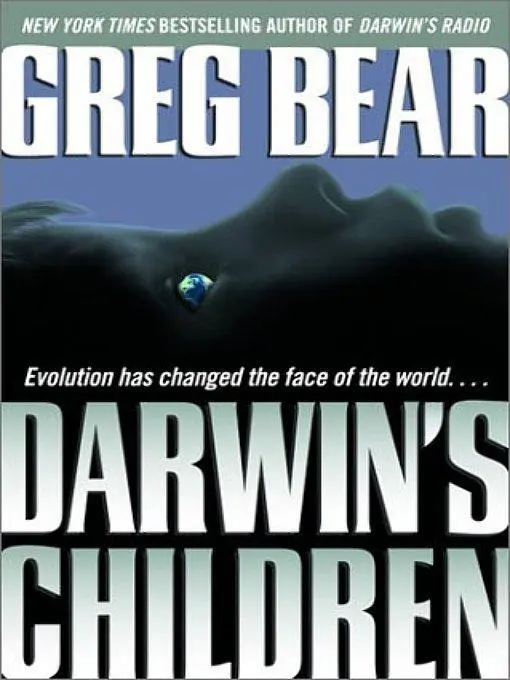
- Название:Darwin's Children
- Автор:
- Издательство:Del Rey Books
- Жанр:
- Год:2010
- Город:New York
- ISBN:9780345448361
- Рейтинг книги:3 / 5. Голосов: 1
-
Избранное:Добавить в избранное
- Отзывы:
-
Ваша оценка:
Darwin's Children: краткое содержание, описание и аннотация
Предлагаем к чтению аннотацию, описание, краткое содержание или предисловие (зависит от того, что написал сам автор книги «Darwin's Children»). Если вы не нашли необходимую информацию о книге — напишите в комментариях, мы постараемся отыскать её.
, painted a chilling portrait of humankind on the threshold of a radical leap in evolution—one that would alter our species forever. Now Bear continues his provocative tale of the human race confronted by an uncertain future, where “survival of the fittest” takes on astonishing and controversial new dimensions.
Eleven years have passed since SHEVA, an ancient retrovirus, was discovered in human DNA—a retrovirus that caused mutations in the human genome and heralded the arrival of a new wave of genetically enhanced humans. Now these changed children have reached adolescence… and face a world that is outraged about their very existence. For these special youths, possessed of remarkable, advanced traits that mark a major turning point in human development, are also ticking time bombs harboring hosts of viruses that could exterminate the “old” human race.
Fear and hatred of the virus children have made them a persecuted underclass, quarantined by the government in special “schools,” targeted by federally sanctioned bounty hunters, and demonized by hysterical segments of the population. But pockets of resistance have sprung up among those opposed to treating the children like dangerous diseases—and who fear the worst if the government’s draconian measures are carried to their extreme.
Scientists Kaye Lang and Mitch Rafelson are part of this small but determined minority. Once at the forefront of the discovery and study of the SHEVA outbreak, they now live as virtual exiles in the Virginia suburbs with their daughter, Stella—a bright, inquisitive virus child who is quickly maturing, straining to break free of the protective world her parents have built around her, and eager to seek out others of her kind.
But for all their precautions, Kaye, Mitch, and Stella have not slipped below the government’s radar. The agencies fanatically devoted to segregating and controlling the new-breed children monitor their every move—watching and waiting for the opportunity to strike the next blow in their escalating war to preserve “humankind” at any cost. DARWIN’S CHILDREN
Darwin's Children — читать онлайн ознакомительный отрывок
Ниже представлен текст книги, разбитый по страницам. Система сохранения места последней прочитанной страницы, позволяет с удобством читать онлайн бесплатно книгу «Darwin's Children», без необходимости каждый раз заново искать на чём Вы остановились. Поставьте закладку, и сможете в любой момент перейти на страницу, на которой закончили чтение.
Интервал:
Закладка:
Phenotype:the physical structure of an organism or distinctive group of organisms. Genotype expressed and developed within an environment determines phenotype.
Pheromone:a chemical message produced by one member of a species that influences the physiology and the behavior of another member of the same species. Whether or not this chemical message is consciously detected (smelled), pheromones have the same effect. Mammalian pheromones, in the form of “social odors,” that one member of a species is exposed to during interaction with another member of the species, cause changes in hormone levels and in behavior. See vomeropherin.
Polyploidy:see chromosome.
Protein:genes often code for proteins, which help form and regulate all organisms. Proteins are molecular machines made up of chains of twenty different types of amino acids. Proteins can themselves chain or clump together. Collagen, enzymes, many hormones, keratin, and antibodies are just a few of the different types of proteins.
Proteome, Proteomics:the total complement of proteins within a cell or group of cells, or in an individual organism as a whole. Different tissues will produce different proteins from a standardized set of genes; gene activation in different tissues at different times causes variation in a cell’s proteome. Knowing which genes have been activated can be traced through identifying proteins and other gene products. (See glycome and lipidome .)
Provirus:the genetic code of a virus while it is contained within the DNA of a host.
Radiology:imaging of the interior of a body using radiation, such as X-rays, PET scans (positron emission tomography), MRI (Magnetic resonance imaging), CAT scans (Computerized axial tomography), etc.
Recombination:exchange of genes between or within organisms or viruses. Sexual reproduction is one such exchange; bacteria and viruses can recombine genes in many different ways. Recombination can also be done artificially in a laboratory.
Retrotransposon, retroposon, retrogene:see movable elements .
Retrovirus:RNA-based virus that inserts its code into a host’s DNA for later replication. Replication can often be delayed for years. AIDS and other diseases are caused by retroviruses.
RNA:ribonucleic Acid. Intermediate copy of DNA; messenger RNA (mRNA) is used by ribosomes as templates to construct proteins. Many viruses consist of single or doubled strands of RNA, usually transcribed to DNA within the host.
SHEVA:fictional human endogenous retrovirus that can form an infectious virus particle, or virion ; an infectious HERV. No such HERV is yet known. In Darwin’s Radio and this novel, SHEVA carries first-order instructions between individuals for a rearrangement of the genome that produces a new variety of human. In effect, SHEVA triggers preexisting genetic “set-asides” that interact in time-proven ways to create a subtly different human phenotype.
Sequencing:determining the sequence of molecules in a polymer such as a protein or nucleic acid; in genetics, discovering the sequence of bases in a gene or a length of DNA or RNA, or in the genome as a whole. Research into the sequence of the entire human genome has made huge strides, but our understanding of the implications of this growing knowledge is in its infancy.
Sex chromosomes:in humans, the X and Y chromosomes. Two X chromosomes results in a female; an X and a Y results in a male. Other species have different types of sex chromosomes.
Shiver:hypothetical activation of dormant endogenous retroviruses in women who have undergone SHEVA pregnancies. Recombination of exogenous and endogenous viral genes may produce new viruses with an unknown pathogenic potential.
Transposon:see mobile elements .
Vaccine:a substance that produces an immune response to a disease-causing organism. See antibody , antigen, immune response .
Virion:infectious virus particle.
Virus:nonliving but organically active particle capable of entering a cell and commandeering the cell’s reproductive capacity to produce more viruses. Viruses consist of DNA or RNA, usually surrounded by a protein coat, or capsid. This capsid may in turn be surrounded by an envelope. There are hundreds of thousands of known viruses, and potentially millions not yet described. See exogenous virus , ERV.
Vomeronasal organ (VNO, also known as Jacobson’s organ):consisting of two pitlike openings in the roof of the mouth or in the nasal septum, this organ, in non-human mammals, provides a pathway that links pheromones to a hormone response and to sex differences in behavior . “Frithing” is a term used to describe sucking in air over the pit-like entrance to this organ, which is in the roof of the mouth in some animals. Cats can sometimes be observed curling their upper lip when smelling something funky; this is also called the flehman response, usually associated with examination of urine, marking scents, etc. Snakes perform similar sampling by drawing in scents from the air on their flicking tongues. Humans have vomeronasal pits, though they are very small and somewhat difficult to find; they may play a role in mate choice and other behaviors. A 1995 journal article warned plastic surgeons to preserve the human vomeronasal organ during reconstructive surgery, lest damage lead to loss of sexual interest and subsequent litigation.
Vomeropherin:a marketing term for a pheromone detected by the human vomeronasal organ (the same as a mammalian pheromone detected by the mammalian VNO).
Xenotransplant:transplant of nonhuman tissues and organs into humans. Xenotransplants in the past have involved baboon and other ape organs. Most xenotransplant research now focuses on pig tissues and organs. Xenotransplants could be risky because of the existence of latent viruses within the donor tissues. (See ERV , herpes, PERV .) The case of Mrs. Carla Rhine described in this novel is unlikely in real life; Mrs. Rhine’s maladies come from the unfortunate combination of a relatively rare evolutionary viral event and transplantation. Nevertheless, the possibilities of viral contamination or viral recombination within human recipients of animal tissues is very real, and demands further research.
ACKNOWLEDGMENTS
Special thanks to Mark Minie, Ph.D., and Rose James, Ph.D.; Deirdre V. Lovecky, Ph.D.; Dr. Joseph Miller; Dominic Esposito of the National Cancer Institute; Dr. Elizabeth Kutter; Cleone Hawkinson; Alison Stenger, Ph.D.; David and Diane Clark; Brian W. J. Mahy, Ph.D., Sc.D., director of the Division of Viral and Rickettsial Diseases at the Center for Disease Control; Karl H. Anders, M.D.; Sylvia Anders, M.D.; Howard Bloom and the International Paleopsychology Project; Cynthia Robbins-Roth, Ph.D., James V. Kohl, Oliver Morton, Karen Anderson, Lynn Caporale, and Roger Brent, Ph.D.
A BRIEF READING LIST
Aconcise, elegantly written and conservative view of neo-Darwinian evolutionary theory is available in Richard Dawkins’s River out of Eden: A Darwinian View of Life , BasicBooks, 1995. Dawkins is one of our best science writers and an excellent whetstone for anyone wishing to challenge institutionalized views of biology and evolution. It is my belief that he is wrong on many points, but he defines the debate in ways few others can.
Читать дальшеИнтервал:
Закладка:
Похожие книги на «Darwin's Children»
Представляем Вашему вниманию похожие книги на «Darwin's Children» списком для выбора. Мы отобрали схожую по названию и смыслу литературу в надежде предоставить читателям больше вариантов отыскать новые, интересные, ещё непрочитанные произведения.







Обсуждение, отзывы о книге «Darwin's Children» и просто собственные мнения читателей. Оставьте ваши комментарии, напишите, что Вы думаете о произведении, его смысле или главных героях. Укажите что конкретно понравилось, а что нет, и почему Вы так считаете.