Greg Bear - Darwin's Children
Здесь есть возможность читать онлайн «Greg Bear - Darwin's Children» — ознакомительный отрывок электронной книги совершенно бесплатно, а после прочтения отрывка купить полную версию. В некоторых случаях можно слушать аудио, скачать через торрент в формате fb2 и присутствует краткое содержание. Город: New York, Год выпуска: 2010, ISBN: 2010, Издательство: Del Rey Books, Жанр: Фантастика и фэнтези, на английском языке. Описание произведения, (предисловие) а так же отзывы посетителей доступны на портале библиотеки ЛибКат.
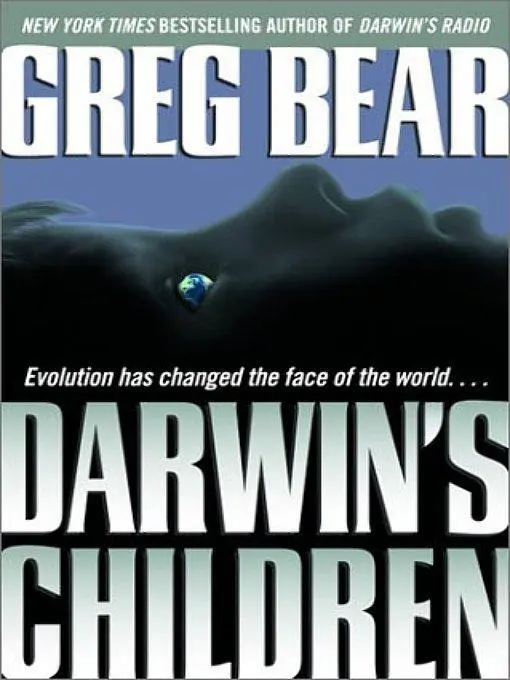
- Название:Darwin's Children
- Автор:
- Издательство:Del Rey Books
- Жанр:
- Год:2010
- Город:New York
- ISBN:9780345448361
- Рейтинг книги:3 / 5. Голосов: 1
-
Избранное:Добавить в избранное
- Отзывы:
-
Ваша оценка:
Darwin's Children: краткое содержание, описание и аннотация
Предлагаем к чтению аннотацию, описание, краткое содержание или предисловие (зависит от того, что написал сам автор книги «Darwin's Children»). Если вы не нашли необходимую информацию о книге — напишите в комментариях, мы постараемся отыскать её.
, painted a chilling portrait of humankind on the threshold of a radical leap in evolution—one that would alter our species forever. Now Bear continues his provocative tale of the human race confronted by an uncertain future, where “survival of the fittest” takes on astonishing and controversial new dimensions.
Eleven years have passed since SHEVA, an ancient retrovirus, was discovered in human DNA—a retrovirus that caused mutations in the human genome and heralded the arrival of a new wave of genetically enhanced humans. Now these changed children have reached adolescence… and face a world that is outraged about their very existence. For these special youths, possessed of remarkable, advanced traits that mark a major turning point in human development, are also ticking time bombs harboring hosts of viruses that could exterminate the “old” human race.
Fear and hatred of the virus children have made them a persecuted underclass, quarantined by the government in special “schools,” targeted by federally sanctioned bounty hunters, and demonized by hysterical segments of the population. But pockets of resistance have sprung up among those opposed to treating the children like dangerous diseases—and who fear the worst if the government’s draconian measures are carried to their extreme.
Scientists Kaye Lang and Mitch Rafelson are part of this small but determined minority. Once at the forefront of the discovery and study of the SHEVA outbreak, they now live as virtual exiles in the Virginia suburbs with their daughter, Stella—a bright, inquisitive virus child who is quickly maturing, straining to break free of the protective world her parents have built around her, and eager to seek out others of her kind.
But for all their precautions, Kaye, Mitch, and Stella have not slipped below the government’s radar. The agencies fanatically devoted to segregating and controlling the new-breed children monitor their every move—watching and waiting for the opportunity to strike the next blow in their escalating war to preserve “humankind” at any cost. DARWIN’S CHILDREN
Darwin's Children — читать онлайн ознакомительный отрывок
Ниже представлен текст книги, разбитый по страницам. Система сохранения места последней прочитанной страницы, позволяет с удобством читать онлайн бесплатно книгу «Darwin's Children», без необходимости каждый раз заново искать на чём Вы остановились. Поставьте закладку, и сможете в любой момент перейти на страницу, на которой закончили чтение.
Интервал:
Закладка:
He made a path through the crowd for the people Eileen pointed out, holding her hand over their heads and nodding.
“Coming through,” Carlton said, and they climbed the aluminum steps. He was the last.
Stella looked down on the excavation. At first, all she saw was a large jumble of dark bones on hard planed dirt, mud, and what looked like old ash. She could smell the dust. Nothing more.
Mitch and Kaye stood across from her, Celia and LaShawna beside her; John Hamilton and Senator Bloch, both very quiet, were catercorner on the scaffold beside Carlton. Oliver Merton was staying out of the way, standing alone in one corner with arms crossed.
Eileen and Connie Fitz and Laura Bloch had also stayed below. It was now Carlton’s show.
“There are eight adult females and two children, one male and one female, in this grouping,” Carlton said. “A lahar of volcanic gas and mud and water came roaring down this river bed about twenty thousand years ago. They died together, covered with hot mud. One of them dropped a woven grass basket. Its mold is still in that cube of unexcavated mudstone to the right. The woman on top of the group—she’s marked with a red plastic square, and her outline is made more clear by the thin strip of blue tape—is taller and more robust; she’s Homo erectus , a late stage variety similar to heidelbergensis but as yet without a scientific designation. She appears to be in her forties, well past child bearing and very old for the time. A grandma type. We think she was protecting the children, and perhaps two other women. The female child and the other females are all Homo sapiens , virtually indistinguishable from you and me. The male child is another Homo erectus.
“At first, we thought—Connie and Eileen and the pioneers at this site thought, that is; I’m sort of late here—that there were only females, that the males had run off and abandoned them. Later, Mr. Rafelson found the first signs of the males, not far away and across the river. We thought they might have been out hunting and coming back to their females. Well, that may still be the case, but there was a lot more going on. We’ve since excavated thirteen sites around the Spent River, all within a thousand yards of here. We’ve found a total of fifty-three whole skeletons and perhaps seventy partials, a bit of femur or skull cap or tooth here and there.
“This was a kind of village, set up in the autumn to take advantage of salmon runs in the river. Family groups made camp along a loose network of trails, waiting for the run to begin. They were caught by the volcanic eruption and frozen in time, for us to find, and to reacquaint ourselves with… well, I think of them as old friends. Old teachers, actually.”
Stella glanced at Mitch and saw a tear on his cheek.
Carlton paused to gather his thoughts. Celia was transfixed and maybe a little frightened by this big, rough-looking male. Her jaw hung open. LaShawna was frowning in concentration.
“And what they teach us now is pretty simple. They were traveling as equals. Personally, I don’t know what they were offering each other. But we’ve found roughly equal numbers of both species, erectus and sapiens . There are children of both species, and males as well. Our first site was anomalous. If I could make a guess…”
“He’s a lot like you, Mitch,” Eileen called from the crowd below the scaffold.
Carlton smiled shyly. “I’d say maybe the erectus individuals worked as hunters, using tools made by the sapiens . We haven’t finished analyzing one of the outermost digs yet, a hunting party, but it looks like some of the erectus females served as lead hunters. They carried flint knapping tools and the heavy weapons and some stones that might or might not be hunting charms. That’s right. Tall girls with great sniffers leading the brainy boys.
“We’re looking for a central butchering ground for game—usually near where the large cutting tools were manufactured. In those days hunters tended to carry big game back to the village and butcher it in a protected area. We aren’t sure why—either they hadn’t yet thought of carrying the butchering tools with them, or they were trying to avoid attracting large predators.
“The sapiens females cooperated in weaving grass and leather and bark and preparing the fish and gathering berries and bugs and such around the camps. We’ve found beetles and grubs and grass and blackberry seeds in some of the baskets. Everyone had their place. They worked together.”
“So should we all,” said Senator Bloch, and Stella could see that she, too, was deeply moved.
Stella did not know what to think. The bones were still a tangle, as were her thoughts.
“As we reveal the bones, remove the overburden and brush them clean, we don’t know what beliefs they held, twenty thousand years ago,” Carlton said softly. “So basically we just respect them with silence, for a while, and gratitude. We get acquainted, as it were. They were not our direct ancestors, of course—we’ll probably never find direct ancestors that old. It would be like digging up needles in a mighty sparse and distributed haystack.
“But the people down here, and all around the Spent River, they’re still us . Nobody owns them. But they’re family.” Carlton nodded to his own strong convictions.
“Amen,” Eileen and Connie Fitz said simultaneously below the scaffold.
Stella saw her father’s hands on the rail. His knuckles were white and he was staring directly at her. Stella leaned her head to one side. He moved his lips. She could easily tell what he was saying.
Human.
Eileen and Laura Bloch and Mitch watched as the photographers arranged Kaye and the girls at the base of the mesa, standing in front of the scaffolding. No pictures of the bones were being allowed.
“Rumor has it Kaye met God,” Eileen said in a low voice to Mitch. “Is it true?”
“So she tells me.”
“That’s got to be awkward for a scientist,” Eileen said.
“She’s doing okay,” Mitch said. “She calls it just another kind of inspiration.”
Senator Bloch listened to this with a focused pug-dog expression.
“What about you?” Eileen asked.
“I remain blissfully ignorant.”
“Kind of a sometime thing, huh?”
Bloch weighed in. “That can’t be bad,” she mused. “Not for politics. Did she see Jesus?”
Mitch shook his head. “I don’t think so. That’s not what she says, anyway.”
Bloch pouched out her lips. “If there’s no Jesus, we best keep it under our hats for now.”
“What does God tell her about all of this?” Eileen asked, sweeping her hand over the excavations, the revealed bones.
Mitch scowled. “Not much, probably. It doesn’t seem to be that kind of relationship.”
“What good is he, then?” Eileen asked petulantly.
Mitch had to look hard to tell if she was joking. She appeared to be, and she lost interest as some photographers came too near a grid square propped against a table and almost knocked it over.
After berating them and resetting the square, she came back and patted Mitch on the shoulder. “Good for Kaye,” she said. “Just proves that we’re a tough old species. We can survive anything, even God. How about you? Going to come back soon and dig with us?” Eileen asked.
“No,” Mitch said. “That’s over for me.”
“Shame. He was the best,” Eileen said to Bloch. “A real natural.”
Mitch helped Kaye back into the van. Kaye sat and massaged her calves. Her feet were numb and she had had a difficult time climbing the stairs out of the shelter.
Stella and Celia and LaShawna walked in a tight cluster to the van and climbed in behind her, then sat quietly. John Hamilton and Mitch stood talking as they waited for Bloch to rejoin them.
Читать дальшеИнтервал:
Закладка:
Похожие книги на «Darwin's Children»
Представляем Вашему вниманию похожие книги на «Darwin's Children» списком для выбора. Мы отобрали схожую по названию и смыслу литературу в надежде предоставить читателям больше вариантов отыскать новые, интересные, ещё непрочитанные произведения.






Обсуждение, отзывы о книге «Darwin's Children» и просто собственные мнения читателей. Оставьте ваши комментарии, напишите, что Вы думаете о произведении, его смысле или главных героях. Укажите что конкретно понравилось, а что нет, и почему Вы так считаете.