Robert Sawyer - Foreigner
Здесь есть возможность читать онлайн «Robert Sawyer - Foreigner» весь текст электронной книги совершенно бесплатно (целиком полную версию без сокращений). В некоторых случаях можно слушать аудио, скачать через торрент в формате fb2 и присутствует краткое содержание. Год выпуска: 1994, ISBN: 1994, Издательство: Ace Books, Жанр: Фантастика и фэнтези, на английском языке. Описание произведения, (предисловие) а так же отзывы посетителей доступны на портале библиотеки ЛибКат.
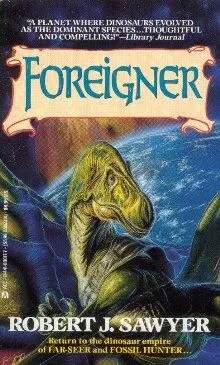
- Название:Foreigner
- Автор:
- Издательство:Ace Books
- Жанр:
- Год:1994
- ISBN:0-441-00017-7
- Рейтинг книги:3 / 5. Голосов: 1
-
Избранное:Добавить в избранное
- Отзывы:
-
Ваша оценка:
Foreigner: краткое содержание, описание и аннотация
Предлагаем к чтению аннотацию, описание, краткое содержание или предисловие (зависит от того, что написал сам автор книги «Foreigner»). Если вы не нашли необходимую информацию о книге — напишите в комментариях, мы постараемся отыскать её.
trilogy depicts an Earth-like world on a moon which orbits a gas giant, inhabited by a species of highly evolved, sentient Tyrannosaurs called Quintaglios, among various other creatures from the late cretaceous period, imported to this moon by aliens 65 million years prior to the story.
Foreigner — читать онлайн бесплатно полную книгу (весь текст) целиком
Ниже представлен текст книги, разбитый по страницам. Система сохранения места последней прочитанной страницы, позволяет с удобством читать онлайн бесплатно книгу «Foreigner», без необходимости каждый раз заново искать на чём Вы остановились. Поставьте закладку, и сможете в любой момент перейти на страницу, на которой закончили чтение.
Интервал:
Закладка:
Five days.
Novato sighed.
Still, in that time she’d seen a lot of wonderful sights. While looking down, she’d seen a streak through the night sky, over the vast body of water. She realized it must have been a large meteor, seen from above. And, with the aid of the far-seer, she was able to make out the crimson points of erupting volcanoes in Edz’toolar—something Toroca had said was long overdue. She even saw an eclipse from in the middle, as another moon, the Big One, passed directly overhead at noon, its circular black shadow moving rapidly across Land.
She looked down again.
Her blood ran cold.
The tower, this marvelous tower to the stars, now appeared to be bowing out as if it were about to fold over and break in half. She’d thought at first that it was an optical illusion: the curving horizon line made it difficult to tell by sight if the tower was truly straight, but as the bowing became more pronounced, there could be no mistake.
She’d known what her daughter Karshirl had said: the tower was unstable. There was no way for something so tall and so narrow to stand without buckling, and yet she’d been fool enough to think that whatever magic had held it against its own weight so far would continue to keep it erect for the duration of her voyage.
Her first thought was that she was going to die, plummeting back to the ground at a dizzying speed. Her second thought was that hundreds of people would die when giant pieces of the tower fell out of the sky.
She felt herself slowly being pushed up toward the ceiling. She saw now that the tower was bowing the other way farther down, as if it were a great blue snake, undulating its way to the stars. After a time, she began drifting toward the floor again.
And then Novato realized what was happening.
Erupting volcanoes in Edz’toolar, the province next to Fra’toolar, where the tower was anchored.
Landquake.
What she was seeing was the rippling of the landquake being transferred up the structure of the tower. The first wave had yet to reach her. She could see another huge wave rolling up behind it, the tower bowing first to the east then to the west like a string plucked by a giant’s hand. In addition, the tower was moving up and down in longitudinal compression waves.
But something else was happening. White gas was shooting out of the copper cones that projected from every fifth strut up the tower’s length. She’d seen little puffs shoot out from time to time during her ascent, but these were massive exhalations, geysers against the night.
Novato saw a dent appear in the crest of the wave that was hurtling toward her, saw the tower material bow inward, moving in the opposite direction of the gas plume, saw the one giant wave become two smaller ones, with lesser crests and shorter lengths. And then it happened again, slowly, majestically, the waves splitting once more into new waves half as long and half as tall. When the disturbance did reach her, the lifeboat simply rose and fell gently, like a sailing ship rolling on a swell.
The waves continued to dampen out. Soon, the jets of white fog coming from the copper cones became smaller and less frequent.
And it hit her, all at once: how the tower had remained standing, and what those occasional puffs of gas she’d seen venting from ihe cones had meant.
When the tower began leaning to the left, compressed gas nudged it to the right. When it began to topple to the right, a jet of air pushed it to the left. Along its whole length, the tower was constantly adjusting its orientation. Karshirl had been correct: no normal structure as long and thin as this one could stand. Like the mythical Tower of Howlee, it would buckle, regardless of the strength of the building material. But that had assumed that the tower was passive—and this tower was not. It was—the thought was incredible—it was alive, in a very real sense, constantly detecting shifts in its attitude and compensating for them with jets of air. Even the giant shifts caused by a landquake rippling up its length were dampened by this process.
Whoever had built the ancient blue ark had been incredibly advanced. They had plied the distance between stars, something Novato was only beginning to comprehend the difficulty of doing. They had created the strange and wonderful dust that had built this massive tower, an object longer than the world was wide. Nor was it any ordinary object; it was smart, reacting to changes in conditions.
And yet, whoever the ark-makers were, they, too, had failed. One of their arks had crashed, the crew killed, its cargo of lifeforms never released. If something could defeat the ark-makers, what chance did Quintaglios have against the fate that awaited them?
Novato hugged her arms to her body and tucked her tail between her legs. She settled slowly to the floor, afraid.
*20*
The Dasheter continued to race back toward Land, the armada of Other ships in hot pursuit. The Face of God was already half submerged below the waves. Right now, the sun was touching one horizon, and the Face, completely full, was sitting on the other. Toroca, standing on deck, cast a long shadow away from the sun, but the shadow itself was partially filled in by the soft ocher light reflecting from the Face.
Captain Keenir approached Toroca from up ahead. Even though he knew Toroca was free of territorial feeling, Keenir couldn’t overcome the ingrained protocols: whenever possible, approach from the front rather than behind.
“Beautiful sunset,” said Keenir, stopping ten paces shy of the younger Quintaglio.
Toroca nodded. “That it is.”
Keenir leaned against the gunwale. “You know,” said the captain, his gravelly voice carrying an unusual tone of reflection, “I’ve been lucky. I’m eighty-three, a lot older than I have any right to be. I’ve probably seen more sunsets from aboard a ship than any other Quintaglio alive.” He gestured at the thin line of cloud, stained dark purple against the purplish-red sky, and at the swollen egg of the sun. “Even so, I never get tired of looking at them.”
They watched the sun slip below the waves. Almost at once, the sky began to darken. Toroca turned to face Keenir. “Did you want to see me about something?”
“Yes,” said Keenir, the standard gruffness returning to his voice. “The Other infant.”
“Taksan,” said Toroca.
“You’ve named it?” said Keenir, surprised.
“Of course. And he’s a him, not an it. There is no creche master around; who else would name him?”
“I suppose,” said Keenir. Then: “What are you going to do with him?”
“What do you mean?”
Keenir exhaled noisily, as if he felt Toroca was being dense. “I mean, good Toroca, we are at war with his people. Surely the child should be disposed of.”
“What?” said Toroca, shocked.
“You made a good start when you got rid of the other two,” said Keenir. “After all, taking prisoners isn’t normal procedure.”
“There are no ‘normal procedures,’ ” said Toroca. “There has never been a war like this.”
“No, no. But in the ancient territorial conflicts, before the time of Dasan, prisoners were never taken. I mean, you can’t put a bunch of Quintaglios into a cell together; they’d kill each other.”
“Taksan is not a Quintaglio; his race is not territorial.”
“I know that,” said Keenir, a hint of exasperation in his tone. “Still, we have no facilities on this ship for holding a prisoner—”
“Stop calling him that,” said Toroca. “He is not a prisoner.”
“Well, use whatever term you want. But he is one of the enemy, and has no place aboard this ship.”
“What would you have me do, Keenir?”
“I don’t know,” said the captain, scratching the underside of his jaw. “Toss him overboard, I suppose.”
Читать дальшеИнтервал:
Закладка:
Похожие книги на «Foreigner»
Представляем Вашему вниманию похожие книги на «Foreigner» списком для выбора. Мы отобрали схожую по названию и смыслу литературу в надежде предоставить читателям больше вариантов отыскать новые, интересные, ещё непрочитанные произведения.






Обсуждение, отзывы о книге «Foreigner» и просто собственные мнения читателей. Оставьте ваши комментарии, напишите, что Вы думаете о произведении, его смысле или главных героях. Укажите что конкретно понравилось, а что нет, и почему Вы так считаете.