Robert Sawyer - Foreigner
Здесь есть возможность читать онлайн «Robert Sawyer - Foreigner» весь текст электронной книги совершенно бесплатно (целиком полную версию без сокращений). В некоторых случаях можно слушать аудио, скачать через торрент в формате fb2 и присутствует краткое содержание. Год выпуска: 1994, ISBN: 1994, Издательство: Ace Books, Жанр: Фантастика и фэнтези, на английском языке. Описание произведения, (предисловие) а так же отзывы посетителей доступны на портале библиотеки ЛибКат.
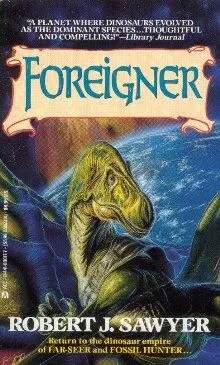
- Название:Foreigner
- Автор:
- Издательство:Ace Books
- Жанр:
- Год:1994
- ISBN:0-441-00017-7
- Рейтинг книги:3 / 5. Голосов: 1
-
Избранное:Добавить в избранное
- Отзывы:
-
Ваша оценка:
Foreigner: краткое содержание, описание и аннотация
Предлагаем к чтению аннотацию, описание, краткое содержание или предисловие (зависит от того, что написал сам автор книги «Foreigner»). Если вы не нашли необходимую информацию о книге — напишите в комментариях, мы постараемся отыскать её.
trilogy depicts an Earth-like world on a moon which orbits a gas giant, inhabited by a species of highly evolved, sentient Tyrannosaurs called Quintaglios, among various other creatures from the late cretaceous period, imported to this moon by aliens 65 million years prior to the story.
Foreigner — читать онлайн бесплатно полную книгу (весь текст) целиком
Ниже представлен текст книги, разбитый по страницам. Система сохранения места последней прочитанной страницы, позволяет с удобством читать онлайн бесплатно книгу «Foreigner», без необходимости каждый раз заново искать на чём Вы остановились. Поставьте закладку, и сможете в любой момент перейти на страницу, на которой закончили чтение.
Интервал:
Закладка:
“Yes.”
“And seven members of The Family died in that replaying.”
Afsan raised a hand. “Only six. Spenress from Chu’toolar was still alive when Dybo finally forced the blackdeath to retreat; she lives here in the Capital now.”
“Still, six deaths…”
Afsan’s tone was defensive. “There are many who said that only one of them should have been alive in the first place.”
“Of course,” said Mokleb. “Of course.” Then, a moment later, “Nonetheless… six deaths.” She tilted her head to one side and looked at Afsan. His forehead was high, his muzzle strong and firm. Perhaps this was it… “Do you,” she said casually, “feel guilt over the death of those six people?”
A lightning bolt illuminated the room, throwing everything into stark relief. Mokleb felt her heart skip, but Afsan, of course, did not react at all. “It’s an interesting question. Certainly, I dislike seeing anyone die—even someone as nasty as Rodlox.” And then the thunderclap came, loud and long, shaking the adobe walls of the building. Afsan waited for the reverberations to fade before he spoke again. “But it was necessary for the good of our people that both Dybo’s authority and the credibility of the bloodpriests be restored.”
Mokleb shook her head. She felt she was getting closer, but still, maddeningly, the answer was out of reach.
At first Novato thought she’d been imagining it, thought it had been a by-product of her excitement.
But it wasn’t. It was really happening.
She stood firmly on the lifeboat’s transparent floor and dropped a small metal tool she was holding in her left hand.
It fell.
But it fell slowly.
A day and a half had elapsed since her journey up the tower began. If she was right about the lifeboat’s speed, she was now some two thousand paces above the ground, a distance equal to one-third of the east-west length of Land.
There could be no doubt. The apparent gravity was less. Much less. The tool had seemed to fall with only half its normal speed. She stooped over and picked it up. It felt light in her hand.
Lower gravity, thought Novato. Incredible.
The tower continued up.
Novato decided she liked this lightness. It made her feel kilodays younger.
*18*
The eggling Others presented a problem.
Traditionally, shortly after a clutch of Quintaglio babies had opened their eyes, a bloodpriest would be summoned to visit the creche. The priest would meditate for daytenths, drink a sacred potion, don the purple halpataars robe, and enter the creche chamber. And then, by the flickering light of the heating fires, he’d let loose a loud roar and break into a run, sending the hatchlings scurrying to get away. One by one, he’d pounce on the egglings, slurping them down his gullet, devouring them until only one, the fastest, was left.
But in kiloday 7126, the bloodpriests had been banished from most Packs for collusion in allowing The Family’s hatchlings to forego the culling. The bloodpriests had eventually been reinstated, but Dybo had decreed that a new selection criterion—something other than physical strength—would be used in future. Toroca, originator of the theory of evolution, was charged with finding an appropriate criterion.
Toroca hadn’t done that yet, arguing that such a monumental change required considerable thought, and so, at least temporarily, the bloodpriests were culling hatchlings in the traditional way again.
And now Toroca had three baby Others in his care.
In a Quintaglio clutch, only one would be allowed to live. Should the same hold true for these Others? Toroca had seen what had happened when the bloodpriests had been banished from their Packs, when, for a time, every hatchling had been allowed to live. The population had swollen, youngsters were underfoot everywhere, and mass dagamant had gripped all of Land.
The people had been willing to accept the bloodpriests so long as they thought every clutch was subjected to their culling. But once an exception had been found, the people rose up in anger, banishing or even killing the halpataars .
And now into their midst had come a special clutch. Granted, there were only three hatchlings in it instead of the Quintaglio norm of eight. Still…
Toroca leaned on his tail, deep in thought. To risk once again to be seen playing favorites, to be killing seven out of every eight babies from Quintaglio clutches, but to let all of these offspring live… The public would be incensed, especially so soon after the scandal involving Dybo and his brothers and sisters.
And to make matters worse, Toroca was, in effect, leader of the bloodpriests until such time as he had developed a new culling criterion. For what amounted to the head bloodpriest to be seen again to be flouting the customs of the people…
And yet, these were not Quintaglio hatchlings. Their mother had been killed by a Quintaglio, the eggs had been taken, albeit accidentally, from their native land. Surely a dispensation could be made in this case, surely all three could be allowed to live…
Surely…
No.
The risk was too great. Quintaglio population controls had to be kept in place, and that meant nothing could be allowed to discredit the bloodpriests.
Toroca hated himself for what he did next, but he had no choice. At least, since the babies were only a few daytenths old, their eyes weren’t yet open; Quintaglio egglings opened their eyes about a day after leaving their shells.
Toroca swallowed one of the hatchlings, the squirming form moving down his gullet. It took a while for him to regain his nerve, but when he did he swallowed a second hatchling, leaving only one alive.
Afsan and Mokleb’s next session was held at Rockscape. The ground had not completely dried from the downpour of two days ago. Mokleb’s feet were covered with mud and her legs were soaked after making her way through tall grasses to the rock that she used, downwind of Afsan’s rock.
“You mentioned in our last session,” she said, “that the first time you’d experienced dagamant was kilodays ago, aboard the Dasheter .”
“That’s right,” said Afsan, stretching out on his boulder. “We were sailing on beyond the Face of God, something no ship had ever done before. Emperor Dybo—he was Prince Dybo back then—and I were sunning ourselves on deck when a sailor named Nor-Gampar came charging between us, in full bloodlust. Bobbing up and down from the waist, glazed eyes, claws exposed—the whole thing.”
“You were with Dybo, you say?”
“Yes.”
“But it was you who killed this Gampar?”
“Yes.”
“So you saved Dybo’s life.”
“I never thought about it that way, but, yes, I suppose I did.”
“Dybo did not repay you well.”
A few moments of quiet. “No, he did not.”
“But you killed Gampar so that the prince could live.”
“Yes.”
“Surely this went beyond simple territoriality,” said Mokleb. “You weren’t just responding to the fact that Gampar was threatening you and Dybo. There was a larger issue at stake: the need to know. You’d convinced Captain Keenir to sail around the world, something no one had ever done. Gampar objected to that.”
“Yes.”
“He stood in the way of that knowledge.”
“Yes.”
“He stood in the way of a better life for Quintaglios.”
“Yes.”
“And, well, if a few people die now and then for the good of society as a whole, that’s all right, isn’t it?”
“No.”
“Strides are never made without sacrifices. People will always die so others can live better lives.”
“No.”
“Don’t you believe that?”
“No. No, there should be alternatives. Death shouldn’t be necessary.”
Читать дальшеИнтервал:
Закладка:
Похожие книги на «Foreigner»
Представляем Вашему вниманию похожие книги на «Foreigner» списком для выбора. Мы отобрали схожую по названию и смыслу литературу в надежде предоставить читателям больше вариантов отыскать новые, интересные, ещё непрочитанные произведения.







Обсуждение, отзывы о книге «Foreigner» и просто собственные мнения читателей. Оставьте ваши комментарии, напишите, что Вы думаете о произведении, его смысле или главных героях. Укажите что конкретно понравилось, а что нет, и почему Вы так считаете.