Robert Sawyer - Foreigner
Здесь есть возможность читать онлайн «Robert Sawyer - Foreigner» весь текст электронной книги совершенно бесплатно (целиком полную версию без сокращений). В некоторых случаях можно слушать аудио, скачать через торрент в формате fb2 и присутствует краткое содержание. Год выпуска: 1994, ISBN: 1994, Издательство: Ace Books, Жанр: Фантастика и фэнтези, на английском языке. Описание произведения, (предисловие) а так же отзывы посетителей доступны на портале библиотеки ЛибКат.
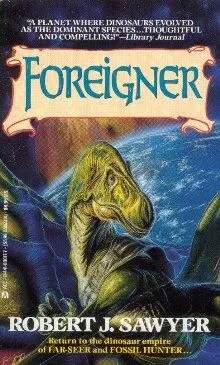
- Название:Foreigner
- Автор:
- Издательство:Ace Books
- Жанр:
- Год:1994
- ISBN:0-441-00017-7
- Рейтинг книги:3 / 5. Голосов: 1
-
Избранное:Добавить в избранное
- Отзывы:
-
Ваша оценка:
Foreigner: краткое содержание, описание и аннотация
Предлагаем к чтению аннотацию, описание, краткое содержание или предисловие (зависит от того, что написал сам автор книги «Foreigner»). Если вы не нашли необходимую информацию о книге — напишите в комментариях, мы постараемся отыскать её.
trilogy depicts an Earth-like world on a moon which orbits a gas giant, inhabited by a species of highly evolved, sentient Tyrannosaurs called Quintaglios, among various other creatures from the late cretaceous period, imported to this moon by aliens 65 million years prior to the story.
Foreigner — читать онлайн бесплатно полную книгу (весь текст) целиком
Ниже представлен текст книги, разбитый по страницам. Система сохранения места последней прочитанной страницы, позволяет с удобством читать онлайн бесплатно книгу «Foreigner», без необходимости каждый раз заново искать на чём Вы остановились. Поставьте закладку, и сможете в любой момент перейти на страницу, на которой закончили чтение.
Интервал:
Закладка:
“I’d forgotten that Lubal had said that,” said Afsan. “It’s been an awfully long time since I’ve been able to read the Book of Lubal, after all, and…”
“And?”
“And, well, it’s not the sort of thing my apprentice would expect me to ask her to read to me.”
Mokleb inventoried her possible responses, chose a click of the teeth. “No, I suppose that’s true.”
“In any event, the thunderbeast wasn’t a demon. And Kal-ta-goot… well, chasing it was what allowed the Dasheter to complete the first circumnavigation of the globe. If anything, Kal-ta-goot was a savior.”
“Var-Keenir would not agree.”
“As much as I like and admire the old sailor, Keenir and I often disagree.”
Mokleb was silent.
“Anyway, Mokleb, this is just another case of you forcing the words to mean something they don’t really say. I killed no demons.”
“ ‘Demons,’ ” repeated Mokleb thoughtfully. “Strictly speaking, demons are defined as those who can lie in the light of day.”
“Exactly. And I’ve never killed anyone who could do that. I’ve never even known anyone who could…”
“Yes?”
“Nothing.”
“Once again, you are hiding your thoughts, Afsan. I must know what you are thinking if I’m to help you.”
“Well, it’s just that Det-Yenalb, the priest who put out my eyes—I’d never thought about it this way before, but he once hinted to me that he could lie in the light of day. He implied that it went with being a successful priest. I never knew whether he was serious about it, or was just trying to frighten me, but…”
“Yes?”
“He was killed in 7110, during the skirmish between the palace loyal and the Lubalites. I didn’t kill him myself, but, well, if he could lie without his muzzle turning blue, then I suppose he was demon and, in a way, he was killed in my name.”
“And in any event,” said Mokleb, looking down at her notes, “the word Lubal used was ‘defeat,’ not ‘kill.’ You personally did indeed defeat Det-Yenalb, for society now pursues your goal of spaceflight instead of following Yenalb’s teachings.” She paused. “Besides, what about all your great hunts?”
“All of them? There were only three of any significance before I lost my sight.”
“But such hunts!” said Mokleb. “The giant thunderbeast. Kal-ta-goot. And a fangjaw!”
Afsan made a contemptuous motion with his hand. “You don’t understand. You’re just like the rest of them. No one seems to understand.” He turned his head so that his blind eyes faced her. “I have never hunted. Not really. Not like a true hunter. Mokleb, the time I really needed to hunt in order to save myself, I failed miserably. As a child, I was lost in a forest. I couldn’t catch a single thing to eat. I was reduced to trying to eat plants. Plants!” He snorted. “Me, a hunter? I’m nothing of the kind.”
“But your kills…?”
“Those weren’t examples of hunting prowess. I honestly believe I have little of that. Don’t you see? They were intances in which I solved problems. That’s all I’ve ever done. That’s the only thing I’m good at.” He paused. “Consider the thunderbeast hunt—my first ritual hunt. The other members of the pack were taking bites out of the thing’s legs and sides.” He shook his head, remembering. “That’s how you kill a small animal, not a living mountain. No, it was obvious to me that the thunderbeast’s vulnerable spot was the same as yours or mine—the underside of the throat. So I shimmied up the thing’s neck and bit it there. Anyone could have done that; I just happened to be the first to think of it.”
“And Kal-ta-goot?”
“A great hunt? Please. Even Det-Bleen, the Dasheter’s blow-hard priest, had reservations about that one. He wouldn’t consecrate the meal at first. Mokleb, I used tools for that kill. I wasn’t interested in ritual hunting at all. I realized that the animal had to breathe, just as we do, so I wrapped the anchor chain around its neck, constricting its flow of air. Again, that had nothing to do with athletic skill or hunting prowess or stealthful tracking. It was the application of the tools at hand to a specific problem.”
“Ah, but what about the fangjaw? That animal is rarely killed by any hunter, yet you felled one on your first attempt.”
Afsan spread his arms. “That’s the most obvious example of all. Pahs-Drawo and I stalked the fangjaw on the backs of runningbeasts. It was the runners that gave us the edge, not any skill of our own. And when it came time to actually attack, Drawo and I leapt off the runningbeasts, aiming for the fangjaw’s back. Drawo missed, landing in the dirt. I succeeded. Don’t you see? That kill wasn’t a result of hunting skill. Rather it was because I was able to calculate the trajectory properly to leap from one moving body onto another. Mathematics, that’s all that was. Mathematics and problem-solving. The same as my other hunts.”
“But other Quintaglios would have failed in your place. Isn’t it the results that matter?”
“Oh, possibly. But the real point is simply that I kept my head during those hunts, that I was thinking, always thinking, while the others were letting their instincts guide them. Rationality is the key. No matter what’s going on around you, you have to keep your logic at the fore.”
“That’s something our people aren’t very good at, I guess,” said Mokleb.
“No,” said Afsan, his voice heavy. “No, they’re not.”
“Still,” said Mokleb after a moment, “prophecy is a metaphorical game. It does sound to me as though you’ve fulfilled most of the requirements of being The One.”
“Nonsense,” said Afsan, annoyed. “Words mean what they mean. ‘The One will defeat demons of the land and of the water,’ Lubal said. Maybe, just maybe, the death of Det-Yenalb could be construed as having defeated a demon of the land. But demons of the water? No such things exist, and, even if they did, I’m hardly likely to ever come into contact with them, let alone be the one who defeats them.”
Novato’s lifeboat continued its long ascent up the tower.
She’d been traveling for almost five days now. That meant she was some six thousand kilopaces above the surface. By coincidence, six thousand kilopaces was the radius of her world; she was as far away from the surface of Land now as she would have been if she’d burrowed all the way to the center of her moon.
The gravity continued to diminish. Things fell in leisurely slowness, as though settling gently through thick liquid. If Novato tucked her legs under her body, it was several beats before her knees gently touched the transparent floor. She guessed that the apparent gravity was only one-sixth of what it had been on the ground.
Novato thought about the reduction in gravity. There were three forces involved: two pulling her down and one trying to push her up. The moon’s gravity and the gravity from the Face behind it were both drawing her down. But the tower itself was rigid, swinging through a vast arc once per day. It was as if she were a weight at the end of a six-thousand-kilopace rope being swung in a circle. The centrifugal force would be flinging her upward. Although the gravity from the Face and the moon would have lessened somewhat because of her travel away from them, she would have weighed substantially more if it hadn’t been for the centrifugal force.
The lightness was wonderful, but Novato was anxious nonetheless.
Five days.
Five days locked in here.
She needed to get outside, to run, to hunt! She couldn’t stand the thought of another meal of dried meat and salted fish. Yet she was still less than halfway to the tower’s summit.
Clear walls pressed down on her, invisible yet claustrophobic.
Читать дальшеИнтервал:
Закладка:
Похожие книги на «Foreigner»
Представляем Вашему вниманию похожие книги на «Foreigner» списком для выбора. Мы отобрали схожую по названию и смыслу литературу в надежде предоставить читателям больше вариантов отыскать новые, интересные, ещё непрочитанные произведения.








Обсуждение, отзывы о книге «Foreigner» и просто собственные мнения читателей. Оставьте ваши комментарии, напишите, что Вы думаете о произведении, его смысле или главных героях. Укажите что конкретно понравилось, а что нет, и почему Вы так считаете.