Robert Sawyer - Mindscan
Здесь есть возможность читать онлайн «Robert Sawyer - Mindscan» весь текст электронной книги совершенно бесплатно (целиком полную версию без сокращений). В некоторых случаях можно слушать аудио, скачать через торрент в формате fb2 и присутствует краткое содержание. Год выпуска: 2005, ISBN: 2005, Издательство: Tor Books, Жанр: Фантастика и фэнтези, на английском языке. Описание произведения, (предисловие) а так же отзывы посетителей доступны на портале библиотеки ЛибКат.
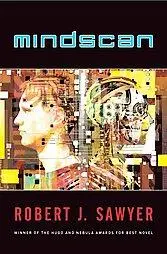
- Название:Mindscan
- Автор:
- Издательство:Tor Books
- Жанр:
- Год:2005
- ISBN:0-765-31107-0
- Рейтинг книги:4 / 5. Голосов: 1
-
Избранное:Добавить в избранное
- Отзывы:
-
Ваша оценка:
Mindscan: краткое содержание, описание и аннотация
Предлагаем к чтению аннотацию, описание, краткое содержание или предисловие (зависит от того, что написал сам автор книги «Mindscan»). Если вы не нашли необходимую информацию о книге — напишите в комментариях, мы постараемся отыскать её.
Mindscan — читать онлайн бесплатно полную книгу (весь текст) целиком
Ниже представлен текст книги, разбитый по страницам. Система сохранения места последней прочитанной страницы, позволяет с удобством читать онлайн бесплатно книгу «Mindscan», без необходимости каждый раз заново искать на чём Вы остановились. Поставьте закладку, и сможете в любой момент перейти на страницу, на которой закончили чтение.
Интервал:
Закладка:
Sabrina always hugged me when she saw me; she made no move to do so this time, though, and without some signal from her, I wasn’t going to initiate it.
“It’s … it’s amazing,” said bald-headed Rudy Ackerman, another old friend—we’d hiked around Eastern Canada and New England the summer after our first year at U of T. The “it” Rudy was referring to was my new body.
I tried to make my tone light. “The current state of the art,” I said. “It’ll get more lifelike as time goes on, I’m sure.”
“It’s pretty funky as is, I must say,” said Rudy. “So … so do you have super strength?”
Rebecca was still looking mortified, but Sabrina imitated a TV announcer. “He’s an upload. She’s a vegetarian rabbi. They fight crime.”
I laughed. “No, I’ve got normal strength. Super strength is an extra-cost option. But you know me: I’m a lover not a fighter.”
“It’s so … weird,” said Rebecca, at last.
I looked at her, and smiled as warmly—as humanly —as I could. “ ‘Weird’ is just an anagram of ‘wired,’ ” I said, but she didn’t laugh at the joke.
“What’s it like?” asked Sabrina.
Had I still been biological, I would, of course, have taken a deep breath as part of collecting my thoughts. “It’s different ,” I said. “I’m getting used to it, though. Some of it is very nice. I don’t get headaches anymore—at least, I haven’t so far. And that damn pain in my left ankle is gone. But…”
“What?” asked Rudy.
“Well, I feel a little low-res, I guess. There isn’t as much sensory input as there used to be. My vision is fine—and I’m no longer color-blind, although I do have a slight awareness of the pixels making up the images. But there’s no sense of smell to speak of.”
“With Rudy around, that’s not such a bad thing,” said Sabrina.
Rudy stuck his tongue out at her.
I kept trying to catch Rebecca’s eye, but every time I looked at her, she looked away. I lived for her little touches, her hand on my forearm, a leg pressing against mine as we sat on the couch. But the whole evening, she didn’t touch me once. She hardly even looked at me.
“Becks,” I said at last, when Rudy had gone to the wash-room, and Sabrina was off freshening her drink. “It is still me, you know.”
“What?” she said, as if she had no idea what I was talking about.
“It’s me.”
“Yeah,” she said. “Sure.”
In day-to-day life, we hardly ever speak names, either our own or those of others. “It’s me,” we say when identifying ourselves on the phone. And, “Look at you!” when greeting someone. So maybe I was being paranoid. But by the end of the evening, I couldn’t recall anyone, least of all my darling, darling Rebecca, having called me Jake.
I went home in a pissy mood. Clamhead growled at me as I came through the front door, and I growled back.
“Hello, Hannah,” I said to the housekeeper as I came through my mother’s front door the next afternoon.
Hannah’s small eyes went wide, but she quickly recovered. “Hello, Mr. Sullivan,” she said.
Suddenly, I found myself saying what I’d never said before. “Call me Jake.”
Hannah looked startled, but she complied. “Hello, Jake.” I practically kissed her.
“How is she?”
“Not so well, I’m afraid. She’s in one of her moods.”
My mother and her moods. I nodded, and headed upstairs—taking them effortlessly, of course. That much was a pleasant change.
I paused to look into the room that had been mine, in part to see what it looked like with my new vision, and in part to stall, so I could work up my nerve. The walls that I’d always seen as gray were in fact a pale green. So much was being revealed to me now, about so many things. I continued down the corridor.
“Hello, Mom,” I said. “How are you doing?”
She was in her room, brushing her hair. “What do you care?”
How I missed being able to sigh. “I care. Mom, you know I care.”
“You think I don’t know a robot when I see it?”
“I’m not a robot.”
“You’re not my Jake. What’s happened to Jake?”
“I am Jake,” I said.
“The original. What’s happened to the original?”
Funny. I hadn’t thought about the other me for days. “He must be on the moon, by now,” I said. “It’s only a three-day journey there, and he left last Tuesday. He should be getting out of lunar decontamination today.”
“The moon,” said my mother, shaking her head. “The moon, indeed.”
“We should be heading out,” I said.
“What kind of son leaves a disabled father behind to go to the moon?”
“I didn’t leave him. I’m here.”
She was looking at me indirectly: she was facing the mirror above the bureau, and conversing with my reflection in it “This is just like what you—the real you—do with Clamhead when you’re out of town. You have the damned robo-kitchen feed her.
And now, here you come, a walking, talking robokitchen, here in place of the real you, doing the duties the real you should be doing.”
“Mom, please…”
She shook her head at the reflection of me. “You don’t have to come here again.”
“For Christ’s sake, Mom, aren’t you happy for me? I’m no longer at risk—don’t you see? What happened to Dad isn’t going to happen to me.”
“Nothing has changed,” said my mother. “Nothing has changed for the real you. My boy still has that thing in his head, that AVM; my son is still at risk.”
“I—”
“Go away,” she said.
“What about visiting Dad?”
“Hannah will take me.”
“But—”
“Go away,” my mother said. “And don’t come back.”
13
“Ladies and gentlemen,” said a voice over the moonbus intercom, “as you can see on the monitors, we’re about to pass around onto the far side of the moon. So, please do take a moment to look out the windows and enjoy your last sight of the Earth; it won’t be visible at all from your new home.”
I turned and stared at the crescent planet, beautiful and blue. It had been an image I’d known all my life, but when Karen and the rest of these old folks had been children, no one had yet seen the Earth like this.
Karen was sitting next to me at the moment; Quentin Ashburn, my old seatmate from back on the spaceplane, was off chatting with the moonbus pilot about their shared pride and joy. Karen had been born in 1960, and it wasn’t until December 1968 that Apollo VIII got far enough away from the home world to take a photograph of the whole thing. Of course, I wouldn’t normally remember a date like December 1968, but everyone knew that humans first landed on the moon in 1969, and I knew that Apollo VIII —the first manned spaceship to leave Earth orbit—had gone there over Christmas the year before; my Sunday School teacher had once played a staticky audio of one of those astronauts reading from Genesis to commemorate that fact.
Now, though, both Karen and I were seeing for the last time the planet that gave birth to us, and to every one of our ancestors. Well, no, of course, that wasn’t quite true.
Life had originated only once in the solar system—but on Mars, not Earth; it had been seeded on the third planet from the fourth some four billion years ago, transferred on meteorites. And although Earth, less than 400,000 kilometers away, would be forever invisible from Lunar Farside, Mars—easy to spot, brilliant with the color of blood, of life—would frequently be visible in the night sky from High Eden, even though it was often a thousand times farther away than was Earth.
I watched as the nightside part of Earth—lenticular in this perspective, like a cat’s black pupil abutting the blue crescent of the dayside—kissed the gray lunar horizon.
Читать дальшеИнтервал:
Закладка:
Похожие книги на «Mindscan»
Представляем Вашему вниманию похожие книги на «Mindscan» списком для выбора. Мы отобрали схожую по названию и смыслу литературу в надежде предоставить читателям больше вариантов отыскать новые, интересные, ещё непрочитанные произведения.






Обсуждение, отзывы о книге «Mindscan» и просто собственные мнения читателей. Оставьте ваши комментарии, напишите, что Вы думаете о произведении, его смысле или главных героях. Укажите что конкретно понравилось, а что нет, и почему Вы так считаете.