Robert Sawyer - Mindscan
Здесь есть возможность читать онлайн «Robert Sawyer - Mindscan» весь текст электронной книги совершенно бесплатно (целиком полную версию без сокращений). В некоторых случаях можно слушать аудио, скачать через торрент в формате fb2 и присутствует краткое содержание. Год выпуска: 2005, ISBN: 2005, Издательство: Tor Books, Жанр: Фантастика и фэнтези, на английском языке. Описание произведения, (предисловие) а так же отзывы посетителей доступны на портале библиотеки ЛибКат.
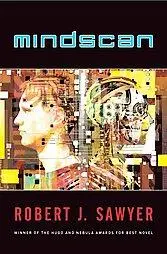
- Название:Mindscan
- Автор:
- Издательство:Tor Books
- Жанр:
- Год:2005
- ISBN:0-765-31107-0
- Рейтинг книги:4 / 5. Голосов: 1
-
Избранное:Добавить в избранное
- Отзывы:
-
Ваша оценка:
Mindscan: краткое содержание, описание и аннотация
Предлагаем к чтению аннотацию, описание, краткое содержание или предисловие (зависит от того, что написал сам автор книги «Mindscan»). Если вы не нашли необходимую информацию о книге — напишите в комментариях, мы постараемся отыскать её.
Mindscan — читать онлайн бесплатно полную книгу (весь текст) целиком
Ниже представлен текст книги, разбитый по страницам. Система сохранения места последней прочитанной страницы, позволяет с удобством читать онлайн бесплатно книгу «Mindscan», без необходимости каждый раз заново искать на чём Вы остановились. Поставьте закладку, и сможете в любой момент перейти на страницу, на которой закончили чтение.
Интервал:
Закладка:
“I thought you had posters of … who was it? That Superman guy?”
Karen grinned. “Him, too.”
We’d both been ignoring the TV, but now the sports came on. “Oooh!” said Karen. “The Yankees won. Terrific!”
“You like baseball?” I said, feeling my eyebrows lift this time—there was a definite jerk as they did so; I’d have to get Porter to file down whatever they were catching on.
“Absolutely!”
“Me, too,” I said. “I wanted to be a pitcher when I was a kid. It wasn’t in the cards, but…”
“You a Blue Jays fan?” asked Karen.
I grinned. “What else?”
“I remember when they won back-to-back World Series.”
“Really? Wow.”
“Yup. Daron and I had just gotten married back then. He and I used to watch the World Series together every year. Big bowls of popcorn, lots of soda, the works.”
“What was it like—those two times Toronto won? How did people react?”
The sun was rising; light spilled into the room.
Karen smiled. “Let me tell you…”
11
We transferred from the spaceplane to the moonship, a metallic arachnid designed only for use in vacuum. I had my own small sleeping compartment—like one of those coffin hotels in Tokyo. When I was out of it, I was enjoying being weightless, although Quentin was still nattering on about moonbuses and other things that interested him. If only he were a baseball fan…
“Now, remember, folks,” said one of the Immortex staff on the third morning of our flight, “the moonbase we’re about to land at is not High Eden. Rather, it’s a multinational private-sector R D facility. It wasn’t built for tourists, and it wasn’t built for luxury—so don’t be disappointed. I promise you, you’ll be pleased when you get to High Eden.”
I listened, thinking High Eden indeed better be good. Of course, I’d taken the virtual tour, and read all the literature. But I’d miss—hell, I already was missing—Clamhead, and Rebecca, and my mother, and…
And, yes, even my father. I’d thought him a burden, I thought I’d feel relief to hand off worrying about him to the other me, but I found myself very sad at the prospect of never seeing him again.
Tears float in zero-gravity. It’s the most astonishing thing.
I went to see Dr. Porter about the problem with thoughts I intended to keep private being spoken aloud.
“Ah, yes,” he said, nodding. “I’ve seen that before. I can make some adjustments, but it’s a tricky mind-body interface problem.”
“You’ve got to fix it. Unless I explicitly decide to do something, it shouldn’t happen.”
“Ah,” said Porter, his eyebrows working with glee, “but that’s not how humans work—not even biological ones. None of us consciously initiate our actions.”
I shook my head. “I’ve studied philosophy, doc. I’m not prepared to give up on the notion of free will. I refuse to believe that we live in a deterministic universe.”
“Oh, indeed,” said Porter. “That’s not what I meant. Say you walk into a room, see someone you know, and decide to extend your hand in greeting. Of course, your hand doesn’t instantly shoot out; first, stuff has to happen in your brain, right? And that stuff—the electrical change in the brain that precedes voluntary action—is called the readiness potential. Well, in a biological brain the readiness potential begins 550 milliseconds—just over half a second—prior to your hand beginning to move. It really doesn’t matter what the voluntary act is: the readiness potential occurs in the brain 550 milliseconds before the motor act begins. Okay?”
“Okay,” I said.
“Ah, but it’s not okay! See, if you ask people to indicate exactly when they decided to do something, they report that the idea occurred to them about 350 milliseconds before the motor act begins. A guy named Benjamin Libet proved that ages ago.”
“But—but that must be a measurement error,” I said. “I mean, you’re talking about milliseconds.”
“No, not really. The difference between 550 milliseconds and 350 milliseconds is a fifth of a second: that’s quite a significant amount of time, and easy enough to measure accurately. This basic test has been replicated over again over again since the 1980s, and the data are rock solid.”
“But that doesn’t make sense. You’re saying—”
“I’m saying that what our intuition tells us the sequence of events should be, and what the sequence actually is, don’t agree. Intuitively, we think the sequence must be: first , you decide to shake hands with your old friend Bob; second , your brain, in response to that decision, begins sending signals to your arm that it wants to shake hands; and third , your arm starts to swing up for the handshake. Right? But what really happens is this: first , your brain starts sending signals to shake hands; second , you consciously decide to shake hands with your old friend; and third , your arm starts to swing up. The brain has started down the road to shaking hands before you have consciously made any decision. Your conscious brain takes ownership of the action, and fools itself into thinking it started the action, but really it’s just a spectator, watching what your body is doing.”
“So you are saying there’s no free will.”
“Not quite. Our conscious minds have the free will to veto the action. See? The action begins 550 milliseconds prior to the first physical movement. Two hundred milliseconds later, the action that’s already been started comes to the attention of your conscious self—and your conscious self has 350 milliseconds to put on the brakes before anything happens. The conscious brain doesn’t initiate so-called voluntary acts, although it can step in and stop them.”
“Really?” I said.
Porter nodded his long face vigorously. “Absolutely. Everybody’s experienced this, if you stop and think about it: you’re lying in bed, quite mellow, and you look over at the clock, and you think to yourself, I really should get up, it’s time to get up, I’ve got to go to work. You may think this a half-dozen times or more, and then, suddenly, you are getting up—the action has begun, without you being consciously aware that you’ve finally, really made the decision to get out of bed. And that’s because you haven’t consciously made that decision; your unconscious has made it for you. It—not the conscious you—has concluded once and for all that it really is time to get out of bed.”
“But I didn’t have this problem when I was biological.”
“No, that’s right. And that was because of the slow speed of chemical reactions. But your new body and your new brain operate at electrical, not chemical, speeds, and the veto mechanism sometimes comes into play too late to do what it’s supposed to do. But, as I said, I can make a few adjustments. Forgive me, but I’m going to have to pull back the skin on your head, and open up your skull…”
Finally, it was time to go back home. And when I got to the house in North York, I couldn’t wait to see my lovable old Irish setter. “Clamhead!” I called out, as I came through the front door. “Here, girl! I’m home!”
Clamhead came bounding down the stairs, but stopped short when she saw me. I’d expected her to leap up and kiss my face, but that didn’t happen. Indeed, she lowered her forelegs, lay her ears flat, reared up her hind legs, and barked menacingly at me.
“Clamhead, it’s me!” I said. “It’s just me.”
The dog barked again, and then growled.
“Clammy, it’s just me, honest!”
The growl became a snarl. The front door was still open and I thought about making a run for it. But no, damn it, no. This was my house.
Читать дальшеИнтервал:
Закладка:
Похожие книги на «Mindscan»
Представляем Вашему вниманию похожие книги на «Mindscan» списком для выбора. Мы отобрали схожую по названию и смыслу литературу в надежде предоставить читателям больше вариантов отыскать новые, интересные, ещё непрочитанные произведения.






Обсуждение, отзывы о книге «Mindscan» и просто собственные мнения читателей. Оставьте ваши комментарии, напишите, что Вы думаете о произведении, его смысле или главных героях. Укажите что конкретно понравилось, а что нет, и почему Вы так считаете.