Robert Sawyer - Mindscan
Здесь есть возможность читать онлайн «Robert Sawyer - Mindscan» весь текст электронной книги совершенно бесплатно (целиком полную версию без сокращений). В некоторых случаях можно слушать аудио, скачать через торрент в формате fb2 и присутствует краткое содержание. Год выпуска: 2005, ISBN: 2005, Издательство: Tor Books, Жанр: Фантастика и фэнтези, на английском языке. Описание произведения, (предисловие) а так же отзывы посетителей доступны на портале библиотеки ЛибКат.
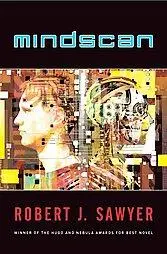
- Название:Mindscan
- Автор:
- Издательство:Tor Books
- Жанр:
- Год:2005
- ISBN:0-765-31107-0
- Рейтинг книги:4 / 5. Голосов: 1
-
Избранное:Добавить в избранное
- Отзывы:
-
Ваша оценка:
Mindscan: краткое содержание, описание и аннотация
Предлагаем к чтению аннотацию, описание, краткое содержание или предисловие (зависит от того, что написал сам автор книги «Mindscan»). Если вы не нашли необходимую информацию о книге — напишите в комментариях, мы постараемся отыскать её.
Mindscan — читать онлайн бесплатно полную книгу (весь текст) целиком
Ниже представлен текст книги, разбитый по страницам. Система сохранения места последней прочитанной страницы, позволяет с удобством читать онлайн бесплатно книгу «Mindscan», без необходимости каждый раз заново искать на чём Вы остановились. Поставьте закладку, и сможете в любой момент перейти на страницу, на которой закончили чтение.
Интервал:
Закладка:
“That’s, um, an unusual way of going through life.”
“You sound like Daron. When he and I used to go for dinner, he’d be embarrassed when a couple at a nearby table was having a fight. Me, I’m always leaning closer and cocking my head to hear better, thinking, ‘Oh, this is great; this is pure gold.’ ”
“ Hmph ,” I said. I was getting good at making all those sounds that aren’t words but still convey meaning.
“And,” said Karen, “with these new ears—God, they’re sensitive!—I’ll be able to hear even more. Poor Daron would hate that.”
“Who’s Daron?”
“Oh, sorry. My first husband, Daron Bessarian, and the last one whose name I took; my maiden name was Cohen. Daron was a nice Armenian boy, from my high school. We were a funny couple, in a way. We used to argue about whose people had suffered the worse holocaust.”
I didn’t know how to reply to that, so instead I said, “Maybe we should go inside before we get too damp.”
She nodded, and we headed into the party room. Draper—the black lawyer—was now playing chess with one of the women; a second woman—the faux sixteen-year-old—was reading something on a datapad; and the third woman was, to my astonishment, doing jumping jacks, under the supervision of an Immortex personal trainer. I thought it incredibly pointless—an upload’s artificial form hardly needed the exercise. But then I realized it must in fact be luxurious to suddenly be nimble and limber again, after years of being trapped in an aged, decaying body.
“Want to catch the 5:00 a.m. newscast?” I asked Karen.
“Sure.”
We walked down a corridor, and found a room I’d noted earlier in the day that had a wall screen.
“Do you mind the CBC?” I said.
“Not at all. I watch it all the time from Detroit. It’s the only way I can find out what’s really going on in my country—or in the rest of the world.”
I told the TV to turn on. It did so. I’d watched newscasts on this channel hundreds of times before, but this one looked completely different, now that I was seeing in full color. I wondered about that, about where the connections in my brain that allowed me to perceive colors I’d never seen before had come from.
The newscaster—a turbaned Sikh whose shift, I knew, went until 9:00 a.m.—was speaking while news footage ran behind him. “Despite another protest on Parliament Hill yesterday afternoon, it seems almost certain that Canada will go ahead and legalize multiple marriages later this month. Prime Minister Chen has scheduled a press conference for this morning, and…”
Karen shook her head, and the movement caught my eye. “You don’t approve?” I asked.
“No,” she said.
“Why not?” I said it as gently as I could, trying to keep my tone from sounding confrontational.
“I don’t know,” she replied, amiably enough.
“Do gay marriages bother you?”
She sounded slightly miffed. “No. I’m not that old.”
“Sorry.”
“No, it’s a fair question. I was in my forties when Canada legalized gay marriages. I actually came to Toronto in the summer of—what was it? Two thousand and three?—to attend the wedding of an American lesbian couple I knew who came up here to get married.”
“But the U.S. doesn’t allow gay marriages—I remember when the constitutional amendment was passed, outlawing them.”
Karen nodded. “The U.S. doesn’t allow a lot of things. Believe me, many of us are uncomfortable with the continued drifting to the right.”
“But you are against multiple marriages.”
“Yes, I am, I suppose. But I’m not sure I can articulate why. I mean, I’ve seen lots of single moms do just fine—including my sister, may God rest her soul. So certainly my definition of family isn’t limited to two parents.”
“What about single dads? What about single gay dads?”
“Yeah, sure, that’s fine.”
I nodded in relief; old people can be so conservative. “So, what’s wrong with multiple marriages?”
“I guess I think you can really only have the level of commitment that constitutes a marriage in a couple. Anything bigger than that waters it down.”
“Oh, I don’t know. Most people have an infinite supply of love; just ask anyone who comes from a big family.”
“I guess,” she said. “I take it you’re in favor of multiple marriages?”
“Sure. I mean, I don’t have any interest in one myself, but that’s not the point. I’ve know several triads over the years, and two quads. They’re all genuinely in love; they’ve got stable, long-term relationships. Why shouldn’t they be entitled to call what they have a marriage?”
“Because it’s not . It just isn’t.”
I certainly didn’t want to start an argument, so I didn’t say anything further. Looking back at the TV, I saw the anchor was now doing a story on the death of former U.S. President Pat Buchanan, who had passed away yesterday at a hundred and six.
“Good riddance,” said Karen, looking at the screen.
“Happy to see him go?” I said.
“Aren’t you?”
“Oh, I don’t know. He certainly was no friend of Canada, but, you know, his ‘Soviet Canuckistan’ nickname for us became a rallying cry for my generation. ‘Live up to the name,’ and all that. I think Canada became even more left-wing just to spite him.”
“So maybe you’re just in favor of multiple marriages because it’ll be another distinction between our two countries,” said Karen.
“Not at all,” I said. “I told you why I’m in favor of it.”
“Sorry.” She glanced at the screen. The piece about Buchanan’s death was over, but apparently she was still dwelling on it. “I’m happy he’s dead, because I see it as maybe the end of an era. It was the judges he packed the Supreme Court with, after all, who overturned Roe v. Wade , and I can’t forgive him for that. But he was twenty years older than me—his values came from a different generation. And now he’s gone, and I’m thinking maybe there’s some hope for change. But…”
“Yes?”
“But I’m not going away, am I? Your friends who want to have their relationship recognized as a group marriage will have to contend with people like me, set in their ways, sticking around forever, standing in the way of progress.” She looked at me. “And it is progress, isn’t it? My parents never understood about gay marriage. Their parents never understood about desegregation.”
I looked at her with new eyes—figuratively, and, of course, literally. “You’re a philosopher at heart,” I said.
“Maybe so. All good writers are, I imagine.”
“But I guess you’re right, to some degree, anyway. They call it the retire-or-expire factor in academia…”
“ ‘Retire or expire’?” said Karen. “Oooh, I like that! And I certainly saw something similar in Georgia, where I grew up, in relation to civil rights: great strides weren’t made by changing people’s minds—no one slaps himself on the forehead and exclaims, ‘What a fool I’ve been all these years!’ Rather, progress was made because the worst racists—the ones who remembered the good ole days of segregation or even slavery—died off.”
“Exactly,” I said.
“But, you know, people’s beliefs do change over time. There’s the long-established fact that people become more politically conservative as they get older—not that it happened to me, thank God. When I found out what Tom Selleck’s politics were, I was appalled.”
“Who’s Tom Selleck?”
“Sigh,” said Karen. Apparently she hadn’t learned to make the sound yet. “He was a gorgeous hunk of an actor; played Magnum P.I . I had posters of him in my bedroom when I was a teenager.”
Читать дальшеИнтервал:
Закладка:
Похожие книги на «Mindscan»
Представляем Вашему вниманию похожие книги на «Mindscan» списком для выбора. Мы отобрали схожую по названию и смыслу литературу в надежде предоставить читателям больше вариантов отыскать новые, интересные, ещё непрочитанные произведения.



Обсуждение, отзывы о книге «Mindscan» и просто собственные мнения читателей. Оставьте ваши комментарии, напишите, что Вы думаете о произведении, его смысле или главных героях. Укажите что конкретно понравилось, а что нет, и почему Вы так считаете.