Pfitzinger Pete - Advanced Marathoning
Здесь есть возможность читать онлайн «Pfitzinger Pete - Advanced Marathoning» весь текст электронной книги совершенно бесплатно (целиком полную версию без сокращений). В некоторых случаях можно слушать аудио, скачать через торрент в формате fb2 и присутствует краткое содержание. Год выпуска: 2008, Издательство: Human Kinetics - A, Жанр: Спорт, на английском языке. Описание произведения, (предисловие) а так же отзывы посетителей доступны на портале библиотеки ЛибКат.

- Название:Advanced Marathoning
- Автор:
- Издательство:Human Kinetics - A
- Жанр:
- Год:2008
- ISBN:нет данных
- Рейтинг книги:5 / 5. Голосов: 1
-
Избранное:Добавить в избранное
- Отзывы:
-
Ваша оценка:
Advanced Marathoning: краткое содержание, описание и аннотация
Предлагаем к чтению аннотацию, описание, краткое содержание или предисловие (зависит от того, что написал сам автор книги «Advanced Marathoning»). Если вы не нашли необходимую информацию о книге — напишите в комментариях, мы постараемся отыскать её.
Advanced Marathoning — читать онлайн бесплатно полную книгу (весь текст) целиком
Ниже представлен текст книги, разбитый по страницам. Система сохранения места последней прочитанной страницы, позволяет с удобством читать онлайн бесплатно книгу «Advanced Marathoning», без необходимости каждый раз заново искать на чём Вы остановились. Поставьте закладку, и сможете в любой момент перейти на страницу, на которой закончили чтение.
Интервал:
Закладка:
The optimal amount of rest between intervals is debatable. One school of thought is to minimize rest so that your metabolic rate stays high during the entire workout. This strategy makes for very difficult workouts (which can be good), but you risk shortening your workouts. Another school of thought is to allow your heart rate to decrease to 70 percent of your maximal heart rate or 65 percent of your heart rate reserve during your recovery between intervals, which provides close to the optimal balance of effort and recovery.
For the lower-tech crowd, a useful rule of thumb is to allow 50 to 90 percent of the length of time it takes to do the interval for your recovery. For example, if you’re running 1,000-meter repeats in 3:20, you would run slowly for 1:40 to 3:00 between intervals. We use this method of measuring recovery in the schedules.
Speed Training
Speed runs are repetitions of 50 to 150 meters that improve leg speed and running form. These workouts train your nervous system to allow you to maintain a faster rate of leg turnover during your races.
Speed runs train your nervous system to allow you to maintain a faster rate of leg turnover during your races.

These sessions are done after a thorough warm-up and often toward the end of a general aerobic run or a recovery run. Allow yourself plenty of rest between repetitions so that you can run each one with good technique.
A typical session is 10 repetitions of 100 meters in which you accelerate up to full speed over the first 70 meters and then float for the last 30 meters. It’s critical to remain relaxed during these accelerations. Avoid clenching your fists, lifting your shoulders, tightening your neck muscles, and so on. Concentrate on running with good form, and focus on one aspect of good form, such as relaxed arms or complete hip extension, during each acceleration.
A typical rest is to jog and walk 100 to 200 meters between repetitions. The most important considerations are to maintain good running form and to concentrate on accelerating powerfully during each repetition.
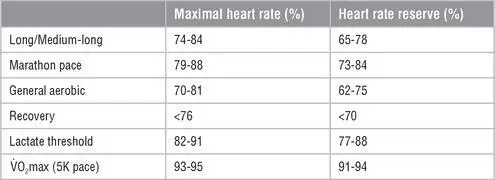
The prescribed training intensities used in this chapter and in chapters 1 and 3 are summarized in table 7.1. These intensity ranges are appropriate for most experienced marathon runners. Less-experienced runners should generally train at the lower end of the recommended ranges, while elite runners will generally train at the high end of the ranges. (Heart rate isn’t relevant during the short speed sessions, so we’ve left them out of this table.)
Heart Rate Intensities for Marathon Training Workouts
Doing Doubles
Marathoners have a tendency to start running twice a day before their weekly mileage warrants it. Doing doubles sounds like serious training, so runners often assume it must be better marathon preparation. The reality is quite different; as you increase your training mileage in preparation for a marathon, you should resist the urge to switch from single runs to doubles.
In chapter 1, we discussed the various training adaptations that are specific to improving your marathon performance. Marathon training focuses on endurance-based adaptations such as depleting your glycogen reserves to provide a stimulus for your body to store more glycogen and training your muscles to utilize more fat at a given speed. You’ll provide a greater stimulus for these adaptations through a single 12-mile (19 km) run than by doing a 7-miler (11 km) and a 5-miler (8 km) at the same pace.
It might sound counterintuitive, but runners preparing for shorter races should run more doubles at a given level of weekly mileage than marathoners. Runners focusing on 5Ks, for example, should start adding doubles when their weekly mileage gets above 50. That’s because the 5K specialists’ main training emphasis is high-quality interval sessions, and more frequent, shorter runs will help keep their legs fresh for these workouts.
For marathoners, the basic guideline is to not do double workouts until you’ve maximized the amount you’re running in single workouts. If you’re preparing for a marathon and are running less than 75 miles (121 km) a week, then you shouldn’t regularly be running doubles. If you’re running less than 75 miles (121 km) a week, by the time you get in your long run and a midweek medium-long run, there’s no reason to double more than once or twice a week to get in the remaining miles. It’s better to get in longer runs and give your body 22 or 23 hours of recovery between runs.
Once you get above 75 miles (121 km) a week, however, double workouts have a definite role in your marathon program. As with any other aspect of training, doubles should be introduced gradually. Start by adding one double per week and then another, as you gradually increase your mileage. The schedules in chapters 8 through 12 reflect this approach to adding doubles, with double days called for only in the higher-mileage programs.
The minimum time for an added second run should be 25 minutes. If you run less than that, it’s hardly worth the extra time and effort – both physiologically and in taking time from your busy life – to change, get yourself out the door, stretch, shower, and so on. That’s especially the case if a too-short, not-crucial run means cutting into precious sleep time. In some situations, it’s wiser to add cross-training to your program than to increase your risk of injury with more miles of running. Various options for cross-training are discussed in chapter 4.
How, then, should you introduce doubles into your program? The training schedules in this book add second runs to a day’s training for specific reasons. One main category of second runs is on hard days. An easy run in the morning will loosen you up for an evening  O 2max session or tempo run. Similarly, 30 minutes of easy running in the evening will help you recover from a morning tempo run.
A second main use of doubles in the schedules is on recovery days. When your mileage increases to where your recovery days call for more than 8 miles (13 km) of running, it’s time to switch those days to easy doubles. It’s easier on your body, and your recovery will be enhanced, if you do two runs of 5 miles (8 km) rather than a single 10-miler (16 km). Avoid the temptation to add mileage to your recovery days for the sole purpose of boosting your weekly mileage. Extra mileage on these days is counterproductive because your recovery will be less complete for your subsequent hard days.
The schedules may also call for an easy second run on the day of your medium-long run. These runs will provide an incremental training stimulus by depleting your carbohydrate stores and training your muscles to rely more on fat at a given speed. It’s preferable to do the second, short run in the evening after a medium-long run in the morning. If your schedule is such that you’ll be doing your medium-long run in the evening, be sure to run very easily in the morning. As we discuss earlier in this chapter and in chapter 1, medium-long runs bring you the most benefit if they’re done at a good pace, so don’t let a short morning run detract from the medium-long run’s quality. A better-quality medium-long run is preferable to a double in which the medium-long run is a slog.
Читать дальшеИнтервал:
Закладка:
Похожие книги на «Advanced Marathoning»
Представляем Вашему вниманию похожие книги на «Advanced Marathoning» списком для выбора. Мы отобрали схожую по названию и смыслу литературу в надежде предоставить читателям больше вариантов отыскать новые, интересные, ещё непрочитанные произведения.







Обсуждение, отзывы о книге «Advanced Marathoning» и просто собственные мнения читателей. Оставьте ваши комментарии, напишите, что Вы думаете о произведении, его смысле или главных героях. Укажите что конкретно понравилось, а что нет, и почему Вы так считаете.