Pfitzinger Pete - Advanced Marathoning
Здесь есть возможность читать онлайн «Pfitzinger Pete - Advanced Marathoning» весь текст электронной книги совершенно бесплатно (целиком полную версию без сокращений). В некоторых случаях можно слушать аудио, скачать через торрент в формате fb2 и присутствует краткое содержание. Год выпуска: 2008, Издательство: Human Kinetics - A, Жанр: Спорт, на английском языке. Описание произведения, (предисловие) а так же отзывы посетителей доступны на портале библиотеки ЛибКат.
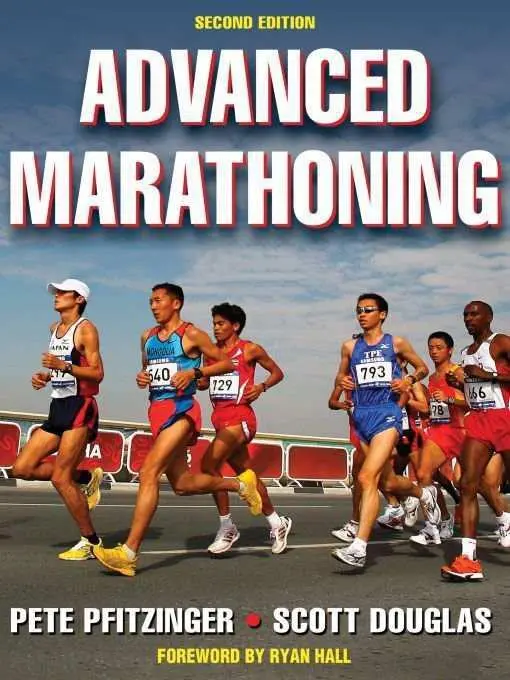
- Название:Advanced Marathoning
- Автор:
- Издательство:Human Kinetics - A
- Жанр:
- Год:2008
- ISBN:нет данных
- Рейтинг книги:5 / 5. Голосов: 1
-
Избранное:Добавить в избранное
- Отзывы:
-
Ваша оценка:
Advanced Marathoning: краткое содержание, описание и аннотация
Предлагаем к чтению аннотацию, описание, краткое содержание или предисловие (зависит от того, что написал сам автор книги «Advanced Marathoning»). Если вы не нашли необходимую информацию о книге — напишите в комментариях, мы постараемся отыскать её.
Advanced Marathoning — читать онлайн бесплатно полную книгу (весь текст) целиком
Ниже представлен текст книги, разбитый по страницам. Система сохранения места последней прочитанной страницы, позволяет с удобством читать онлайн бесплатно книгу «Advanced Marathoning», без необходимости каждый раз заново искать на чём Вы остановились. Поставьте закладку, и сможете в любой момент перейти на страницу, на которой закончили чтение.
Интервал:
Закладка:
• If you’re limping, then your running mechanics are thrown off. You’ll merely aggravate your injury by continuing.
• If you have a specific pain, and that pain is increasing progressively during the race, then you’re doing yourself harm and should stop.
• If you’re light-headed and unable to concentrate, you should stop.
• If you’re overcome by muscle cramps, a torn muscle, heat exhaustion, or the like, then stop.
On to 20 Miles (32 km)
From the halfway mark to 20 miles (32 km) is the no-man’s-land of the marathon. You’re already fairly tired and still have a long way to go. This is where the mental discipline of training will help you maintain a strong effort and a positive attitude. It’s easy to let your pace slip 5 seconds per mile (per 1.6 km), and then 10 seconds per mile or more, during this stretch. By using all the available feedback on your pace – whether in the form of mile or kilometer splits – you’ll know exactly how you’re progressing, and you should be able to concentrate and maintain your goal pace during these miles.
Slowing during this portion of the marathon is often more a matter of not concentrating than of not being able to physically maintain the pace. Focusing on your splits gives you an immediate goal to concentrate on. The ability to do a bit of adding in your head while running is a helpful skill. If you’re supposed to be running 5:40 per mile, and there are markers every mile during the marathon, then just add 6:00 to your previous mile split and subtract 20 seconds to calculate what your next split should be. If you’re 5 seconds too slow, don’t try to make up the lost 5 seconds during the next mile; add 5:40 again as your target to get yourself back on track. By focusing on these incremental goals along the way, you’ll prevent a large drift in your pace and should be able to stay very close to your goal.
It’s not unusual to have a few miles when you just don’t feel good. These bad patches are a test of mental resolve. Often these stretches will last a while and then mysteriously go away. For example, you might feel tight and uncomfortable from miles 15 to 17 but then get back in the groove again and feel good to the finish. The key is to have the confidence that you’ll eventually overcome this bad patch.
In my marathon career, I started 18 marathons and finished 16, including 8 victories. Of the two dropouts, one was because of injury and the other was because of stupidity. Both occurred in 1986.
The dropout because of stupidity was the Boston Marathon. This was the first professional Boston Marathon, with lots of media excitement and financial incentives. I ignored my usual race plan of running even splits and got carried away early. During the first 10 miles, Greg Meyer and I exchanged the lead several times. Whenever Greg would take the lead, I would try to take it back.
This was overly aggressive racing for so early in the marathon. Meanwhile, Rob de Castella, who won that day, sat in behind us, probably laughing to himself at the lack of patience of the two Americans. By 12 miles, my breathing wasn’t in its usual rhythm, my legs were already pretty beat up, and my intestines were becoming increasingly uncomfortable. During the next mile, I fell off the lead bunch and started to tighten up. Knowing that I had gone too hard too early, I stopped just past the halfway mark and quietly cursed myself. It was a lesson well learned and a mistake I never made again. Note that stupidity doesn’t fall under the list of legitimate reasons to drop out of a marathon.
The only positive aspect of dropping out so early was that I recovered fully in about a week. A few weeks later, I used my fitness and frustration to set a personal best of 28:41 for 10,000 meters on the track, and in July I redeemed myself over 26.2 miles by winning the San Francisco Marathon in 2:13:29.
My other dropout was in the 1986 Twin Cities Marathon, which was also the trial race for the next year’s world championships. I went into the race with a tight hamstring from stretching too hard after a track workout several weeks earlier. It felt okay early in the race but gradually tightened up in the drizzly 40-degree weather. At 20 miles, I was at the back of the lead pack when the hamstring tightened completely. I couldn’t run another step. After walking for about a mile, I gratefully accepted a ride to the finish. That dropout was easier mentally because the decision was out of my hands.
Having had a frustrating year in the marathon, I was determined to get a decent race under my belt as quickly as possible. My physical therapist said that the hamstring wasn’t too badly damaged and that I should run easily for about 10 days. With regular massage, it loosened up, and I decided to run the New York City Marathon, which was 3 weeks after Twin Cities. I ran conservatively and gradually moved from 30th place at halfway to finish 9th in 2:14:09. It had been a year of lessons learned.
– Pete Pfitzinger
Pete learned this lesson during the 1983 San Francisco Marathon. After working quite hard from 13 to 16 miles, he had a stretch of about 3 miles when his breathing felt out of sync, and he struggled to stay with the other two leaders. Pete kept telling himself to relax and that the other guys might be hurting, too. Fortunately, he settled back into a comfortable rhythm by 19 miles, felt strong enough to drop the other two runners by the 20-mile mark, and cruised home to victory. If Pete had let himself think negatively during the bad patch and let the other two runners get away, he wouldn’t have won that race.
Taking in carbohydrate as often as possible during the second half of the race can help you maintain your mental focus. The only fuel for your brain is glucose (carbohydrate), and when you become carbohydrate depleted, the amount of glucose reaching the brain starts to decrease. If you’ve carbohydrate loaded, this shouldn’t start to affect you until well past the 20-mile (32 km) mark. Taking in carbohydrate during the race and particularly between miles 13 and 20 (km 21 and 32), however, will help ensure that you stay alert and think clearly throughout the race.
The Final 6 Miles and 385 Yards (10 km)
Having made it to 20 miles (32 km), you’re at the most rewarding stage of the marathon. This is the part that you have prepared for during your long months of training. This is when your long runs, during which you worked hard over the last stages, will really pay off. Until now, everything required the patience to hold back. Now, you’re free to see what you’ve got. During these final 6 miles and 385 yards (10 km), you get to dig deep and use up any energy that you have left. This is what the marathon is all about. This is the stretch that poorly prepared marathoners fear and well-prepared marathoners relish.
The key from 20 miles (32 km) to the finish is to push as hard as you can without having disaster strike in the form of a cramp or very tight muscles. You will have prepared yourself for this during your long runs, your marathon-pace runs, and, to a lesser extent, your tempo runs. You need to use your body’s feedback to determine just how hard you can push. Chances are that, by now, your calf muscles, hamstrings, quads, or some combination of these are on edge and will limit how fast you can go. You need to test the waters a bit and push to what you perceive to be the limit that your muscles will tolerate. This is a progressive meting-out process, in which you can take progressively greater risks as the finish line nears.
Although doing the how-many-miles-to-go math can be daunting early on in the marathon, in this final stage it can help keep you focused. As the finish approaches, telling yourself, “Less than 3 miles to go,” or “Just 15 minutes more,” can be motivating. If you’re struggling a bit toward the end, picture yourself finishing a run on your favorite training loop so that the remaining distance seems more manageable.
Читать дальшеИнтервал:
Закладка:
Похожие книги на «Advanced Marathoning»
Представляем Вашему вниманию похожие книги на «Advanced Marathoning» списком для выбора. Мы отобрали схожую по названию и смыслу литературу в надежде предоставить читателям больше вариантов отыскать новые, интересные, ещё непрочитанные произведения.







Обсуждение, отзывы о книге «Advanced Marathoning» и просто собственные мнения читателей. Оставьте ваши комментарии, напишите, что Вы думаете о произведении, его смысле или главных героях. Укажите что конкретно понравилось, а что нет, и почему Вы так считаете.