Steve LeVine - Putin's Labyrinth
Здесь есть возможность читать онлайн «Steve LeVine - Putin's Labyrinth» весь текст электронной книги совершенно бесплатно (целиком полную версию без сокращений). В некоторых случаях можно слушать аудио, скачать через торрент в формате fb2 и присутствует краткое содержание. Город: New York, Год выпуска: 2008, ISBN: 2008, Издательство: Random House, Жанр: Публицистика, на английском языке. Описание произведения, (предисловие) а так же отзывы посетителей доступны на портале библиотеки ЛибКат.
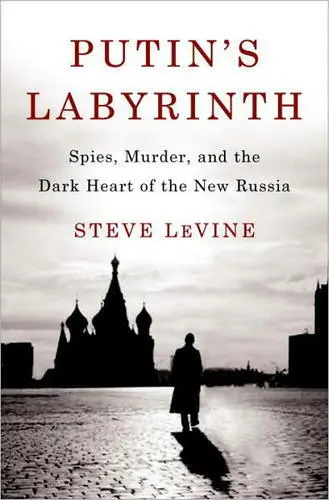
- Название:Putin's Labyrinth
- Автор:
- Издательство:Random House
- Жанр:
- Год:2008
- Город:New York
- ISBN:978-1-58836-815-7
- Рейтинг книги:3 / 5. Голосов: 1
-
Избранное:Добавить в избранное
- Отзывы:
-
Ваша оценка:
Putin's Labyrinth: краткое содержание, описание и аннотация
Предлагаем к чтению аннотацию, описание, краткое содержание или предисловие (зависит от того, что написал сам автор книги «Putin's Labyrinth»). Если вы не нашли необходимую информацию о книге — напишите в комментариях, мы постараемся отыскать её.
Drawing on new interviews with eyewitnesses and the families of victims, LeVine documents the bloodshed that has stained Putin’s two terms as president. Among the incidents chronicled in these pages: The 2002 terrorist takeover of a crowded Moscow theater—which led to the government gassing the building, and the deaths of more than a hundred terrified hostages–seen here from new angles, through the riveting words of those who survived; and the murder of courageous investigative reporter Anna Politkovskaya, shot in the elevator of her apartment building on Putin’s birthday, purportedly as a malicious “gift” for the president from supporters. Finally, a shocking story that made international headlines–the 2006 death of defector Alexander Litvinenko in London—is dramatized as never before. LeVine traces the steps of this KGB-spy-turned-dissident on his way to being poisoned with polonium-210, a radioactive isotope. And in doing so, LeVine is granted a rare series of interviews with a KGB defector who was nearly killed in strangely similar circumstances fifty years earlier. Through LeVine’s exhaustive research, we come to know the victims as real people, not just names in brief news accounts of how they died.
Putin’s Labyrinth
Putin's Labyrinth — читать онлайн бесплатно полную книгу (весь текст) целиком
Ниже представлен текст книги, разбитый по страницам. Система сохранения места последней прочитанной страницы, позволяет с удобством читать онлайн бесплатно книгу «Putin's Labyrinth», без необходимости каждый раз заново искать на чём Вы остановились. Поставьте закладку, и сможете в любой момент перейти на страницу, на которой закончили чтение.
Интервал:
Закладка:
It is hard to overstate Chechnya’s extraordinary place in the Russian soul, firmly lodged there after centuries of writing by novelists and poets—Mikhail Lermontov, Alexander Pushkin, and Lev Tolstoy, among others—who romanticized that disorderly southern region. By the 1990s, it was also a seductive place for war correspondents from around the world, and Anna would be no exception. After her first trip there, Chechnya became “a dragon in her blood,” said Elena Morozova. “She didn’t want to live without it.”
Anna did not immediately return to Chechnya. She found a new job at a scrappy biweekly called Novaya Gazeta. At first, she contributed general-interest pieces, including a call for emergency measures to control the march of AIDS in Russia, and a tirade against Russia’s forty million “slaves to tobacco” and their “aggressive and contemptuous” attitude toward nonsmokers.
The hectoring tone of the tobacco commentary illustrated Anna’s lifelong habit of lecturing to people. She told boys whom she heard cursing in public that they were “infringing on my rights. I don’t want to hear that language.” When the boys responded with the equivalent of “Go to hell,” friends pulled her away before the confrontation could worsen. Elena Morozova recalled the sermonizing that three drunks had to endure after asking for money. “I know that if I give you money, you’ll just buy vodka,” Anna told them. “And look how [awful] you look.” Elena decided that her friend had a messiah complex.
Another companion, Yevgenia Albats, remarked on Anna’s stubbornness. Friends often accused Yevgenia of unwillingness to compromise, “but next to Anna, I am the most compromising person on the planet,” she said.
But Anna also was a stickler for ethical behavior. After the Nord-Ost hostage tragedy, she bonded with the survivor group Nord-Ostsi. She was especially close to Elena Baranovskaya, who had lost her son and husband in the shoot-out and gassing that ended the theater standoff. Anna arrived at Elena’s apartment one day to find the survivor group waiting with a cake and a gift of dishes, in honor of Anna’s birthday. Sorry, said Anna, she could not accept the dishes. Gifts were off-limits for journalists, strictly unprofessional. One of the men nonetheless slipped the dishes into the trunk of Anna’s car. A few days later, Anna telephoned Elena: “I’m coming by with the dishes.”
In August 1999, more than a thousand Chechen militants crossed into the neighboring Russian republic of Dagestan to support a small Islamic uprising. Russian forces pushed back, forcing the Chechens’ commander, Shamil Basayev, to retreat. Then came the bombings of the four apartment buildings in Moscow and elsewhere, and the launching of the Second Chechen War by Russia’s new president, Vladimir Putin. Anna’s editor at Novaya Gazeta dispatched her to the war-torn region.
She made no pretense at objectivity. She seemed to see nothing heroic on either side, and focused almost exclusively on casualties of the war—innocent civilians whose lives were destroyed, hapless Russian soldiers flung into deadly combat. In one of her earliest dispatches, about a man named Vakha who had been blown up in a minefield, she wrote: “Now dead, Vakha lies on a field again, but this time fearlessly, with his wounded face looking up and his hands spread wider than they’ve ever been in his life. The left hand is about ten yards from his black jacket, which has been torn to pieces. The right hand is a bit closer, about five steps away. And Vakha’s legs are quite a problem: They disappear, most likely turning to dust at the time of the explosion and flying away with the wind.”
Her husband, Alexander, told Anna that he was not pleased with her absences and the danger she was facing. But after all the years of living in his shadow, she had no intention of stopping. Within a year, in her mid-forties, Anna hit her stride as a war correspondent, distinguished not only for her unapologetic irony and sarcasm, but also for a willingness to go to places where few others dared venture. Her career became forever intertwined with the callousness of the Chechen war and the conduct of Putin, its chief prosecutor.
At turns she sympathized with and castigated the Chechen leadership. She wrote increasingly accusatory stories about the Chechen prime minister, Ramzan Kadyrov, whose political career was launched after his pro-Moscow father, Akhmad, was killed in a bombing by Chechen opponents. While Anna thought Akhmad was brutal, she thought worse of Ramzan, whom she called “psychopathic and extremely stupid,” the “deranged” leader of a torture-and-murder paramilitary force. She ridiculed his loyalty to Putin. “What kind of qualifications do you need to be a favorite of Putin?” Anna wrote. “To have ground Chechnya beneath your heel, and forced the entire republic to pay you tribute like an Asiatic bey, is evidently a plus.”
Her salary wasn’t much, and her newspaper’s circulation wasn’t large. But its readers were passionate, especially the dwindling number of liberals who admired Anna for writing regularly on painful subjects that most of the population seemed happy to ignore. And she relished the attention that came her way. Even official Russia—especially agencies dealing with foreign policy and security in Chechnya and the Caucasus as a whole—read what she wrote and took it seriously. As she became known as an expert on Chechnya, “she started liking it,” her brother-in-law said.
Outside the country, Anna was a journalistic celebrity. Her articles—and, eventually, four books that were largely expansions of her reporting—attracted speaking invitations from around the world. She visited the United States, France, Norway, and Great Britain, and over three years collected almost $100,000 in prize money from organizations that supported human rights, press freedom, and achievements in reporting.
With the money—no small sum, even in booming Moscow—she at last was able to establish a comfortable life for herself and her family. Above all, she wanted Vera to have a place of her own, and so Anna gave her apartment to her daughter and bought another for herself in a lively neighborhood of cafés, within strolling distance of the historic Mayakovski Theater. Anna looked at Vera as a wisp of a girl, different from her son, the sturdy Ilya. He exhibited the discipline, steeliness, and ambition of his mother, and had become director of an advertising company. I thought Anna underestimated her daughter. It was true that Vera inherited her father’s artistic gifts and devil-may-care manner, but I also sensed in her a tough inner strength and street smarts.
Anna’s marriage to Alexander, under increasing strain, finally collapsed. As her fame had grown, his had gone into a steep decline. He could not attract commercial support for the kind of programs that suited his talent. In the familiar tradition of broadcast journalism everywhere, others had risen in his place. But Anna had learned from his natural talent and absorbed his appetite for risk, and then taken both to new levels.
The two never officially divorced, although Alexander made only sporadic appearances in her life. Anna complained to friends that he was distant from the children; she was especially angry at him for not sharing the costs of their son’s wedding reception in 2003, which Anna arranged (including a traditional troika with three white horses). When I last saw Alexander, in late 2007, he had taken a second wife, a woman twenty-three years his junior, and was making short documentaries in his own small studio, while mentoring the occasional young journalist.
Anna was often called fearless, but she was the first to say she was not. “I’m afraid a lot during every trip [to Chechnya],” she told a Polish journalist. “But, if I wanted to live without fear and risk, I would become a teacher or a housewife.”
Читать дальшеИнтервал:
Закладка:
Похожие книги на «Putin's Labyrinth»
Представляем Вашему вниманию похожие книги на «Putin's Labyrinth» списком для выбора. Мы отобрали схожую по названию и смыслу литературу в надежде предоставить читателям больше вариантов отыскать новые, интересные, ещё непрочитанные произведения.






Обсуждение, отзывы о книге «Putin's Labyrinth» и просто собственные мнения читателей. Оставьте ваши комментарии, напишите, что Вы думаете о произведении, его смысле или главных героях. Укажите что конкретно понравилось, а что нет, и почему Вы так считаете.