Steve LeVine - Putin's Labyrinth
Здесь есть возможность читать онлайн «Steve LeVine - Putin's Labyrinth» весь текст электронной книги совершенно бесплатно (целиком полную версию без сокращений). В некоторых случаях можно слушать аудио, скачать через торрент в формате fb2 и присутствует краткое содержание. Город: New York, Год выпуска: 2008, ISBN: 2008, Издательство: Random House, Жанр: Публицистика, на английском языке. Описание произведения, (предисловие) а так же отзывы посетителей доступны на портале библиотеки ЛибКат.
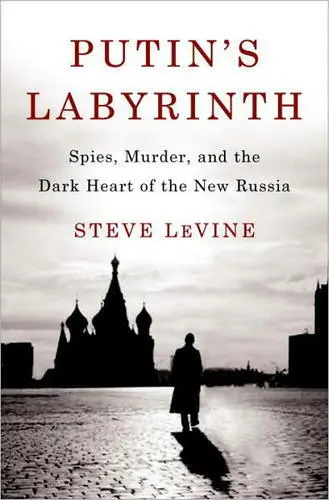
- Название:Putin's Labyrinth
- Автор:
- Издательство:Random House
- Жанр:
- Год:2008
- Город:New York
- ISBN:978-1-58836-815-7
- Рейтинг книги:3 / 5. Голосов: 1
-
Избранное:Добавить в избранное
- Отзывы:
-
Ваша оценка:
Putin's Labyrinth: краткое содержание, описание и аннотация
Предлагаем к чтению аннотацию, описание, краткое содержание или предисловие (зависит от того, что написал сам автор книги «Putin's Labyrinth»). Если вы не нашли необходимую информацию о книге — напишите в комментариях, мы постараемся отыскать её.
Drawing on new interviews with eyewitnesses and the families of victims, LeVine documents the bloodshed that has stained Putin’s two terms as president. Among the incidents chronicled in these pages: The 2002 terrorist takeover of a crowded Moscow theater—which led to the government gassing the building, and the deaths of more than a hundred terrified hostages–seen here from new angles, through the riveting words of those who survived; and the murder of courageous investigative reporter Anna Politkovskaya, shot in the elevator of her apartment building on Putin’s birthday, purportedly as a malicious “gift” for the president from supporters. Finally, a shocking story that made international headlines–the 2006 death of defector Alexander Litvinenko in London—is dramatized as never before. LeVine traces the steps of this KGB-spy-turned-dissident on his way to being poisoned with polonium-210, a radioactive isotope. And in doing so, LeVine is granted a rare series of interviews with a KGB defector who was nearly killed in strangely similar circumstances fifty years earlier. Through LeVine’s exhaustive research, we come to know the victims as real people, not just names in brief news accounts of how they died.
Putin’s Labyrinth
Putin's Labyrinth — читать онлайн бесплатно полную книгу (весь текст) целиком
Ниже представлен текст книги, разбитый по страницам. Система сохранения места последней прочитанной страницы, позволяет с удобством читать онлайн бесплатно книгу «Putin's Labyrinth», без необходимости каждый раз заново искать на чём Вы остановились. Поставьте закладку, и сможете в любой момент перейти на страницу, на которой закончили чтение.
Интервал:
Закладка:
Klebnikov’s supporters began to have misgivings when word got around that the defendants and defense lawyers seemed to relax as the trial wore on. Suspicions arose that someone had tampered with the jury, always a possibility in Russia. In May 2006, the jury acquitted both defendants and the judge ordered their release. The Klebnikov camp felt defeated. But six months later, the Supreme Court intervened—in Russia, there is no concept of double jeopardy—and overturned the acquittals. A new trial was ordered. The second Chechen suspect, Musa Vakhaev, appeared at preliminary hearings, but the accused shooter, Dukuzov, vanished. In his absence, the judge halted all proceedings; the retrial was pending as of this writing.
Like his book publisher, I was not satisfied with the notion that Klebnikov died because of the way he portrayed a Chechen warlord in print. I turned to Mark Franchetti for some insight. He had lived and worked in Moscow for a decade, and was a seasoned reporter. Franchetti figured that a journalist in Russia had to do one of two things to get killed: either get really seriously into someone’s personal life, or ruin someone’s business deal. For instance, in 1994, a twenty-seven-year-old Russian reporter named Dmitri Kholodov was investigating allegations that the then defense minister, Pavel Grachev, and others were selling off military goods for personal gain. One day, a source called to say he had documents that could help advance Kholodov’s corruption probe. When the reporter opened the briefcase supposedly containing the documents, it blew up, killing him.
Investigative reporters in Russia know that the unpublished story poses the greatest danger to the writer. After a piece is printed, the damage is done. But when the makings for a potentially explosive article are still in a journalist’s notebook, everything is at risk, especially the reporter’s personal safety. Some believe Klebnikov was working on a blockbuster at the time of his death, a story involving large sums of money stolen in the multi-billion-dollar reconstruction of Chechnya. Klebnikov’s family, which has access to his computer hard drive and other personal effects, said there was no evidence of such a story. But it is an angle worth further consideration.
It is not possible to know, of course, but I think it likely that Klebnikov would have disapproved of this book, especially my critical view of Putin and the “new Russian state” that he fathered. Klebnikov was a tough reporter in pursuit of elements he felt were sullying the state he loved, but toward the end of his life he thought it was time to write more positively about the country itself. Klebnikov’s wife, Musa, and his brother Peter declined to cooperate while I was doing my research. They specifically objected to his murder being lumped in with the deaths of Litvinenko and others who had defected from Russia or were enemies of Putin, or both. Klebnikov’s story was fundamentally different—he was not one of them—and he did not deserve to be in their company.
But here is the trouble with that reasoning: Klebnikov’s murder repudiated his own message about Russia—that Putin was taking it toward deserved greatness and that it was on the cusp of achieving equal footing with the West. In my opinion, his death sent the opposite message: that Russia was more prosperous but ultimately the same dangerous place it had always been. Putin was following the path dictated by his autocratic predecessors for centuries, glorifying the state over the individual. He was presiding over a system that continued to protect those who killed to further its interests.
It makes no sense to pretend that Klebnikov does not belong in the company of these victims of the Putin era. He crossed the same invisible line as the rest, and it became acceptable for someone to murder him.
In the end, he became the victim of a Russia whose nature he never fully grasped.
CHAPTER 8

Murder on an Elevator
Anna Politkovskaya and the Voiceless of Russia
I NEVER MET THE JOURNALIST ANNA POLITKOVSKAYA. WHEN I covered the First Chechen War, she was in Moscow toiling for a small-time newspaper. By the time the second war rolled around, I had left for Afghanistan and environs. That is when Anna began reporting on the horrors of Chechnya, a career-changing experience that turned her against Vladimir Putin. She soon became the most angry and acid public critic of Putin in all of Russia.
“Putin has, by chance, gotten hold of enormous power and has used it to catastrophic effect,” she once wrote. “I dislike him because he does not like people. He despises us. He sees us as a means to his ends, a means for the achievement and retention of personal power, no more than that. Accordingly, he believes he can do anything he likes with us, play with us as he sees fit, destroy us if he wishes. We are nobody, while he whom chance has enabled to clamber to the top is today czar and God. In Russia we have had leaders with this outlook before. It led to tragedy, to bloodshed on a vast scale, to civil wars.”
My introduction to Anna was Putin’s Russia, her gritty 2004 account of life under the Russian leader. It is a defense of the defenseless, and its powerful language is rich in detail and often moving. She was blessed with unerring intuition and stuck to writing about what she actually saw. Anna was self-possessed, but not self-impressed.
That was all the more remarkable in view of her celebrity abroad and the admiration showered upon her by some of the most hard-bitten Western correspondents in Moscow. Time magazine’s talented war correspondent Yuri Zarakhovich in 2003 wrote that Anna “made her name by writing detailed, accurate and vivid reports on the plight of the civilian population in Chechnya…. She tells stories of people who are taken from their homes at night and never come back; about extra-judicial executions; about the hungry refugees in cold and damp camps.”
A year later, James Meek, a talented reporter with the British newspaper Guardian, described her as “one of the bravest of Russia’s many brave journalists.”
“Her seriousness is not just her frown, her severe glasses and full head of gray hair,” he wrote. “It’s the tension, anger and impatience in her whole body, making clear that her sense of the continual injustice being perpetrated in her homeland never leaves her, that she can’t shut it out in a way almost all British journalists, even the campaigning, radical kind, can.”
In her coda to Putin’s Russia, Anna made this plea: “We cannot just sit back and watch a political winter close in on Russia for several more decades. We want to go on living in freedom. We want our children to be free and our grandchildren to be born free. That is why we long for a thaw in the immediate future, but we alone can change Russia’s political climate.”
The West wasn’t going to help, she continued: “All we hear from the outside world is ‘al-Qaeda, al-Qaeda,’ a wretched mantra for shuffling off responsibility for all the bloody tragedies yet to come, a primitive chant with which to lull a society desiring nothing more than to be lulled back to sleep.”
Anna pushed journalistic boundaries in a way that would be frowned upon in the West: She repeatedly crossed the line between journalist and active participant in events she covered. Trying to resolve the Nord-Ost hostage standoff was an example of that. She thought that playing dual roles was a shrewd strategy.
It was not something I could see myself doing—negotiating with terrorists—but Anna’s style did lead her to a more profound understanding of the play of events and personalities than virtually anyone else I read in Russia.
Читать дальшеИнтервал:
Закладка:
Похожие книги на «Putin's Labyrinth»
Представляем Вашему вниманию похожие книги на «Putin's Labyrinth» списком для выбора. Мы отобрали схожую по названию и смыслу литературу в надежде предоставить читателям больше вариантов отыскать новые, интересные, ещё непрочитанные произведения.







Обсуждение, отзывы о книге «Putin's Labyrinth» и просто собственные мнения читателей. Оставьте ваши комментарии, напишите, что Вы думаете о произведении, его смысле или главных героях. Укажите что конкретно понравилось, а что нет, и почему Вы так считаете.