Steve LeVine - Putin's Labyrinth
Здесь есть возможность читать онлайн «Steve LeVine - Putin's Labyrinth» весь текст электронной книги совершенно бесплатно (целиком полную версию без сокращений). В некоторых случаях можно слушать аудио, скачать через торрент в формате fb2 и присутствует краткое содержание. Город: New York, Год выпуска: 2008, ISBN: 2008, Издательство: Random House, Жанр: Публицистика, на английском языке. Описание произведения, (предисловие) а так же отзывы посетителей доступны на портале библиотеки ЛибКат.
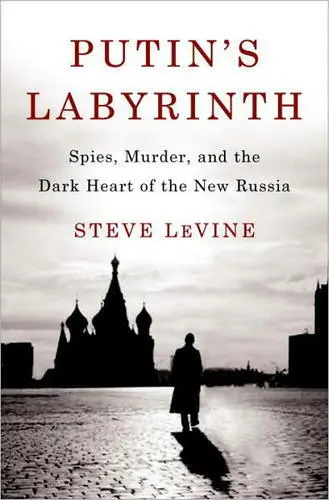
- Название:Putin's Labyrinth
- Автор:
- Издательство:Random House
- Жанр:
- Год:2008
- Город:New York
- ISBN:978-1-58836-815-7
- Рейтинг книги:3 / 5. Голосов: 1
-
Избранное:Добавить в избранное
- Отзывы:
-
Ваша оценка:
Putin's Labyrinth: краткое содержание, описание и аннотация
Предлагаем к чтению аннотацию, описание, краткое содержание или предисловие (зависит от того, что написал сам автор книги «Putin's Labyrinth»). Если вы не нашли необходимую информацию о книге — напишите в комментариях, мы постараемся отыскать её.
Drawing on new interviews with eyewitnesses and the families of victims, LeVine documents the bloodshed that has stained Putin’s two terms as president. Among the incidents chronicled in these pages: The 2002 terrorist takeover of a crowded Moscow theater—which led to the government gassing the building, and the deaths of more than a hundred terrified hostages–seen here from new angles, through the riveting words of those who survived; and the murder of courageous investigative reporter Anna Politkovskaya, shot in the elevator of her apartment building on Putin’s birthday, purportedly as a malicious “gift” for the president from supporters. Finally, a shocking story that made international headlines–the 2006 death of defector Alexander Litvinenko in London—is dramatized as never before. LeVine traces the steps of this KGB-spy-turned-dissident on his way to being poisoned with polonium-210, a radioactive isotope. And in doing so, LeVine is granted a rare series of interviews with a KGB defector who was nearly killed in strangely similar circumstances fifty years earlier. Through LeVine’s exhaustive research, we come to know the victims as real people, not just names in brief news accounts of how they died.
Putin’s Labyrinth
Putin's Labyrinth — читать онлайн бесплатно полную книгу (весь текст) целиком
Ниже представлен текст книги, разбитый по страницам. Система сохранения места последней прочитанной страницы, позволяет с удобством читать онлайн бесплатно книгу «Putin's Labyrinth», без необходимости каждый раз заново искать на чём Вы остановились. Поставьте закладку, и сможете в любой момент перейти на страницу, на которой закончили чтение.
Интервал:
Закладка:
“Paul Lavurda had been deserted on the battlefield and then forgotten,” Anna wrote. “Nobody cared that his body was lying there, or that he had a family awaiting his return. What happened after his death is typical of the army, a disgraceful episode that stands for an ethos in which a human is nothing, in which no one watches over the troops, and there is no sense of responsibility toward the families.”
Anna was born in 1958 in New York, where her father was an interpreter for diplomats at the United Nations. Four years later, the family returned to Russia. Anna grew up as a member of the privileged nomenklatura, the Communist Party equivalent of the West’s upper middle class, with access to hard-to-obtain Western goods and education at select schools.
Her readiness to challenge authority was apparent at an early age. In class, Anna’s best friends cringed each time she shot up to correct something the teacher had said. But she was the top student at School 33, and in her final year she was elected chapter head of the elite Club for International Friendship, part of the Communist Party youth group Komsomol.
She was a journalism student at Moscow State University, the Harvard of the Soviet Union, when she began dating her future husband, Alexander Politkovsky. Their relationship puzzled her friends. He was five years older, prematurely gray, and from a wholly different world: While Anna and her friends were society girls, Alexander was the son of artists and a habitué of Moscow’s dissident crowd. She was a serious thinker; he was a charming rogue with the gift of gab and a taste for drink. Over beers after Anna’s death, he described to me an ideal day: fly-fishing at a brook (the sound of the line hitting the water—“tuk, tuk, tuk”), a flask of whiskey in his breast pocket, a nap on the grass. That was the good-time Alexander.
To Anna, he was a beguiling exotic. One friend recalled her behaving like a schoolgirl around him, asking Alexander to hold her hand and to embrace her. On summer vacation at a Black Sea resort, she could be found each morning in her hotel room with wads of paper strewn across the floor. They were false starts on another daily letter to Alexander.
The two married after twenty-year-old Anna discovered she was pregnant. Her upper-crust parents were so incensed at her choice of a husband (who showed up for the wedding toting a half-finished bottle of vodka inside a bag) that they cut Anna off financially. At first, the newlyweds and their infant son, Ilya, survived on Alexander’s slim earnings as a novice journalist and Anna’s pay for scrubbing floors at a tailor shop. (She lost the job after the tailor tired of her “telling them how to work, how to treat people, how to treat her, a university [student],” said a friend, Elena Morozova.)
As graduation neared, Anna chose a literary outcast as the subject for her senior thesis. Marina Tsvetayeva was a great Soviet poet whose work ranged over the human cost of the Bolshevik revolution, her crushing loneliness, and her sexuality, including hints at lesbianism. Her life was tragic: Her poems were suppressed by Stalin’s government, her White Russian husband was arrested and executed, and Tsvetayeva hanged herself at the age of forty-eight, in 1941. The poet was a controversial choice for a thesis at a Russian university. But Anna was mesmerized and would not be deterred.
At home, life was tense. Anna and Alexander argued constantly. Before long, a second child was born—a girl, Vera. Alexander had earned a toehold in television, but his wages were modest and the couple was just scraping by. Then everything changed. It was the mid-1980s, and Mikhail Gorbachev’s glasnost, or openness, unshackled the Russian press. Alexander became a roving correspondent for a TV news show called Vsglyad, or “Outlook”—a loose version of America’s 60 Minutes. The weekly program electrified the country by daring to challenge the official Kremlin version of events, and it made him an instant celebrity.
In 1990, Anna and her family allowed a Russian filmmaker and crew to share their apartment for six weeks. The resulting documentary, entitled A Taste of Freedom, is mainly about Alexander and the risks he took as a TV journalist challenging the system. But it also provides revealing glimpses of everyday life with the Politkovskys. Alexander, dressed down in trademark denim jacket and red plaid cap crowning his long, wavy hair, plays to the camera. Doe-eyed Anna is coquettish and vulnerable as the housewife.
Her sister Elena told me that Anna was “a crazy mom, very involved with her children,” and that is evident in the film. In one scene, daughter Vera is playing the violin, accompanied on piano by Anna, who insisted that both her children learn music from an early age. (Anna’s friends laughed at their memories of arriving at the door to her apartment and hearing her loud, exasperated voice from inside, “That note isn’t right. Play it right.” It was Anna the perfectionist, but also Anna the realist. On camera, she says that if anything happened to her, Ilya and Vera could earn a living on their own, even if that meant “playing in some restaurant.”)
As the documentary unfolds, Anna is at turns frightened out of her wits about Alexander’s safety while he is on a perilous assignment and chafing that she is stuck at home with domestic chores. Sometimes the dangers follow him to their apartment. Soviets not happy with his reporting leave threats on the family answering machine, including this one from a male caller: “Think about your children. You have two of them, I think.”
Questioned by the filmmaker, Marina Goldovskaya, Anna declares, not entirely convincingly, that she has learned to live with the fear. “I can’t cry twenty-four hours a day,” she says. Should her husband be imprisoned, she adds, friends have invited her and the children to live with them in the countryside far away from Moscow.
As his television career flourished, Alexander began drinking more heavily. Part of it was the lifestyle that came with his fame; when he and Anna were at a party or a restaurant, people rushed to shake his hand and toast him with celebratory rounds of vodka. But she detested his liking for alcohol, especially when nights on the town ended with him being quite drunk, and she felt it was poisoning their marriage.
Anna also fretted over her career ambitions. She had begun writing feature stories for a small newspaper, work that she found less than satisfying. She wanted a career in television like her husband. But he was doing everything he could to block her way, she told friends. In fact, the main problem with their marriage was that neither she nor Alexander was willing or able to play a supporting role to the other, not for any extended period, anyway. Both wanted to be Number 1.
The making of the documentary revealed a preoccupation with her appearance on camera. She was nearly blind without her spectacles, but if she wore them during the filming, no one would notice her best feature—her large dark eyes. What should I do, she wondered aloud. She ended up appearing without eyeglasses throughout the film.
In 1995, she and her husband were shaken by the murders of two friends in Moscow. The television superstar Vlad Listyev, to whom Alexander was especially close, died after being shot outside his house by unidentified assailants, in March. Five months later, the second friend, a forty-six-year-old banker named Ivan Kivelidi who drove around town in a Cadillac and a cowboy hat, went into convulsions in his office, and died. Police said the culprit was a highly lethal poison, either smeared on his telephone or poured into his tea.
Anna’s halting career as a writer began to brighten three years later, when she joined the staff of Obshchaya Gazeta, an independent weekly of note. Her editor was Yegor Yakovlev, the legendary father of the bold newspaper reportage that had erupted under perestroika. The sixty-nine-year-old Yakovlev soon expressed his confidence in Anna by offering her a prized assignment—to accompany him on a trip to Chechnya.
Читать дальшеИнтервал:
Закладка:
Похожие книги на «Putin's Labyrinth»
Представляем Вашему вниманию похожие книги на «Putin's Labyrinth» списком для выбора. Мы отобрали схожую по названию и смыслу литературу в надежде предоставить читателям больше вариантов отыскать новые, интересные, ещё непрочитанные произведения.








Обсуждение, отзывы о книге «Putin's Labyrinth» и просто собственные мнения читателей. Оставьте ваши комментарии, напишите, что Вы думаете о произведении, его смысле или главных героях. Укажите что конкретно понравилось, а что нет, и почему Вы так считаете.