Steve LeVine - Putin's Labyrinth
Здесь есть возможность читать онлайн «Steve LeVine - Putin's Labyrinth» весь текст электронной книги совершенно бесплатно (целиком полную версию без сокращений). В некоторых случаях можно слушать аудио, скачать через торрент в формате fb2 и присутствует краткое содержание. Город: New York, Год выпуска: 2008, ISBN: 2008, Издательство: Random House, Жанр: Публицистика, на английском языке. Описание произведения, (предисловие) а так же отзывы посетителей доступны на портале библиотеки ЛибКат.
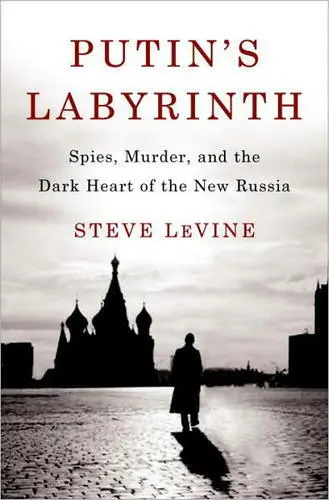
- Название:Putin's Labyrinth
- Автор:
- Издательство:Random House
- Жанр:
- Год:2008
- Город:New York
- ISBN:978-1-58836-815-7
- Рейтинг книги:3 / 5. Голосов: 1
-
Избранное:Добавить в избранное
- Отзывы:
-
Ваша оценка:
Putin's Labyrinth: краткое содержание, описание и аннотация
Предлагаем к чтению аннотацию, описание, краткое содержание или предисловие (зависит от того, что написал сам автор книги «Putin's Labyrinth»). Если вы не нашли необходимую информацию о книге — напишите в комментариях, мы постараемся отыскать её.
Drawing on new interviews with eyewitnesses and the families of victims, LeVine documents the bloodshed that has stained Putin’s two terms as president. Among the incidents chronicled in these pages: The 2002 terrorist takeover of a crowded Moscow theater—which led to the government gassing the building, and the deaths of more than a hundred terrified hostages–seen here from new angles, through the riveting words of those who survived; and the murder of courageous investigative reporter Anna Politkovskaya, shot in the elevator of her apartment building on Putin’s birthday, purportedly as a malicious “gift” for the president from supporters. Finally, a shocking story that made international headlines–the 2006 death of defector Alexander Litvinenko in London—is dramatized as never before. LeVine traces the steps of this KGB-spy-turned-dissident on his way to being poisoned with polonium-210, a radioactive isotope. And in doing so, LeVine is granted a rare series of interviews with a KGB defector who was nearly killed in strangely similar circumstances fifty years earlier. Through LeVine’s exhaustive research, we come to know the victims as real people, not just names in brief news accounts of how they died.
Putin’s Labyrinth
Putin's Labyrinth — читать онлайн бесплатно полную книгу (весь текст) целиком
Ниже представлен текст книги, разбитый по страницам. Система сохранения места последней прочитанной страницы, позволяет с удобством читать онлайн бесплатно книгу «Putin's Labyrinth», без необходимости каждый раз заново искать на чём Вы остановились. Поставьте закладку, и сможете в любой момент перейти на страницу, на которой закончили чтение.
Интервал:
Закладка:
The dangers that she faced because of her fiery articles were quite real. She was imprisoned for four harrowing days by a Russian military unit while in Chechnya to investigate accounts of civilians being brutalized in a concentration camp. Anna said her captors tortured her, but she declined to describe “the details of the interrogations, because they are utterly obscene.” One officer put her through a mock execution and threatened to rape her in a bathhouse. Another officer, identified as an FSB agent, intervened, and she was confined to a bunker until her release.
Anna received multiple threats after writing that a Russian Interior Ministry officer named Sergei “Cadet” Lapin had tortured a prisoner who then vanished. Lapin said he was coming to Moscow to kill her, while an anonymous letter to her newspaper warned that a sniper would be sent to exact revenge. Anna’s editor ordered her to stay home and police assigned four officers to guard her. When a fresh set of threats erupted after she appeared in a televised interview, Anna took temporary refuge in Vienna. Soon her children were calling to report that a woman of Anna’s approximate age, height, and hair color had been murdered in front of her apartment house. They were sure the killer had mistaken the victim for their mother. As for Lapin, he was later convicted in the case Anna had exposed, and sentenced to ten years in prison.
Ramzan Kadyrov, the Chechen prime minister, whom she had accused of atrocities and called an imbecile, also threatened to kill her. Many Chechens seemed to think the pro-Putin Kadyrov was serious, according to Anna. But she discounted his threat. He wouldn’t risk harming her because he would be too obvious a suspect, she reasoned. “The people in Chechnya are afraid for me, and I find that very touching,” Anna wrote. “They fear for me more than I fear for myself, and that is how I survive.” In fact, she did not believe that the greatest risk to her lay in Chechnya; more danger lay elsewhere.
In 2004, Chechen terrorists seized an elementary school in Beslan, in the southern Russian region of North Ossetia. They took some 1,200 children, parents, and teachers hostage and strapped explosives to the interior of the sweltering building. Anna, in Moscow, took matters into her own hands. She telephoned Akhmed Zakayev, the European representative of rebel Chechen leader Aslan Maskhadov, and urged that the latter go quickly to the school and negotiate for the children’s immediate release. Zakayev (who was a friend of Alexander Litvinenko and lived across the street from him, in London) told her that he would get in touch with the rebel commander and try to make that happen.
Along with a mob of other journalists, Anna rushed to a Moscow airport to catch a flight to Beslan, but none could be had. Then a young man approached and identified himself as an airport employee. “Are you Anna Politkovskaya?” he said. “We very much respect your newspaper. We are going to let you on this flight,” referring to a departure to Rostov, from which she could drive to Beslan. According to Anna’s account, he said that someone from the FSB had directed him to put her on the flight.
On board, Anna asked for a cup of tea. Within minutes of drinking it, she became extremely ill. She later recalled that aircraft crew members “beat me on the face and asked me, cried to me, ‘Please don’t die. Don’t die.’” An unconscious Anna was hospitalized in Rostov and given emergency care. A nurse later told her she was “almost hopeless” when brought in. “My dear, they tried to poison you,” the nurse said. Doctors who treated her later in Moscow confirmed that her symptoms were consistent with poisoning. But the substance that nearly killed her was never identified.
Anna was irritated at her own carelessness. How vain to think that airport personnel would recognize her so readily. She should have had second thoughts when they let her on the plane without demanding a passport or any other document. The thought that something was wrong had never crossed her mind.
She never made it to Beslan, where bedlam broke out after a three-day standoff. Shooting and explosions erupted as children began to pour out of the schoolhouse and terrorists tried to make their escape. In the end, some 330 children and adults were killed.
Anna’s commitment to Chechnya made those close to her anxious about her well-being. Dima Muratov, her editor, wondered if it was time she turned to topics right in Moscow. At one point, he ordered her to stop going to Chechnya, but she went anyway.
Many family and friends thought she was in grave danger and regularly pleaded with her to stay home. Elena Baranovskaya, the Nord-Ost mother who now was Anna’s friend, said she and others in the Nord-Ostsi survivors’ group were aghast at the Chechnya articles. “Why are you writing this stuff?” Elena asked. “It’s so dangerous.” Anna’s curt response was, “Well, don’t read it.”
But she let down her guard in a conversation with Alexander Litvinenko in London. She told the onetime KGB officer that she feared entering her apartment building—every time she stood in its dimly lit entryway, she thought someone might be lurking in the shadows. He gave her tips on how to safely enter the building, but said the only sure way to be safe was to leave Russia.
It was the same advice she got from her brother-in-law, Yuri Kudimov, himself an ex–KGB officer and now a wealthy banker in Moscow. “You live in a country where someone could be shot because of a thousand-dollar debt,” he told Anna. “Think about that,” he said.
You’re right, Anna replied, but I’m not ready to give up my job. “I’ve got to do it because I like it,” she said, “but it’s also how I make my money.”
Yuri thought that Anna should at least have a sure way to get out of the country—just in case. The wisest course, he argued, was to take advantage of her birthright and obtain an American passport. With Anna’s consent, he prevailed on U.S.-based friends from his KGB days to collect the necessary documentation from New York archives. The U.S. embassy in Moscow issued the passport, but she showed no inclination to put it to immediate use.
Her friendship with Yuri puzzled me at first. As an undercover KGB agent, he had traveled the globe in the guise of a journalist. His wife, Elena—Anna’s older sister—had accompanied him. One would think that Anna would be bothered by his service in an agency she hated, and surely displeased that her sister had married him. But the matter was not that simple.
Anna and Yuri had been friends for a quarter century, ever since he began dating her sister. There is a charming story of how he impersonated a visiting Canadian to enable Anna to save face at her high school. Elena, already a university student, came home one day to find her sister “at the point of breaking.” Anna had agreed to organize a school assembly with a foreign student as guest of honor. She had found a Cuban boy to fill the role, but at the last minute he had canceled. Now Anna’s prestige was on the line.
Elena called Yuri, her strapping twenty-one-year-old boyfriend. “Don’t worry,” he said. “I’ll be the foreigner.”
The following day, Anna stood before the assembly. We have a Canadian guest, she told the students. Yuri stood. He was wearing a borrowed denim jacket and T-shirt, with a pack of Philip Morris cigarettes stuffed in the front pocket—his best effort to look like a Westerner. Using what he later called “bad Russian” (he didn’t think his English would pass muster), he proceeded to describe life in Canada. He talked about Canadian literature and politics, and handed out cigarettes to some of the boys. He was an absolute hit, and Anna was showered with praise. Her English teacher was the only skeptic, suggesting that next time it would be more “ideologically correct” to invite a Communist brother from Poland or Czechoslovakia.
Читать дальшеИнтервал:
Закладка:
Похожие книги на «Putin's Labyrinth»
Представляем Вашему вниманию похожие книги на «Putin's Labyrinth» списком для выбора. Мы отобрали схожую по названию и смыслу литературу в надежде предоставить читателям больше вариантов отыскать новые, интересные, ещё непрочитанные произведения.









Обсуждение, отзывы о книге «Putin's Labyrinth» и просто собственные мнения читателей. Оставьте ваши комментарии, напишите, что Вы думаете о произведении, его смысле или главных героях. Укажите что конкретно понравилось, а что нет, и почему Вы так считаете.