George Friedman - The Next Decade
Здесь есть возможность читать онлайн «George Friedman - The Next Decade» весь текст электронной книги совершенно бесплатно (целиком полную версию без сокращений). В некоторых случаях можно слушать аудио, скачать через торрент в формате fb2 и присутствует краткое содержание. Город: New York, Год выпуска: 2011, ISBN: 2011, Издательство: Doubleday, Жанр: Публицистика, Политика, на английском языке. Описание произведения, (предисловие) а так же отзывы посетителей доступны на портале библиотеки ЛибКат.

- Название:The Next Decade
- Автор:
- Издательство:Doubleday
- Жанр:
- Год:2011
- Город:New York
- ISBN:978-0-385-53295-2
- Рейтинг книги:5 / 5. Голосов: 1
-
Избранное:Добавить в избранное
- Отзывы:
-
Ваша оценка:
The Next Decade: краткое содержание, описание и аннотация
Предлагаем к чтению аннотацию, описание, краткое содержание или предисловие (зависит от того, что написал сам автор книги «The Next Decade»). Если вы не нашли необходимую информацию о книге — напишите в комментариях, мы постараемся отыскать её.
bestseller
now focuses his geopolitical forecasting acumen on the next decade and the imminent events and challenges that will test America and the world, specifically addressing the skills that will be required by the decade’s leaders. The next ten years will be a time of massive transition. The wars in the Islamic world will be subsiding, and terrorism will become something we learn to live with. China will be encountering its crisis. We will be moving from a time when financial crises dominate the world to a time when labor shortages will begin to dominate. The new century will be taking shape in the next decade.
In
, George Friedman offers readers a provocative and endlessly fascinating prognosis for the immediate future. Using Machiavelli’s
as a model, Friedman focuses on the world’s leaders—particularly the American president—and with his trusted geopolitical insight analyzes the complex chess game they will all have to play. The book also asks how to be a good president in a decade of extraordinary challenge, and puts the world’s leaders under a microscope to explain how they will arrive at the decisions they will make—and the consequences these actions will have for us all.
The Next Decade — читать онлайн бесплатно полную книгу (весь текст) целиком
Ниже представлен текст книги, разбитый по страницам. Система сохранения места последней прочитанной страницы, позволяет с удобством читать онлайн бесплатно книгу «The Next Decade», без необходимости каждый раз заново искать на чём Вы остановились. Поставьте закладку, и сможете в любой момент перейти на страницу, на которой закончили чтение.
Интервал:
Закладка:
By moving too slowly, the United States allowed the Russians to regain their balance, just as the U.S. was losing its own strategic balance in Iraq. At the very moment that it needed to concentrate power on the Russian periphery to lock into place its containment system, the United States had its forces elsewhere, and its alliances in Europe were too weak to be meaningful. It is to avoid such missteps and missed opportunities that the American president will need to adopt a new and more consistent strategy in the decade ahead.
THE REEMERGENCE OF RUSSIA
In the long run, Russia is a weak country. Putin’s strategy of focusing on energy production and export is a superb short-term tool, but it works only if it forms the basis for major economic expansion. To achieve this larger objective, Russia has to deal with its underlying structural weaknesses, yet these weaknesses are rooted in geographical problems that are not readily overcome.
Unlike much of the industrial world, Russia has both a relatively small population for its size and a population that is highly dispersed, tied together by little more than a security apparatus and a common culture.
Even the major cities, such as Moscow and St. Petersburg, are not the centers of a giant megalopolis. They are stand-alone entities, separated from each other by vast distances of farmland and forest. Leaving apart the fact that the Russian population is in decline, the current distribution of population makes a modern economy, or even efficient distribution of food, difficult, if not impossible. The infrastructure connecting farming areas to the city is poor, as is the infrastructure connecting industrial and commercial centers.
The problem in connectivity stems from the fact that Russia’s rivers go the wrong way. Unlike American rivers, which connect farming country to ports where food can be distributed, Russian rivers merely create barriers. Neither the czars and their railway bonds nor Stalin with his enforced starvation ever came close to overcoming the problem, and the cost of building a connective tissue for the Russian economy—extensive rail systems and roads—remains staggering. Russia has always wielded a military force that outstripped its economy, but it cannot do so forever.
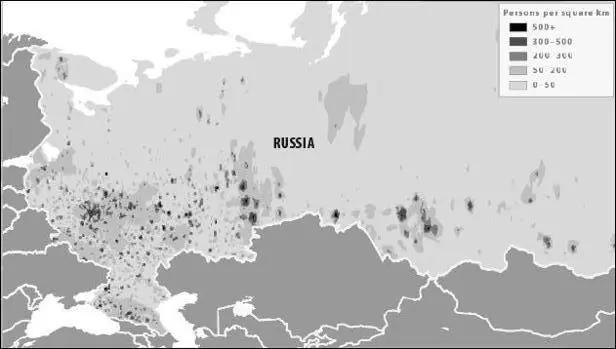
Russia must concentrate on the short term while it has the twin advantages of German dependence on its energy and America’s distraction in the Middle East. It must try to create lasting structures—some of them domestic, some foreign—that can hold together even in the face of economic limitations.
The domestic structure is already emerging, with Russia, Belarus, and Kazakhstan having reached agreement on an economic union and now discussing a common currency. Armenia, Kyrgyzstan, and Tajikistan have expressed interest in joining in, and Russia has floated the idea of Ukraine joining as well. This is a relationship that will evolve into a political union of some sort, like the European Union, an alignment that will go far in re-creating the central features of the former Soviet Union.
The international structure Russia needs is perhaps more important and problematic. It begins with a relationship with Europe, particularly Germany. Russia needs access to technology, which the Germans have in abundance, while Germany needs access to Russian natural resources. Germany fought two wars to get hold of these resources but failed. Its interest in these resources has not diminished, but its means are now diplomatic rather than military. The desire to exploit this complementary relationship will be at the heart of Russian strategy during the next ten years.
Germany is the driving force of the European Union, which, as we will see, carries with it unexpected burdens. Germany has little interest in American operations in the Middle East and no interest whatever in expanding NATO, and with it American influence, to the Russian periphery. It wants to keep its distance from the United States, and it needs options other than the EU. Closer cooperation with Russia is not a bad idea from Germany’s point of view, and it is an outstanding idea from Russia’s point of view. Putin knows the Germans well enough to understand their fear and distrust of Russia. But he also knows them well enough to realize that they have outgrown the postwar world, are facing serious economic problems of their own, and need Russian resources.
The simultaneous reconstruction of a Russian-dominated sphere of influence and the creation of structural relations with Germany is an idea that Russia needs to push, and push quickly, since time is not on its side. It must convince Germany that it can be a reliable partner without taking any steps to disrupt the EU or Germany’s relations with it. These developments will be a ballet backed by real, if transitory, power.
To have any chance for maneuvering in the coming years, Russia must split the United States from Europe. At the same time, it will do everything it can to keep the United States bogged down in Iraq, Afghanistan, and, if possible, Iran. From the Russian point of view, the U.S.-jihadist war is like Vietnam: it relieves Russia of the burden of dealing with the American military, and it actually makes the Americans dependent on Russian cooperation in measures such as imposing sanctions on countries like Iran. The Russians can play the Americans indefinitely by threatening to ship weapons to anti-American groups and to countries such as Iran and Syria. This locks the United States in place, trying to entice the Russians when in fact the only thing the Russians want the Americans to do is to remain permanently bogged down in the war.
This Russian strategy reveals the price of the American overcommitment to the war on terror. It also shows that it is imperative for the United States to find an effective response to radical Islam, as well as an effective response to the Russians. Lurking behind each Russian move is a potential geopolitical nightmare for the Americans.
THE AMERICAN STRATEGY
The American interest in Eurasia—understood as Russia and the European peninsula—is the same as U.S. interest everywhere: for no single power or coalition to dominate. The unification of Russia and Europe would create a force whose population, technological and industrial capability, and natural resources would at the very least equal America’s, and in all likelihood outstrip them.
During the twentieth century, the United States acted three times to prevent the kind of Russian-German entente that could unify Eurasia and threaten fundamental American interests. In 1917, Russia’s separate peace with the Germans turned the tide against the Anglo-French in World War I. The U.S. intervened in World War II, supplying the British and especially the Soviets, who bled the Wehrmacht and prevented a German takeover of the vast Russian territories. In 1944, the United States then invaded Western Europe, blocking not only the Germans but the Soviets as well. From 1945 to 1991, the United States devoted enormous resources to preventing the Soviets from dominating Eurasia.
The response of the United States to a Russian-German entente must be the same during the next ten years as it was in the twentieth century. The United States must continue to do everything it can to block a German-Russian entente and to limit the effect that Russia’s sphere of influence might have on Europe, because the very presence of a militarily powerful Russia changes the way Europe behaves.
Germany is the European center of gravity, and if it shifts its position, other European countries will have to shift accordingly, with perhaps enough countries moving to tilt the balance of the entire region. As Russia reconstitutes and solidifies its hold on the countries of the former Soviet Union, it will be able to take most of those countries along. However informal the relationship might be at the beginning, it will solidify into something more substantial over time, because the parts simply fit together too neatly for it to be otherwise. This would be a historic redefinition of U.S.-European relations, a fundamental shift not only in the regional but also in the global balance of power, with outcomes that are highly unpredictable.
Читать дальшеИнтервал:
Закладка:
Похожие книги на «The Next Decade»
Представляем Вашему вниманию похожие книги на «The Next Decade» списком для выбора. Мы отобрали схожую по названию и смыслу литературу в надежде предоставить читателям больше вариантов отыскать новые, интересные, ещё непрочитанные произведения.




Обсуждение, отзывы о книге «The Next Decade» и просто собственные мнения читателей. Оставьте ваши комментарии, напишите, что Вы думаете о произведении, его смысле или главных героях. Укажите что конкретно понравилось, а что нет, и почему Вы так считаете.