Nick Reding - Methland
Здесь есть возможность читать онлайн «Nick Reding - Methland» весь текст электронной книги совершенно бесплатно (целиком полную версию без сокращений). В некоторых случаях можно слушать аудио, скачать через торрент в формате fb2 и присутствует краткое содержание. Город: New York, Год выпуска: 2009, ISBN: 2009, Издательство: Bloomsbury USA, Жанр: Публицистика, на английском языке. Описание произведения, (предисловие) а так же отзывы посетителей доступны на портале библиотеки ЛибКат.
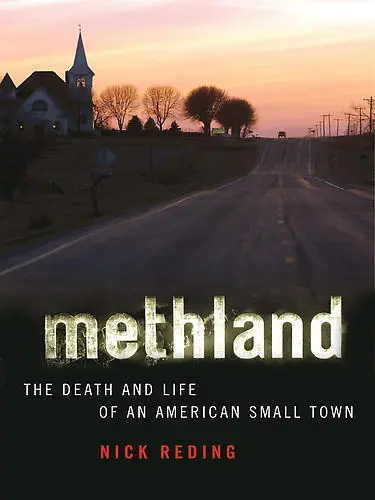
- Название:Methland
- Автор:
- Издательство:Bloomsbury USA
- Жанр:
- Год:2009
- Город:New York
- ISBN:978-1-60819-156-7
- Рейтинг книги:3 / 5. Голосов: 1
-
Избранное:Добавить в избранное
- Отзывы:
-
Ваша оценка:
Methland: краткое содержание, описание и аннотация
Предлагаем к чтению аннотацию, описание, краткое содержание или предисловие (зависит от того, что написал сам автор книги «Methland»). Если вы не нашли необходимую информацию о книге — напишите в комментариях, мы постараемся отыскать её.
Methland Over a period of four years, journalist Nick Reding brings us into the heart of Oelwein through a cast of intimately drawn characters, including: Clay Hallburg, the town doctor, who fights meth even as he struggles with his own alcoholism; Nathan Lein, the town prosecutor, whose caseload is filled almost exclusively with meth-related crime; and Jeff Rohrick, a meth addict, still trying to kick the habit after twenty years.
Tracing the connections between the lives touched by the drug and the global forces that set the stage for the epidemic,
offers a vital and unique perspective on a pressing contemporary tragedy.
Methland — читать онлайн бесплатно полную книгу (весь текст) целиком
Ниже представлен текст книги, разбитый по страницам. Система сохранения места последней прочитанной страницы, позволяет с удобством читать онлайн бесплатно книгу «Methland», без необходимости каждый раз заново искать на чём Вы остановились. Поставьте закладку, и сможете в любой момент перейти на страницу, на которой закончили чтение.
Интервал:
Закладка:
Mafia history in Oelwein is taken today as a foregone conclusion. It’s a piece of the town’s cultural tapestry that’s at once as obvious as the cornfields and the railroad tracks and as illusory as the fading memories of the rail workers who once rubbed elbows with such American luminaries as Bugsy Malone and Jimmy Hoffa. Whether Little Chicago was really ever a cooling-out place for mobsters who needed a few days away from the heat in the Windy City is arguable, though the stories seem too well known, too oft-repeated, and too finely detailed to be false. These include how, for instance, the homes of three particular Italian families were not only immediately rebuilt but were rebuilt in grander style shortly after the tornado of 1968 nearly wiped Oelwein from the map. According to Clay and Nathan, those families—the Leos, the Pirillos, and the Vanattas—owned the bars and the clubs on Main Street beneath which the gaming dens were located, replete with revolving doors and hidden rooms dating back to Prohibition. The Sportsmen’s Lounge was founded by Dominic and Pete Pirillo shortly after they returned from World War II; they’d served only after an Oelwein judge gave them a choice between the army and jail. The Sportsmen’s was famed as much for the Pirillos’ twenty-four-hour slow-cooked prime rib as for the poker game that reportedly went on for five decades in the back room, which regularly had an audience of what were politely referred to as “dancing girls.” Mafiosi, people swear around Oelwein, would circulate between the Pirillos’ bar, the Leos’ Highway 150 South Club, and the Vanattas’ Pink Pussycat, all the while unafraid that any of Oelwein’s three cops (one of whom was part-time) would give them up to federal agents sent from Chicago.
The only undeniable truth in all the stories is that the more sinister side of the “good old days” has either been forgotten completely or has come to be shrouded in the golden glow of longing. Today, the Sportsmen’s Lounge is little more than a hulking afterthought. In place of the prime rib—which Larry Murphy remembers as being so tender you could cut it with a fork—there is something called a Blooming Onion, which involves a Vidalia that’s been crosscut, battered, and deep-fried. And that’s only when the Sportsmen’s is open, which doesn’t seem to be that often. The meaning of the place is palpable, if not quite tangible, and is less about that particular structure than the era in Oelwein’s history it evokes. Clay Hallberg laments the loss of the raucous Saturday nights of yore at the Pink Pussycat strip club, after which he claims Mrs. Vanatta would make her girls sit in the front pew down the street at Sacred Heart Catholic Church. Nathan Lein wishes that there was a strip club somewhere—anywhere—closer than Waterloo. Seventy-five-year-old Herman “Gus” Gaddow, a former rail-man turned farrier, thinks back fondly on the 1950s and 1960s. Back then, says Gus, people had good manners, and three cops were enough to keep crime non existent. The implication is that no one stepped out of line for fear of having to answer to the boys from Chicago. It’s in this way that the melding of Oelwein’s history and present circumstance provides a case study of the complexity of trying to regain a throne that was perhaps epically tarnished in its heyday.
And so it seemed only fitting that the key to Murphy’s economic stimulus plan was the Industrial Park, kitty-corner from the Sportsmen’s, where in March 2006 a gridded road system already cut the acreage into blocks. Among the weeds sprouting up now that the farmer who once leased those 250 acres was no longer spraying herbicide, a sign read “Oelwein Industrial Park—Come Grow with Us!” Murphy said the city had been courting a call center to lease the space, but it had two competitors: a similar-sized town in Nebraska and a town near Mumbai, India. If the call center prospect fell through, there were bound to be other options, said Murphy. It just wasn’t entirely clear what they might be, or when they’d make themselves available. Meanwhile, things in Oelwein were growing more desperate every month. On March 17, 2006, Tyson had closed the doors of what had, a long time ago, been the old Iowa Ham plant, costing the town another hundred jobs. Upon getting the news, Murphy chose to look at things with his characteristic optimism. Rock bottom, he observed, provides a firm foundation. From there, Oelwein could do nothing but push itself up.
Larry Murphy is fifty-five years old. A compactly built five feet eight, he has the sun-bleached blond hair of a road worker; dry, ruddy cheeks; and an open, friendly face dominated by a wide nose and alert, mischievous blue eyes. He keeps his hair short and wears aviator-style Ray-Ban sunglasses. Murphy put himself through school—first at tiny Loras College, in Dubuque, Iowa, and then at Drake University, from which he graduated in 1975 with a degree in journalism—by working the graveyard shift on the kill-floor of a slaughterhouse in Davenport, Iowa. Before the night’s work began, he says, he’d head across the street to the bar with the axmen and the sledge-heads who’d worked at the plant for decades. They drank boilermakers—shots of whiskey dropped into pints of beer—to help deal with a job that was by turns brutally boring and just plain brutal.
Murphy is a lifelong Democrat who makes his political home on a tightrope stretched between a staunch support of unions and a solid rejection of abortion. He works at home, in the den of his house, in order to save Oelwein the money it would cost for him to have a proper office. Political activism predicated on liberal fiscal beliefs seems less a calling for Murphy and more a part of his genetic coding. He was in his twenty-fourth straight year of elective office in Iowa, including stints as county supervisor, state senator, and now, mayor. One of his seven surviving siblings, Pat, had just become Speaker of the Iowa House of Representatives after seventeen years in office. Murphy’s father worked at the telephone company in Dubuque for thirty years and was a lifelong member of the Communications Workers of America. Murphy’s sister Margaret left a convent in order to organize migrant laborers in California and Arizona on behalf of César Chavez. His brother David is a former welder turned nurse, and his brother Bob is a negotiator for the United Food and Commercial Workers. Murphy himself organized his first labor union, at a grocery store in Dubuque, in 1959, when he was fourteen years old.
Murphy said he had little trouble understanding why people with difficult, low-income jobs would do methamphetamine, and why, once they’d lost those jobs or had their wages slashed, they’d turn to making the drug themselves. Murphy knew well the utility of a little pick-me-up before beginning the graveyard shift at a slaughterhouse, even back in the day when you could make a decent wage, get health insurance, buy a car, and put yourself through college doing that kind of work. It angered Murphy that trends in the industries that had once buoyed towns like Oelwein now contributed to the numbers of people digging in the trash behind the Conocostation. To scenes like this, Murphy still reacted with disbelief. Every time he saw a destitute person in his town, it got his dander up. A proud, action-oriented Midwesterner, Murphy just couldn’t square what he saw now with the little town he’d moved to in 1977. The rundown homes and the trash piling up on the lawns broke his heart. What bothered him most were the kids who, abandoned by their parents and set adrift in the foster care system, flunked out of Oelwein High. At that point, those same kids were summarily condemned to the Alternative School, which, for an astonishingly bleak 60 percent of the students, was nothing more than a stepping-stone to jail. It killed Murphy, he said, that there was no money to help the kids of addicts or their parents, beyond visits by underpaid and overworked DHS in-home caseworkers. That, or the Northeast Iowa Behavioral Health Clinic, which had but one addiction specialist to minister to the needs of a town of over six thousand people.
Читать дальшеИнтервал:
Закладка:
Похожие книги на «Methland»
Представляем Вашему вниманию похожие книги на «Methland» списком для выбора. Мы отобрали схожую по названию и смыслу литературу в надежде предоставить читателям больше вариантов отыскать новые, интересные, ещё непрочитанные произведения.









Обсуждение, отзывы о книге «Methland» и просто собственные мнения читателей. Оставьте ваши комментарии, напишите, что Вы думаете о произведении, его смысле или главных героях. Укажите что конкретно понравилось, а что нет, и почему Вы так считаете.