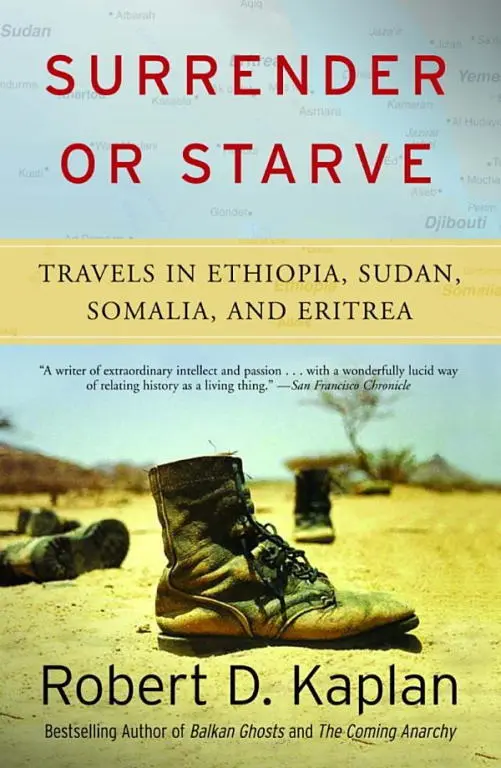
Robert Kaplan - Surrender or Starve
Здесь есть возможность читать онлайн «Robert Kaplan - Surrender or Starve» весь текст электронной книги совершенно бесплатно (целиком полную версию без сокращений). В некоторых случаях можно слушать аудио, скачать через торрент в формате fb2 и присутствует краткое содержание. Город: New York, Год выпуска: 2003, ISBN: 2003, Издательство: Vintage Books, Жанр: Публицистика, nonf_military, на английском языке. Описание произведения, (предисловие) а так же отзывы посетителей доступны на портале библиотеки ЛибКат.
- Название:Surrender or Starve
- Автор:
- Издательство:Vintage Books
- Жанр:
- Год:2003
- Город:New York
- ISBN:978-0-307-54768-2
- Рейтинг книги:5 / 5. Голосов: 1
-
Избранное:Добавить в избранное
- Отзывы:
-
Ваша оценка:
Surrender or Starve: краткое содержание, описание и аннотация
Предлагаем к чтению аннотацию, описание, краткое содержание или предисловие (зависит от того, что написал сам автор книги «Surrender or Starve»). Если вы не нашли необходимую информацию о книге — напишите в комментариях, мы постараемся отыскать её.
, Kaplan illuminates the fault lines in the Horn of Africa, which is emerging as a crucial region for America’s ongoing war on terrorism.
Reporting from Sudan, Ethiopia, Somalia, and Eritrea, Kaplan examines the factors behind the famine that ravaged the region in the 1980s, exploring the ethnic, religious, and class conflicts that are crucial for understanding the region today. He offers a new foreword and afterword that show how the nations have developed since the famine, and why this region will only grow more important to the United States. Wielding his trademark ability to blend on-the-ground reporting and cogent analysis, Robert D. Kaplan introduces us to a fascinating part of the world, one that it would behoove all of us to know more about.
Surrender or Starve — читать онлайн бесплатно полную книгу (весь текст) целиком
Ниже представлен текст книги, разбитый по страницам. Система сохранения места последней прочитанной страницы, позволяет с удобством читать онлайн бесплатно книгу «Surrender or Starve», без необходимости каждый раз заново искать на чём Вы остановились. Поставьте закладку, и сможете в любой момент перейти на страницу, на которой закончили чтение.
Интервал:
Закладка:
When the Carter team took over the State Department, the Soviets, who had made Somalia into a regional military power far out of proportion to its size, already were beginning to sense opportunities next door in Ethiopia. Somalia was an example of how the Soviets, contrary to popular belief, understood Africa better than the United States did. The United States gave millions in development aid after independence in 1960 and then in 1962 offered Somalia $10 million in security assistance. The Somalis said no thanks and took a $32 million offer from the Soviet Union instead. Moscow used its entrée to develop ties within the Somali officers’ corp. In 1969 came General Siad Barre’s coup, which the Kremlin very well may have had a hand in, and Soviet-Somali relations blossomed. Soon U.S. Peace Corps volunteers were being stoned in the streets of the Somali capital of Mogadishu thanks to a Soviet disinformation campaign. Between 1970 and 1975, the Somali army was increased from twelve thousand to twenty-three thousand soldiers. The Soviets supplied hundreds of tanks and fifty-five combat aircraft.
The presence of ethnic Somalis in Ethiopia’s Ogaden desert made Somalia an irredentist state, and the Soviets obviously were taking advantage of Siad Barre’s dreams of conquest and a Great Somalia. The six thousand Soviets in Somalia strutted about as if they owned the place. Naturally they were hated. It didn’t matter. Their bull-in-a-china-shop approach never betrayed them. Although the Soviets eventually would leave Somalia, it was only because they had decided to jump ship to Somalia’s number one enemy, Ethiopia, thus giving Siad Barre no choice but to accept the Americans as sloppy seconds.
As the revolution began to devour its children in Ethiopia, both the Soviets and the irredentist Somalis sensed great opportunities for themselves. Armed to the teeth by the Soviet Union, General Siad was finally in a position to attack his historic enemy, now weakened by revolutionary violence and turmoil. The Soviets, however, were becoming more and more intrigued by a different kind of opportunity: the line of bodies in Addis Ababa was forming a road for them to enter on. Ethiopia was always the prize of the region, which the United States had and which the Soviet Union now wanted. Somalia was but a country of three million people, mostly illiterate nomads, who lived and worked as if hypnotized by the merciless sun and humidity of the Indian Ocean. Ethiopia had ten times as many people, and many of those people were hard-working and culturally developed highlanders, whom the Soviets knew would make excellent fodder for the kind of mechanized African satellite state that they hoped to build. Regardless of a country’s size and place on the map, in the final analysis it can be judged only by the talent of the people who live in it. (Israel is a perfect example.) The Soviets knew what every experienced Africa hand had long been aware of: that the highland Ethiopians—whether Amhara, Tigrean, Eritrean, or Oromo—were the hard-working, efficient people of black Africa. Somalia, a steamy, barely populated hell-hole, never could be anything but a strategic bit of real estate suitable for a naval base or a landing strip. But Ethiopia… now there was a place that could be made into something!
The Kremlin initially thought it could create an entente between the two sworn enemies, with the Soviet Union guaranteeing the sovereignty of Ethiopia and Somalia under an umbrella of military aid; sort of like the arrangement the United States had with Greece and Turkey, both of whom were forever quarreling yet never actually went to war because each was dependent for supplies on the United States, which had bases in both countries. As with Greece and Turkey, the Kremlin wanted to make Ethiopia and Somalia part of a larger alliance that would include Marxist South Yemen and hopefully, someday, North Yemen and Djibouti as well, thus effectively choking off the West at its Red Sea oil windpipe.
In December 1976, the final month of Henry Kissinger’s reign as the vicar of U.S. foreign policy, the Soviets offered $385 million in military aid to the Ethiopian Dergue while trying to reassure the Somalis at the same time. By this time, the Dergue already had switched ideological gears by declaring a commitment to “scientific socialism.” But checkmate was still at least several moves away. The Dergue still was receiving M-60 tanks and F-5 warplanes from the United States, courtesy of Kissinger’s foresight. Consequently, Mengistu was hesitant about going through the disruptive task of switching armorers for an entire army. Moreover, the Dergue still was receiving weapons and U.S. spare parts from an important U.S. ally in the region, Israel, whose position in revolutionary Ethiopia was somewhat better than its position later would be in revolutionary Iran. (The Mossad had trained Haile Selassie’s secret service, and partly for historical and cultural reasons, Israel had developed close ties with the emperor. As with Iran, the relationship existed at so many levels of the Ethiopian bureaucracy that it never was severed totally after Haile Selassie was deposed, especially inside the military. But there the similarities ended. The mass of Ethiopians—Christians and Africanized Moslems—did not hate Israel with the same intensity as did the fundamentalist Shias in Iran; thus, the links with Israel that survived the Ethiopian revolution did not have to be denied by the new regime to quite the same degree as they have been by the authorities in Iran.)
In the early spring of 1977, as the Carter team was in the process of washing its hands of Ethiopia due to massive human rights violations, the Soviets had dispatched East German security police to Addis Ababa to help Mengistu consolidate his revolution, while sending Cuban leader Fidel Castro on a peacekeeping mission to both Ethiopia and Somalia. Admittedly, Carter faced a tough choice. Given the ongoing bloodbath in Ethiopia, it is doubtful whether any administration, liberal or conservative, would have wanted to, or would have been able to, continue delivering U.S. arms at an undisturbed pace to the Dergue. But considering the stakes for the United States and the people of the region, the military aid relationship did not have to be completely severed, as it was in April and May 1977. The situation still was not irreversible, however. As the Horn moved toward a momentous sequence of events in mid 1977, the United States would have other opportunities to remain engaged.
Carter’s decision to cut off all arms deliveries apparently removed all further restraints from Mengistu and the Eastern bloc. In early April, Mengistu flew to Moscow for a week-long state visit where he signed the Declaration of the Foundation for Relationships and Cooperation, which laid the groundwork for one of the most massive Soviet arms transfers ever in the Third World. Within days, Cuban soldiers were sent to Ethiopia directly from Somalia, and tanks and armored personnel carriers began arriving from South Yemen. On May 1, the Red Terror began with the assistance of Mengistu’s newly arrived East German security advisers. During the coming months, hundreds of Ethiopian teenagers would be gunned down in the streets of Addis Ababa.
Following Castro’s ill-fated attempt at peacemaking, Supreme Soviet Presidium Chairman Nikolai Podgorny paid an official visit to Mogadishu in another effort to get the Somalis to accept the new reality—of Soviet support for both them and the Ethiopians. But General Siad was having none of it. Somalia was in a better position than ever for invading Ethiopia, and the Somali leader was willing to risk his relationship with the Soviets rather than let the opportunity pass. Although for a little while longer the Soviets would find themselves the chief arms supplier for both countries, the Kremlin already had made the decision to forfeit Somalia if necessary in return for a bigger prize.
Читать дальшеИнтервал:
Закладка:
Похожие книги на «Surrender or Starve»
Представляем Вашему вниманию похожие книги на «Surrender or Starve» списком для выбора. Мы отобрали схожую по названию и смыслу литературу в надежде предоставить читателям больше вариантов отыскать новые, интересные, ещё непрочитанные произведения.







Обсуждение, отзывы о книге «Surrender or Starve» и просто собственные мнения читателей. Оставьте ваши комментарии, напишите, что Вы думаете о произведении, его смысле или главных героях. Укажите что конкретно понравилось, а что нет, и почему Вы так считаете.