Robert Kaplan - Surrender or Starve
Здесь есть возможность читать онлайн «Robert Kaplan - Surrender or Starve» весь текст электронной книги совершенно бесплатно (целиком полную версию без сокращений). В некоторых случаях можно слушать аудио, скачать через торрент в формате fb2 и присутствует краткое содержание. Город: New York, Год выпуска: 2003, ISBN: 2003, Издательство: Vintage Books, Жанр: Публицистика, nonf_military, на английском языке. Описание произведения, (предисловие) а так же отзывы посетителей доступны на портале библиотеки ЛибКат.
- Название:Surrender or Starve
- Автор:
- Издательство:Vintage Books
- Жанр:
- Год:2003
- Город:New York
- ISBN:978-0-307-54768-2
- Рейтинг книги:5 / 5. Голосов: 1
-
Избранное:Добавить в избранное
- Отзывы:
-
Ваша оценка:
Surrender or Starve: краткое содержание, описание и аннотация
Предлагаем к чтению аннотацию, описание, краткое содержание или предисловие (зависит от того, что написал сам автор книги «Surrender or Starve»). Если вы не нашли необходимую информацию о книге — напишите в комментариях, мы постараемся отыскать её.
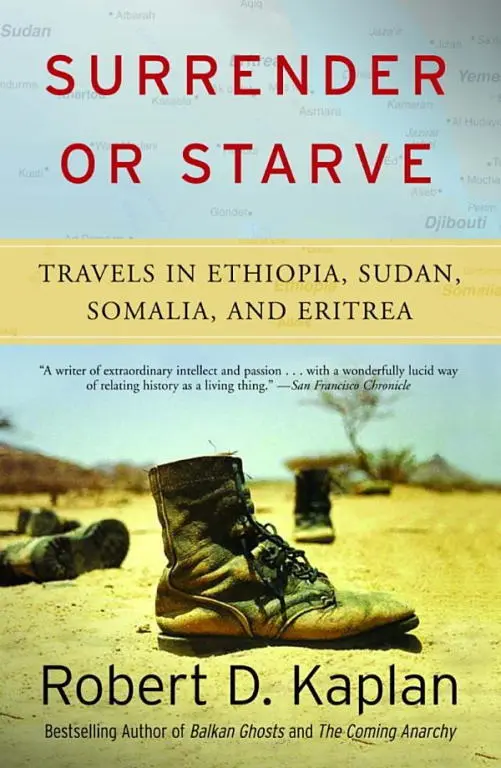
, Kaplan illuminates the fault lines in the Horn of Africa, which is emerging as a crucial region for America’s ongoing war on terrorism.
Reporting from Sudan, Ethiopia, Somalia, and Eritrea, Kaplan examines the factors behind the famine that ravaged the region in the 1980s, exploring the ethnic, religious, and class conflicts that are crucial for understanding the region today. He offers a new foreword and afterword that show how the nations have developed since the famine, and why this region will only grow more important to the United States. Wielding his trademark ability to blend on-the-ground reporting and cogent analysis, Robert D. Kaplan introduces us to a fascinating part of the world, one that it would behoove all of us to know more about.
Surrender or Starve — читать онлайн бесплатно полную книгу (весь текст) целиком
Ниже представлен текст книги, разбитый по страницам. Система сохранения места последней прочитанной страницы, позволяет с удобством читать онлайн бесплатно книгу «Surrender or Starve», без необходимости каждый раз заново искать на чём Вы остановились. Поставьте закладку, и сможете в любой момент перейти на страницу, на которой закончили чтение.
Интервал:
Закладка:
The Dergue threw twenty-five thousand soldiers against the EPLF at Nakfa in November 1985 in the gory, hellbent conclusion to an offensive that lasted from July through November 1985, involved 200,000 troops and $1 billion worth of Soviet weaponry, and resulted in an estimated 14,000 dead and wounded. It had to be one of the biggest unreported stories of the decade. Not more than a handful of articles were written about it in the U.S. press.
The prelude to the 1985 offensive came in the first week of July, when the EPLF captured the strategic hilltop settlement of Barentu in western Eritrea, a major weapons store for the Dergue. During the next seven weeks, the EPLF took more equipment back to its base area than had been captured in many years. The catch reportedly included fifteen T-55 tanks and dozens of trucks and artillery pieces. The government moved an estimated thirty thousand troops into the area as part of a redeployment of two divisions from the Ogaden desert in the south. According to diplomatic and other sources in Khartoum, there were as many as thirteen attempts to retake the town, and 2,000 Ethiopian soldiers were killed or wounded in the process. The EPLF deliberately left open an escape route that it subsequently ambushed; hundreds of bodies littered the field. Finally, the government resorted to bombing from the air. The EPLF withdrew on August 25.
A few days after reoccupying Barentu, Ethiopian troops captured Tessenei, between Barentu and the Sudanese border. Having chopped off the EPLF’s western territorial flank, the Dergue struck eastward and rolled up the Red Sea plain. A guerrilla commander told the London-based Financial Times (December 13, 1985) that one of the tank battles “was like Rommel confronting the British at Tobruk.” The guerrillas now were in control of only an oval-shaped tract the size of Belgium that jutted southward from the Sudanese border and covered Eritrea’s central mountain region in the Sahel district. Near the southern tip of this oval was Nakfa, where the EPLF had its largest concentration of heavy weaponry. The Dergue used napalm, cluster bombs, T-55 tanks, and MIG-23s to support its ground attack on Denden Mountain. But after several weeks of fighting, there still was no breakthrough. The offensive ended inconclusively, and by summer 1986, the EPLF had regained the coastal strip.
The biggest victim of the fighting was the famine relief effort. Daily overflights by MIGs and Antonov bombers forced relief convoys coming from Sudan to travel only at night, according to Chris Cartter, Africa program coordinator for Grassroots International. The Economist, a British weekly magazine, reported that five of the twenty-three relief camps inside EPLF territory were bombed. During a visit to the camp at Salumna, Financial Times correspondent John Murray Brown saw (and reported on December 13, 1985), a “large number of empty cluster bomb-shells.” Eritrean officials claimed that “upon entering the towns of Barentu and Tessenei… the Dergue’s forces… raided a storeroom, seized food, and burned agricultural tools.” The most significant loss was the destruction of the Ali Ghidir agricultural scheme near Tessenei, a 12,355-acre ex-Italian farm, mechanized and irrigated by the EPLF. In one of the few articles written about the offensive in the U.S. press, Clifford D. May reported in The New York Times (September 29, 1985) that “war, rather than drought, is increasingly becoming the main cause of hunger and homelessness on the Horn of Africa.” Unfortunately, the realization came a bit late: the eighth major government offensive in as many years was ravaging Eritrea. In the United States, news coverage of the famine already had peaked several months before, and the public was losing interest in the subject. The last horde of journalists was leaving Sudan and Ethiopia, yet the war in Eritrea still was obscure.
In the warren of slate and sandbagged passageways, noisy with field mice, on Denden Mountain, the war is the only reality. Few existences can be more rugged. Even the strong, sugary tea, which in the austere dietary conditions of the Third World functions as an elixir, rarely is available. Water is usually the only drink, aside from an occasional pitcher of homemade sorghum beer, called suwa. Extremes of heat and cold are the norm. Teeth are brushed with the peeled branch of a tree. Soap is nonexistent. The crucible of toil and suffering has broken down sexual and religious barriers. In a society where clitorectomy and infibulation used to be widespread, the exigencies of war have liberated women, who account for almost a third of all EPLF soldiers. But unlike other armies where women make up a large portion of the recruits, such as Israel’s, in Eritrea they are in frontline combat units, drive tanks and aim artillery, and perform tasks such as repairing automobile motors (30 percent of the wounded reportedly were women).
After years of living and performing in the field exactly as the men, women have come to physically resemble them. Women’s hair is short, their hands and feet calloused, their legs sinewy. As The Guardian correspondent David Hirst put it in a February 19, 1985, article: “The integration seems to be so complete and natural, so devoid of competition or coquetry, that it has subtly moulded their physical appearance and demeanour. It often takes more than a glance to tell the difference between the women and the younger men.” In the cramped, frontline quarters, although men and women sleep side by side, sex is said to be rare; and pregnancies are unusual despite the unavailability of any means of birth control. The EPLF evidently has a puritanical streak. Except for the few fighters who marry or form intimate liaisons, celibacy seems to be the rule. Still, the atmosphere of pent-up emotional tension, so prevalent in almost every Middle Eastern country, is notably absent. Eritrean males also evince little interest in the few Western women they encounter.
Of the few sexually intimate relationships that are established among the guerrillas, many are between Moslems and Christians, who always serve in the same units. The EPLF emerged, in part, as a nonsectarian alternative to the Moslem-dominated ELF, and this history has left its mark in terms of the deliberate unimportance attached to religion by the fighters. In Eritrea, mostly older peasants wear Coptic crosses or Moslem skullcaps, and only a few peasants bear a dirt spot on their foreheads, indicating constant bowing to the ground in the direction of the Moslem holy city of Mecca.
Elsewhere in the world, the breaking down of social barriers often has led to a form of tyranny over the individual, as in communist societies, for instance. But in Eritrea, the reverse is true. There exists a degree of caring for the individual that is extremely rare in Third World armies. Every platoon is equipped with basic medical supplies. Stretchers abound. Makeshift operating rooms are located in the field. One soldier I met, whose eardrums were damaged in a bomb blast, actually was provided with a hearing aid, something I found astounding considering that there isn’t even tea in the trenches. Western intelligence sources say that even with satellite photographs, they have no figures on EPLF battle losses, owing to the guerrillas’ ability to get their dead and wounded off the field quicker than all but the most sophisticated Western armies. It makes for a striking contrast with the Ethiopians, who leave many of their dead behind. (The Dergue, moreover, refuses to admit the existence of the eight thousand prisoners of war being held by the EPLF; this lack of acknowledgment abandons these prisoners to an almost stateless existence, with little hope of ever returning home.) The guerrilla wounded that cannot be treated at battlefield medical stations are transported by trucks and Land Cruisers to the hospital at Orotta, eight hours away from the closest frontline point. Whenever asked what type of military equipment they are in need of most (in addition to shoulder-fired antiaircraft guns), EPLF officials always mention helicopters to get their wounded to Orotta quicker.
Читать дальшеИнтервал:
Закладка:
Похожие книги на «Surrender or Starve»
Представляем Вашему вниманию похожие книги на «Surrender or Starve» списком для выбора. Мы отобрали схожую по названию и смыслу литературу в надежде предоставить читателям больше вариантов отыскать новые, интересные, ещё непрочитанные произведения.







Обсуждение, отзывы о книге «Surrender or Starve» и просто собственные мнения читателей. Оставьте ваши комментарии, напишите, что Вы думаете о произведении, его смысле или главных героях. Укажите что конкретно понравилось, а что нет, и почему Вы так считаете.