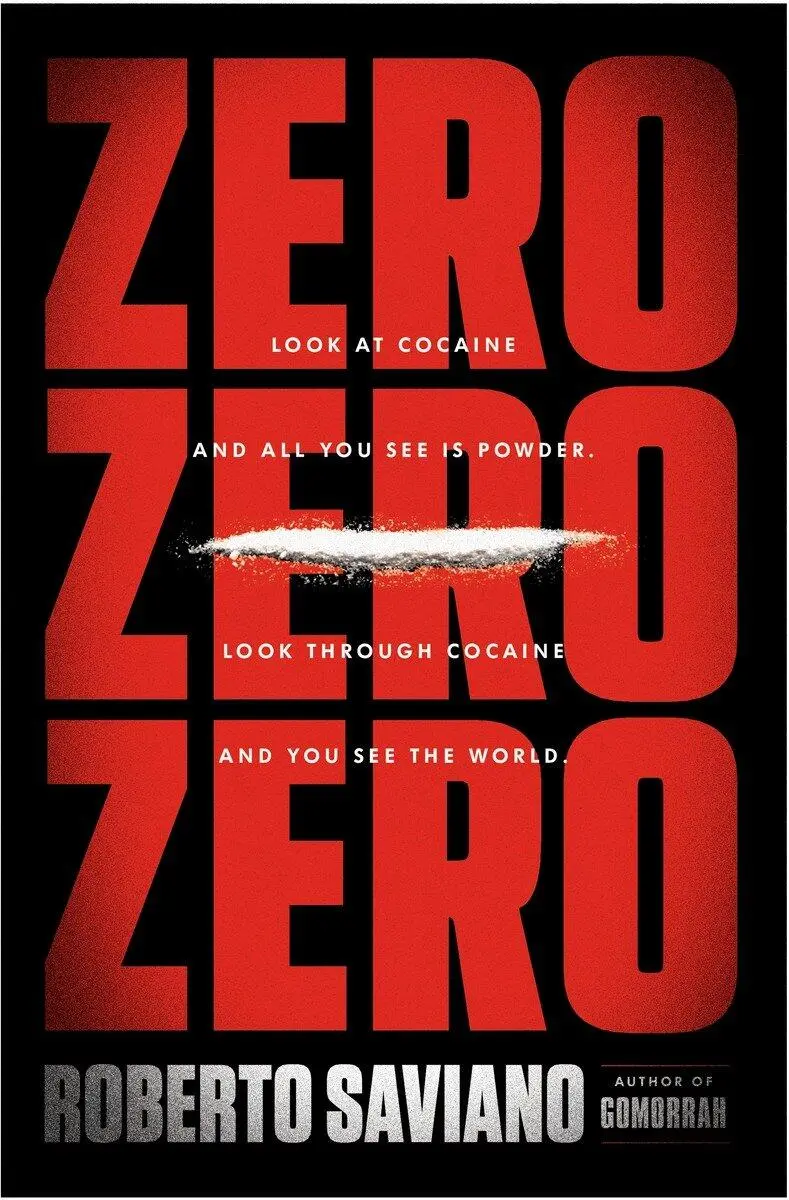
Roberto Saviano - ZeroZeroZero
Здесь есть возможность читать онлайн «Roberto Saviano - ZeroZeroZero» весь текст электронной книги совершенно бесплатно (целиком полную версию без сокращений). В некоторых случаях можно слушать аудио, скачать через торрент в формате fb2 и присутствует краткое содержание. Год выпуска: 2015, Издательство: Penguin Publishing Group, Жанр: Публицистика, Криминальный детектив, на английском языке. Описание произведения, (предисловие) а так же отзывы посетителей доступны на портале библиотеки ЛибКат.
- Название:ZeroZeroZero
- Автор:
- Издательство:Penguin Publishing Group
- Жанр:
- Год:2015
- ISBN:нет данных
- Рейтинг книги:5 / 5. Голосов: 1
-
Избранное:Добавить в избранное
- Отзывы:
-
Ваша оценка:
ZeroZeroZero: краткое содержание, описание и аннотация
Предлагаем к чтению аннотацию, описание, краткое содержание или предисловие (зависит от того, что написал сам автор книги «ZeroZeroZero»). Если вы не нашли необходимую информацию о книге — напишите в комментариях, мы постараемся отыскать её.
Saviano’s
, his explosive account of the Neapolitan mob, the Camorra, was a worldwide publishing sensation. It struck such a nerve with the Camorra that Saviano has lived with twenty-four hour police protection in the shadow of death threats for more than seven years. During this time he has become intimate with law enforcement agencies around the world. Saviano has broadened his perspective to take in the entire global corporate” entity that is the drug trade in cooperation with law enforcement officials, who have fed him information and sources and used him to guide their own thinking and tactics. Saviano has used this extraordinary access to feed his own groundbreaking reportage.
The result is a truly amazing and harrowing synthesis of intimate literary narrative and geopolitical analysis of one of the most powerful dark forces in the global economy. In
, Saviano tracks the shift in the cocaine trade’s axis of power, from Colombia to Mexico, and relates how the Latin American cartels and gangs have forged alliances, first with the Italian crime syndicates, then with the Russians, Africans, and others. On the one hand, he charts an astonishing increase in sophistication and diversification as these criminal entities diversify into many other products and markets. On the other, he reveals the threat of violence to protect and extend power and how the nature of the violence has grown steadily more appalling.
Saviano is a journalist of rare courage and a thinker of impressive intellectual depth and moral imagination, able to see the connections between far-flung phenomena and bind them into a single epic story. Most drug-war narratives feel safely removed from our own lives; Saviano offers no such comfort. As heart racing as it is heady,
is a fusion of a variety of disparate genres into a brilliant new form that can only be called
.
ZeroZeroZero — читать онлайн бесплатно полную книгу (весь текст) целиком
Ниже представлен текст книги, разбитый по страницам. Система сохранения места последней прочитанной страницы, позволяет с удобством читать онлайн бесплатно книгу «ZeroZeroZero», без необходимости каждый раз заново искать на чём Вы остановились. Поставьте закладку, и сможете в любой момент перейти на страницу, на которой закончили чтение.
Интервал:
Закладка:
South Africa is white, and white are her coasts, white her ports, where ships from Latin America arrive. White are the customs of this country. As its wealth has increased, so has its consumption of cocaine.
Mauritania is white. White are the dusty runways where small planes land, jammed full of cocaine. It is the zipper between the Atlantic Ocean and the Maghreb.
Angola is white, because its ties with Brazil are white. Former Portuguese colonies that become brothers through transoceanic coke shipments. Here, as in southern Africa, a good part of the cocaine market is run by Nigerians, who boast of their important criminal history and one of the most organized structures in the world.
Africa is white.
• • •
I look at Mamadu and think about how individual stories can reflect the destiny of an entire continent. The hardest part was learning to deal with the stress, he says. To invent another self, as similar as possible to the few tourists he’s seen in his short life. Awareness has to be crystallized into habit, routine gestures must supplant instinct’s automatic response when faced with danger. Johnny tells him to meet him in front of the Bissau police station. He doesn’t tell him to bring a suitcase, because this time Johnny arrives with an elegant overnight bag. When Mamadu is a few steps away he hands it to him and tells him there’s five thousand dollars inside.
“You could be anybody. You’re a young man with a shiny overnight bag loaded with cash. Go into the police station, chat a bit with the police officers, and then come back out, as if it were nothing.”
“I was sure he was joking,” Mamadu tells me. “If the police officers caught me with a suitcase full of money, how would I explain?”
But Johnny’s not joking in the least. He’s deadly serious; even that conciliatory smile he usually wears is hidden between tightly closed lips.
“I plucked up my courage,” Mamadu tells me. “I prayed that this was the last test I had to face before starting my new job. Then I went into the police station.”
Johnny is the perfect exponent of the most effective and reliable criminal organization on the African continent: the Nigerian underworld.
The Nigerian underworld is an international force that has grown out from its roots to the four corners of the earth. They are small- to medium-size groups with a familial, tribal basis, and the branches of their interests extend to many important open-air drug markets. It’s a mix of tradition and modernity, which has allowed the Nigerians to get a foot in all the African capitals north to south, and to spread beyond the continent, thanks in part to the experience they gained selling heroin in the 1980s — international flights loaded with mules, and when those weren’t enough, Nigerian traffickers recruited the flight crew. Then cocaine arrives, and the Nigerians throw themselves into the new business. Europe’s needs have to be met, and the Africans are ready. So ready that they start obtaining coke directly from the producing countries. Today their presence in Europe is huge, and they’re in great demand by the Colombian and Mexican narcos, as well as by the Italian mafias. One of the progenitors is Peter Christopher Onwumere. Before he was arrested in Brazil in 1997, Onwumere proved he was a real international narco. He negotiated, bought, organized transports, and raked in the cash. The Nigerians are phenomenal subcontractors, and they know where to find cannon fodder, like Mamadu.
“I’ll never forget my first takeoff,” Mamadu tells me. “My stomach sank; it took my breath away. The passenger sitting next to me gives me a paternal smile when he sees me join my hands in prayer; he doesnn’t know I’m just begging God not to let one of the sixty capsules inside me explode. It’s a Royal Air Maroc flight, with a stopover in Casablanca, then from there to Lisbon. I tell myself that it will all be over in a few hours. I can’t help but think how excruciating it will be to expel the capsules, or how I’ll survive a whole day in some unknown European capital. I look anxiously at the tourists who’ve boarded in Casablanca. If I had a sign on my chest that said ‘I’m a drug runner’ I probably would have been less conspicuous amid all these smiling, carefree men and women in shorts and flip-flops, cameras dangling around their necks. Then, like a lightning bolt, a thought comes to me and suddenly chases away my fear. Are these the people who use the stuff inside of me? Are they my clients? So I start looking at them differently, at the stranger in the center row, this really fat guy who’s resting his crossed arms on his belly. The woman next to him, she’s big too, is assailing him with words that have got to be important, but he acts like nothing’s wrong, or maybe he’s fallen asleep. Then I remember what Johnny said about the effects of cocaine, and I think these must be the two principal states: euphoria and oblivion.”
I’m struck by Mamadu’s wisdom, by his ability to see.
“I’ve done nineteen trips from Bissau to Lisbon, Madrid, Amsterdam. You could say I have a job with an ongoing contract, at least until I’m caught or a capsule opens inside of me. I’ve realized by now that I’m a resource that can be sacrificed. Which is why the bosses turn to people like me, even if the amount of merchandise I can carry is small. Because the risk is small too. If I’m arrested, somebody else will be ready to take my place the very next day.”
Mamadu didn’t start to see any money until after he’d done three trips. Johnny would always drag things out, say he didn’t have any cash on him; if Mamadu kept doing such a good job, the small change he had coming to him would soon become a distant memory. But every now and then Johnny would offer him a line, just one, because you have to be familiar with the product you’re selling, he’d say. A bit of white powder revs you up to face customs and the cunning gazes of those European women. Not that Mamadu needs the cocaine. He’s refined his disguise: Now he’s an African until he gets to Casablanca, and then a tourist for the rest of the trip. Tourists have no nationality; being a tourist is an attitude, and at that point the color of your skin, your bloodshot eyes, and your crumpled clothes don’t matter. The fear he felt on his first trip has dissolved into routine. Word that controls are being tightened or news of the mounting tide of seizures don’t bother him at all. European countries have been flexing their muscles for years now, trying to stop the relentless flood of cocaine. Governments have decided to strike at the heart of illegal trafficking, and the list of detainments and seizures grows longer every day. But those names and facts have nothing to do with Mamadu, nor does the new transportation method some mules thought up: They impregnate their clothes with liquid cocaine. At this point he can toss down capsules as if they were cookies. And besides, he can’t stop now. Johnny has told him that there’ll be a stewardess on his next flight who is part of the organization, who facilitates the mules’ work.
“She’s cute,” Johnny added, “and it seems she just broke up with her boyfriend. You could ask her out.”
“I did the math,” Mamadu says to me. “By my thirtieth delivery I should have enough money to treat her to dinner in a fancy restaurant in Lisbon.”
COKE #6
~ ~ ~
Andean folk art paintings
January 21, 2005, Fiumicino airport: A Guatemalan citizen is detained. Five paintings with pre-Columbian motifs are found in his luggage. Behind each painting is an envelope containing a kilo of 92 percent pure cocaine. Total value: €1 million.
Treated and partially treated calfskins
Читать дальшеИнтервал:
Закладка:
Похожие книги на «ZeroZeroZero»
Представляем Вашему вниманию похожие книги на «ZeroZeroZero» списком для выбора. Мы отобрали схожую по названию и смыслу литературу в надежде предоставить читателям больше вариантов отыскать новые, интересные, ещё непрочитанные произведения.

Обсуждение, отзывы о книге «ZeroZeroZero» и просто собственные мнения читателей. Оставьте ваши комментарии, напишите, что Вы думаете о произведении, его смысле или главных героях. Укажите что конкретно понравилось, а что нет, и почему Вы так считаете.