Robert Leckie - Strong Men Armed
Здесь есть возможность читать онлайн «Robert Leckie - Strong Men Armed» весь текст электронной книги совершенно бесплатно (целиком полную версию без сокращений). В некоторых случаях можно слушать аудио, скачать через торрент в формате fb2 и присутствует краткое содержание. Город: Cambridge, Год выпуска: 2010, ISBN: 2010, Издательство: Da Capo Press, Жанр: nonf_military, на английском языке. Описание произведения, (предисловие) а так же отзывы посетителей доступны на портале библиотеки ЛибКат.
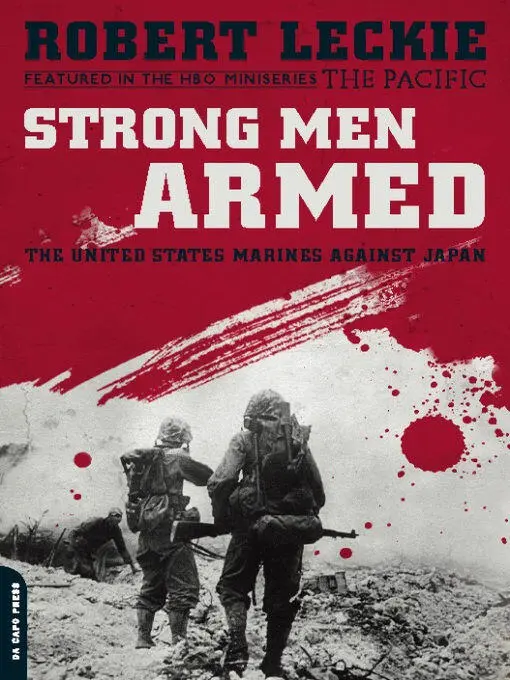
- Название:Strong Men Armed
- Автор:
- Издательство:Da Capo Press
- Жанр:
- Год:2010
- Город:Cambridge
- ISBN:978-0-786-74832-7
- Рейтинг книги:3 / 5. Голосов: 1
-
Избранное:Добавить в избранное
- Отзывы:
-
Ваша оценка:
Strong Men Armed: краткое содержание, описание и аннотация
Предлагаем к чтению аннотацию, описание, краткое содержание или предисловие (зависит от того, что написал сам автор книги «Strong Men Armed»). Если вы не нашли необходимую информацию о книге — напишите в комментариях, мы постараемся отыскать её.
Strong Men Armed — читать онлайн бесплатно полную книгу (весь текст) целиком
Ниже представлен текст книги, разбитый по страницам. Система сохранения места последней прочитанной страницы, позволяет с удобством читать онлайн бесплатно книгу «Strong Men Armed», без необходимости каждый раз заново искать на чём Вы остановились. Поставьте закладку, и сможете в любой момент перейти на страницу, на которой закончили чтение.
Интервал:
Закладка:
Against this the Japanese retaliated with a single torpedo-bomber strike. One Kate got a torpedo into Intrepid, killing 11 men, wounding 17, and forcing the carrier to retire. With this went 12 American fighters downed, seven torpedo-bombers and six dive-bombers—a total of 29 pilots and crewmen killed. There was not an American ship lost.
It was total, stinging defeat, a source of great bitterness to those Japanese fighter pilots who fought so vainly to prevent it. As had the men of the Bastard Air Force at Guadalcanal, the enemy fliers fought throughout the day flying, returning, rearming, and flying again. In midafternoon one of them skidded his Zero into a landing at Param Field. He jumped from his plane and ran for the bomb shelters to sit out the strafing attacks until his plane was ready again.
He passed the slit trench in which the seven Americans were crouched and stopped, astonished. He recovered his composure and said quietly, “I am a Japanese pilot.” The Americans said nothing, though they wondered if the Japanese was joking. “I am a Japanese pilot,” the man said again. He tapped his leather pistol holster ominously. “You bomb here —you die.”
The Americans were still not sure, but having survived weeks of torture in Rabaul, expecting more of it and perhaps death in Japan, they were almost beyond caring.
“With all the goddamn trouble we got already,” Boyington growled, “ain’t you the cheerful son of a bitch.”
There was a bare pause, and then there was the roar of powerful motors, the chilling sound of Hellcat 50-caliber bullets smacking the coral, the tinkling of falling empty cartridges. The Japanese pilot sprinted for the bomb caves, and the Americans were left with another grim joke to sustain them in the bleak eighteen months lying between the present and the day of their liberation in Japan, a liberation which brought Boyington the Medal of Honor and found him still the outstanding Marine ace of all time.
Next morning Admiral Mitscher’s planes flew again over Truk’s fields, but not a single plane rose to oppose them. The Fifth Fleet sailed east in jubilation.
On that same morning Radio Tokyo spoke to the Japanese nation and the world with unaccustomed candor:
“A powerful American task force suddenly advanced to our Caroline Islands Wednesday morning and repeatedly attacked our important strategic base, Truk, with a great number of ship-based planes. The enemy is constantly repeating powerfully persistent raids with several hundred fighters and bombers, attacking us intermittently. The war situation has increased with unprecedented seriousness—nay, furiousness. The tempo of enemy operations indicates that the attacking force is already pressing upon our mainland.”
There had never been such an admission before. It suggested that Premier Tojo’s iron grip upon the Emperor and nation was weakening. Within another day there was to be more bad news to hasten the downfall of Tojo’s “Manchuria gang.”
Engebi was falling.
The Twenty-second Marines attacked bomb-pitted, shell-pocked Engebi two battalions abreast. They ran into Japanese crazed by thirst and maddened by the fury of the bombardment. The battle split off into small separate actions. Sometimes the Japanese fought with knives, leaping into the shellholes where the Marines had set up their guns, closing with a fury born of desperation. Sometimes they fought out of spider holes, lifting the lids after the Marines had passed, firing into their rear. The inevitable debris of the bombardment clogged the routes of advance, and there were often live Japanese firing machine guns from the ruins. But by four o’clock the Marines had overrun the airfield and General Watson had withdrawn the Third Battalion, Twenty-second, for use against Eniwetok Islet the next day. The other battalions dug in—and spent a restless night.
It was the Twenty-second’s first night in combat, and no one had thought to collect all those Japanese and American weapons strewn about the battlefield. The Japanese crept out of their holes, rearmed themselves, and infiltrated. One of them tossed a grenade in a foxhold held by Corporal Anthony Damato and three others. Damato flung himself on the bomb and was killed. He was awarded the Medal of Honor posthumously. Sporadic fighting fluttered on, but by dawn resistance on Engebi had been crushed. Colonel Yano and all but a few of his men were dead, and these others would be mopped up during the day. At dawn, Colonel Walker raised the American flag over Engebi while a private blew “To the Colors” on a captured Japanese bugle.
At dawn of February 19 the two battalions of the 106th Infantry went ashore on Eniwetok Islet. They made slow going at first. General Watson sent in the Third Battalion, Twenty-second. The Marines struck across the islet’s waist, the pace of the other battalions quickened, the Japanese spent themselves with individual squad counterattacks during the night, and Eniwetok Islet was secured by late afternoon of February 20.
It remained to take Parry Islet.
Parry was about two miles north of Eniwetok Islet. It formed the southern side of Deep Passage. Across Deep Passage a half-mile farther north was Japtan Islet. To take Parry, the Recon Boys first seized Japtan Islet as a base for artillery. That was on February 21, and on the same day Pennsylvania and Tennessee stood within a half-mile of Parry’s lagoon beaches and pounded the little islet. Next day, with cruisers, destroyers and rocket boats joining the battleships and the Japtan artillery, all three battalions of the Twenty-second Marines attacked Parry.
At half-past seven that night, after Japanese tanks were destroyed in a pitched battle with the Marine mediums, and after naval gunfire destroyed the last pocket and probably also destroyed Major General Nishida, the battle ended with this message from Colonel Walker to General Watson:
“I present you with Parry. Request this unit be relieved for re-embarkation in the morning.”
The request was granted. On February 23 the Twenty-second Marines went back aboard ship. They were veterans now. They had lost 184 killed, 540 wounded, and had disposed of roughly 2,000 Japanese. They were going back to Kwajalein, where, with Captain Jones’s Fifth Corps Recon Company, with the Scout Company of the Fourth Marine Division, they made dozens of landings to secure the islets of that enormous atoll. Then there was a brief idyll. With other Marines they sang hymns with the Marshallese and walked sentry duty naked but for a tan GI towel swathed about their hips like a Micronesian’s lap-lap. And they tried very hard to twist their tongues around those unpronounceable islet names—Ennumennent, Edgigen, Enubuj, Gugegwe, Bigej, Ennylabegan. When they met and mastered Ennugenliggelap the campaign in the Marshall Islands was obviously over.
29
The swamp fox of New Britain—Major General Iwao Matsuda —had been prepared to flee long before he was ordered to withdraw.
While the Borgen Bay complex had been falling in mid-January, Matsuda had ordered a Lieutenant Hanahara up to Natamo Point on the eastern edge of Borgen Bay and charged him with a do-or-die defense there. He had also brought Colonel Jiro Sato up from the south and ordered him to defend the approaches southwest of Nakarop-Egaroppu.
Hanahara, then, held a roadblock between the Americans at Borgen Bay and the mouth of the trail to Matsuda’s headquarters. Sato held the high ground between the Americans at the airfield and Matsuda. True, the trails from the south coast were now undefended, but it would take the Americans some time to work all the way around the Cape and come up on Nakarop from the south.
Hanahara and Sato were in place before that January 21 on which Matsuda received a message from Lieutenant General Yasushi Sakai, commander of the 17th Infantry Division at Cape Hoskins—a north coast point midway between Cape Gloucester and Rabaul. Sakai instructed Matsuda to pull the 65th Brigade back to a rallying place called Kokopo, about six or seven miles east of Natamo Point and something like a dozen miles northeast along the back-door trail from Nakarop.
Читать дальшеИнтервал:
Закладка:
Похожие книги на «Strong Men Armed»
Представляем Вашему вниманию похожие книги на «Strong Men Armed» списком для выбора. Мы отобрали схожую по названию и смыслу литературу в надежде предоставить читателям больше вариантов отыскать новые, интересные, ещё непрочитанные произведения.











Обсуждение, отзывы о книге «Strong Men Armed» и просто собственные мнения читателей. Оставьте ваши комментарии, напишите, что Вы думаете о произведении, его смысле или главных героях. Укажите что конкретно понравилось, а что нет, и почему Вы так считаете.