Robert Leckie - Strong Men Armed
Здесь есть возможность читать онлайн «Robert Leckie - Strong Men Armed» весь текст электронной книги совершенно бесплатно (целиком полную версию без сокращений). В некоторых случаях можно слушать аудио, скачать через торрент в формате fb2 и присутствует краткое содержание. Город: Cambridge, Год выпуска: 2010, ISBN: 2010, Издательство: Da Capo Press, Жанр: nonf_military, на английском языке. Описание произведения, (предисловие) а так же отзывы посетителей доступны на портале библиотеки ЛибКат.
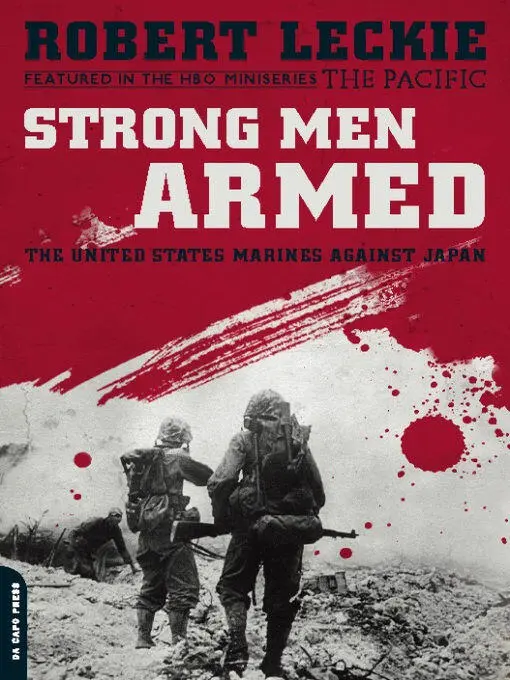
- Название:Strong Men Armed
- Автор:
- Издательство:Da Capo Press
- Жанр:
- Год:2010
- Город:Cambridge
- ISBN:978-0-786-74832-7
- Рейтинг книги:3 / 5. Голосов: 1
-
Избранное:Добавить в избранное
- Отзывы:
-
Ваша оценка:
Strong Men Armed: краткое содержание, описание и аннотация
Предлагаем к чтению аннотацию, описание, краткое содержание или предисловие (зависит от того, что написал сам автор книги «Strong Men Armed»). Если вы не нашли необходимую информацию о книге — напишите в комментариях, мы постараемся отыскать её.
Strong Men Armed — читать онлайн бесплатно полную книгу (весь текст) целиком
Ниже представлен текст книги, разбитый по страницам. Система сохранения места последней прочитанной страницы, позволяет с удобством читать онлайн бесплатно книгу «Strong Men Armed», без необходимости каждый раз заново искать на чём Вы остановились. Поставьте закладку, и сможете в любой момент перейти на страницу, на которой закончили чтение.
Интервал:
Закладка:
In late 1943 the staging for Kwajalein began and it seemed that Colonel John Walker’s regiment would at last see battle. But the Twenty-second wound up with the 106th Army Infantry in that tactical reserve commanded by Brigadier General Thomas Watson. They stood off Kwajalein in their ships while the “boots” of the Fourth Marine Division went ashore at Roi-Namur.
Now it was these very Fourth Division boots who were salty. They hadn’t a month overseas yet, but they were already coming around offering to show their scars. It was not pleasant for a grizzled gunnery sergeant of the Twenty-second to be patronized by fuzzy-chinned teen-agers who were still wearing their first pair of GI socks. To them the hash-marked gunnies could not scream, “Yuh chicken-boot—I’ve worn out more seabags than you have socks!” The boots had only to blink and inquire earnestly:
“You guys seen any action yet?”
But all this would change at Eniwetok.
Up at Engebi Islet at Eniwetok Atoll, Colonel Toshio Yano of the 3rd Battalion, 1st Amphibious Brigade, was completing his battle orders. Colonel Yano calmly expected the invasion of Engebi, for it was the largest of Eniwetok’s northern islets and it possessed the atoll’s airfield. Also on Engebi were about 1,200 of the 2,586 troops with which Major General Yoshima Nishida was supposed to defend Eniwetok. On the tenth of February, with General Watson’s plans for the invasion of Eniwetok already complete, Colonel Yano informed his troops that they could expect to be bombed and shelled and invaded, concluding with this directive:
“Plans must be followed to lure the enemy to the water’s edge and then annihilate him with withering firepower and continuous attacks.”
It was the inflexible Imperial Staff doctrine of “annihilation at the water’s edge” again, but unfortunately for Colonel Yano and his men, the Staff Manual said nothing about what was to be done with battleships “lured” to the water’s edge.
There were battleships almost at the water’s edge that windy, overcast morning of February 17.
Great, ghostly, gray shapes—old Pennsylvania, Tennessee and Colorado —they prowled not a mile off Engebi’s beaches with the muzzles of their 14-inch guns streaming flame and smoke.
The entire invading force had entered the lagoon. Rear Admiral Harry Hill had decided to force his way through the southern reef, through Wide Passage, 25 miles directly south of Engebi at the bottom of the lagoon, seven miles northeast of Wide Passage. Minesweepers had cleared a path, sweeping up 28 moored mines in Wide Passage, and then the ships formed column. The little minesweepers led them in, then the destroyers, next the battlewagons and cruisers, finally the transports. They came in with all guns firing, blasting and raking blackjack-shaped Eniwetok Islet on the right at Wide Passage, battering Parry and Japtan Islets to either side of Deep Entrance.
They sailed up the lagoon to Engebi and pummeled her, while Major General Nishida got off this signal from his headquarters on Parry Islet: “Enemy fleet entering the lagoon in large numbers. Request reinforcements.” Even if it had been possible to send them, they could never have arrived in time. Already Captain Jim Jones’s Recon Boys were going ashore on Camellia and Rujiyoru, two coral specks lying to the east or right of Engebi. Before two o’clock in the afternoon, Jones had reported their capture. By nightfall Company D (Scout) of the Fourth Tank Battalion had captured little Bogon to the left of Engebi, and artillery was ashore and emplaced on these bracketing islands, ready to join the warships at dawn.
That same evening of February 17, “the Gibraltar of the Pacific” had been found to be not an impregnable rock but rather an empty shell.
For years American planners had spoken in awe of Japan’s secret base in the Carolines. Truk had been the invincible this and the invulnerable that. No one wanted any part of Truk—not the Army, not the Army Air Force, not the United States Marines. It was the most perfect oceanic fortress that nature could devise. It was a drowned mountain range within a coral reef. The peaks of those mountains formed the numerous wooded islands within vast Truk Lagoon. On four of these islands the Japanese had built airfields and on other islands were naval and administrative centers. All of these islands, and the ships sheltering in Truk Lagoon, were beyond the range of hostile warships forced to stand outside the enclosing coral reef. The Truk Islands were therefore safe against naval surface attack, and assault troops would never get across that reef—if Truk’s airplanes ever allowed them to reach it. Truk was only open to attack from the air, but before Kwajalein, airplanes had to fly a long, long way to reach Truk. Before Torokina and Tarawa it was beyond range. By early February, however, the terrible attrition of the Bismarcks and the Solomons had siphoned off much of Truk’s air strength. At the same time two Marine pilots-Major James Christensen and Captain James Yawn—had taken Liberator scout planes aloft from Torokina Airfield and flown 850 miles to Truk under cover of freak tropical storms. Upon their return they produced the war’s first aerial photographs of Truk, photos which electrified Nimitz’ headquarters because they showed the Japanese Combined Fleet anchored in Truk Lagoon.
That had been February 4, the very date on which the Army’s 7th Division secured Kwajalein Islet, ending the entire Kwajalein Atoll Campaign. Immediately Rear Admiral Mitscher’s three fast carrier groups sped down to Majuro to refuel. On February 12 they were streaking north of Eniwetok to rendezvous with tankers, to join up later with the battleships, cruisers, destroyers and submarines which, with themselves, formed Spruance’s Fifth Fleet.
But by then the bird had flown. The eight-rayed flag of the commander in chief, Japanese Combined Fleet, had departed Truk Lagoon forever. Fleet Admiral Koga had not liked the appearance of that American reconnaissance plane and had ordered his big ships back to Tawi-Tawi. He himself sailed to Japan in 63,000-ton Musashi.
Yet, as 72 Hellcats rose off the decks of five carriers before dawn of February 17, and as Admiral Spruance led the big warships on a round-the-atoll prowl, there were still two Japanese cruisers, eight destroyers and upwards of 50 merchant ships in and around Truk Lagoon, to say nothing of 365 airplanes and those four airfields which Mitscher’s warbirds were coming to destroy.
At sunrise the Hellcats were over Truk and battling 45 Japanese fighters. They shot down 30 of them, formed again and came roaring down to shoot up the aircraft parked on three fields. One exuberant Hellcat pilot spotted a transport plane which had slipped into a safe landing at Param Field. Its occupants were dashing for a concrete slit trench at one end of the field. The Hellcat pilot swooped and blew up the transport. He came back again to try for about 15 fighters parked near the slit trench. He hit a few and tried to spray slugs within the trench but he wasn’t able to—which was lucky, for Major Pappy Boyington and six other American fliers were in that trench. The Japanese had been taking them from Rabaul to Japan via Truk, and had arrived in time for the Americans to take a dubious delight in the capabilities of the new Hellcat fighters.
Though Boyington and his companions had been blindfolded, their guards were not at that moment insisting on regulations. The Americans saw the Hellcats chew up about 40 more Japanese planes. They even watched while the Avengers came in with hundred-pound fragmentation bombs, but they ducked for safety with the arrival of Dauntlesses bearing thousand-pounders.
Most of the big bombs were dropped on the ships in the lagoon. They hit everything afloat, and outside the atoll there were more ships sinking beneath the bombs of the carrier planes or being slashed into shredded steel by the guns of mammoth New Jersey and Iowa, the heavy cruisers Minneapolis and New Orleans, and four destroyers. The Japanese sailors fought with customary valor, here a destroyer taking on a battleship, here a subchaser trying to outgun a destroyer, but the results outside the atoll were the same as within. In all, Japan lost two light cruisers, four destroyers, three auxiliary cruisers, two submarine tenders, two subchasers, an armed trawler and an airplane ferry—and 24 merchant ships, of which five were tankers. With smaller craft, a total of 200,000 tons of shipping was lost. Most of Truk’s 365 aircraft were either destroyed or damaged, and 75 per cent of the base’s supplies ruined.
Читать дальшеИнтервал:
Закладка:
Похожие книги на «Strong Men Armed»
Представляем Вашему вниманию похожие книги на «Strong Men Armed» списком для выбора. Мы отобрали схожую по названию и смыслу литературу в надежде предоставить читателям больше вариантов отыскать новые, интересные, ещё непрочитанные произведения.











Обсуждение, отзывы о книге «Strong Men Armed» и просто собственные мнения читателей. Оставьте ваши комментарии, напишите, что Вы думаете о произведении, его смысле или главных героях. Укажите что конкретно понравилось, а что нет, и почему Вы так считаете.