Brian Williams - Predators
Здесь есть возможность читать онлайн «Brian Williams - Predators» весь текст электронной книги совершенно бесплатно (целиком полную версию без сокращений). В некоторых случаях можно слушать аудио, скачать через торрент в формате fb2 и присутствует краткое содержание. Город: Dulles, Virginia, Год выпуска: 2013, ISBN: 2013, Издательство: Potomac Books, Жанр: nonf_military, Публицистика, на английском языке. Описание произведения, (предисловие) а так же отзывы посетителей доступны на портале библиотеки ЛибКат.
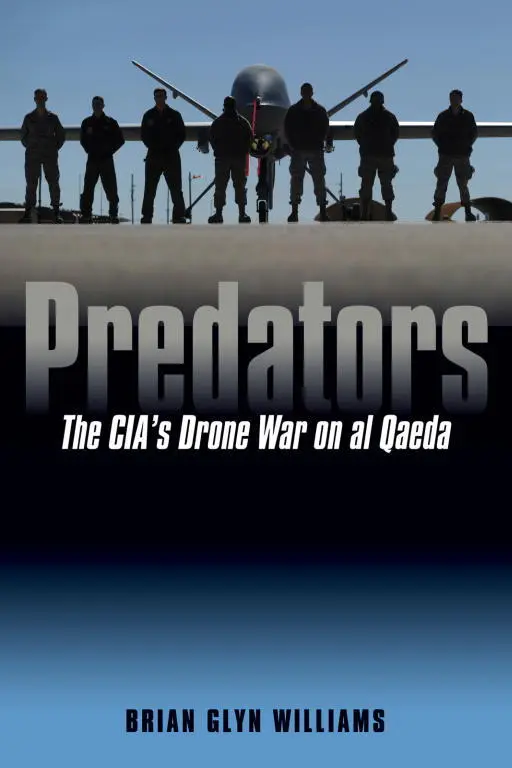
- Название:Predators
- Автор:
- Издательство:Potomac Books
- Жанр:
- Год:2013
- Город:Dulles, Virginia
- ISBN:978-1-61234-617-5
- Рейтинг книги:3 / 5. Голосов: 1
-
Избранное:Добавить в избранное
- Отзывы:
-
Ваша оценка:
Predators: краткое содержание, описание и аннотация
Предлагаем к чтению аннотацию, описание, краткое содержание или предисловие (зависит от того, что написал сам автор книги «Predators»). Если вы не нашли необходимую информацию о книге — напишите в комментариях, мы постараемся отыскать её.
, the cigarette lighter–size homing beacons spies plant on their unsuspecting targets to direct drone missiles to them, the author describes the drone arsenal in full.
Evaluating the ethics of targeted killings and drone technology, Williams covers more than a hundred drone strikes, analyzing the number of slain civilians versus the number of terrorists killed to address the claims of antidrone activists. In examining the future of drone warfare, he reveals that the U.S. military is already building more unmanned than manned aerial vehicles. Predators helps us weigh the pros and cons of the drone program so that we can decide whether it is a vital strategic asset, a “frenemy,” or a little of both.
Predators — читать онлайн бесплатно полную книгу (весь текст) целиком
Ниже представлен текст книги, разбитый по страницам. Система сохранения места последней прочитанной страницы, позволяет с удобством читать онлайн бесплатно книгу «Predators», без необходимости каждый раз заново искать на чём Вы остановились. Поставьте закладку, и сможете в любой момент перейти на страницу, на которой закончили чтение.
Интервал:
Закладка:
Thus, powerful figures in Pakistan see the strikes as undermining the country’s fragile civilian government and creating problems with the tribesmen who are caught between the drones and the Taliban. The undermining of the already unstable Pakistani government has grave strategic implications. For example, it is difficult for the Pakistani military to carry out its own anti-Taliban operations in places such as North Waziristan because the drone campaign makes it appear as if the army is doing so only in furtherance of U.S. goals. Pakistanis perceive their army as a “stooge” fighting fellow Muslims on behalf of the Americans.
The drone strikes also provide the Taliban with more reason to hate the Pakistani military and the United States. According to one Pakistani army officer quoted in the London Times , the drone strikes have provided the Taliban with a “huge motivation to fight against the Government and the army.” Another Pakistani general said, “We complained about it [the strike]. It was detrimental to our operations. I was about to mount an operation and the moment the drone did its attack I had to change dates. Our success lies with the writ of the Government and our popularity with the people. We have to take into account the influences and perceptions these people have.” 14Major General Abbas complained, “The US might have achieved tactical gains through the drone strikes, but they too had caused enormous damage to Pakistan’s efforts towards fighting the terrorism.” 15Similarly, progovernment tribal elders have pleaded for an end to the strikes because they “made them look like puppets” and “gave lie to the argument that we’ve made for a long time, this fight is theirs too.” 16Michael J. Boyle, an assistant professor of political science at La Salle University, summed up the previous Pakistani positions aptly: “Despite the fact that drone strikes are often employed against local enemies of the governments in Pakistan and Yemen, they serve as powerful signals of these governments’ helplessness and subservience to the United States and undermine the claim that these governments can be credible competitors for the loyalties of the population.” 17
Criticism of the drone strikes is not limited to the Pakistani government. There has been no person more critical of the strategic setbacks caused by the drone campaign than retired admiral Dennis C. Blair, a former director of national intelligence. Since being forced out of his post in 2010 for voicing his criticism of the strikes, Blair has called for the CIA to hand over the drone campaign to the military. He went so far as to suggest that the United States “pull back on unilateral actions… , except in extraordinary circumstances.” He further said, “We’re alienating the countries concerned, because we’re treating countries just as places where we go [to] attack groups that threaten us. We are threatening the prospects for long-term reform raised by the Arab Spring… which would make these countries capable and willing allies who could in fact knock that threat down to a nuisance level.” 18Speaking specifically about the drones, Blair said,
As the drone campaign wears on, hatred of America is increasing in Pakistan. American officials may praise the precision of the drone attacks. But in Pakistan, news media accounts of heavy civilian casualties are widely believed. Our reliance on high-tech strikes that pose no risk to our soldiers is bitterly resented in a country that cannot duplicate such feats of warfare without cost to its own troops.
Our dogged persistence with the drone campaign is eroding our influence and damaging our ability to work with Pakistan to achieve other important security objectives like eliminating Taliban sanctuaries, encouraging Indian-Pakistani dialogue, and making Pakistan’s nuclear arsenal more secure. 19
Blair has also said that there is “little point in killing easily replaceable foot soldiers if the cost is public outrage in Pakistan.” He believes that the reliance on unpopular drone strikes undermines America’s credibility in Pakistan and hurts the Pakistani army’s ability to gain support to fight the war to seize territory from the Taliban. The only way to keep from further alienating the Pakistanis, in Blair’s opinion, is to “put two hands on the trigger,” that is, allow the Pakistanis veto rights and a voice in choosing drone targets. The war against the Taliban, Blair thinks, cannot be won from the air; it can best be won with aid and assistance to impoverished villages in the FATA. This would help improve the U.S. and Pakistani government’s images and win over tribesmen who might be on the fence by offering positive instead of negative incentive. Blair also complained, “The steady refrain in the White House that ‘This is the only game in town’—reminded me of body counts in Vietnam.” 20
Blair was not alone in his views. One critic of the drone campaign, Nathaniel Fick of the Center for a New American Security, wrote, “Drone strikes excite visceral opposition across a broad spectrum of Pakistani opinion. The persistence of these attacks on Pakistani territory offends people’s deepest sensibilities, alienates them from their government, and contributes to Pakistan’s instability.” 21Writing for the Daily Times , former Pakistani general Talat Masood similarly argued,
For Pakistan, these strikes are a huge embarrassment. An ally is challenging its sovereignty and independence repeatedly and humiliatingly….
A government that is already under criticism and has credibility issues is being made to look helpless in the face of US attacks. The leadership, especially President Asif Zardari, is losing popularity and no one is prepared to take seriously the official condemnations that follow every incident….
This war has to be won through the people’s support, and the advantage that a democratically elected government has over a dictatorship is obliterated if the former is seen as helpless against US strikes. In fact, drone strikes are diverting attention from combating insurgency, and anti-Americanism is on the rise. And even if the militants seem to be losing tactically in the short-term, there will be a long-term rise in the number of militants as well as the number of alienated people. There is further negative blowback as the militants hold the government complicit in these attacks. 22
The U.S. ambassador to Pakistan and other members of the State Department who are tasked with cleaning up the public relations mess after strikes like the Datta Khel attack, which killed scores of villagers, would most likely agree with Mr. Masood. They think that the CIA ignores the huge diplomatic cost that comes from strikes that now increasingly kill mere Taliban foot soldiers. 23Opinion in Pakistan, a country of 190 million people, is being turned against the United States all for the sake of killing hundreds of low-level Taliban fighters. The public opinion fallout has given anti-American politicians from the various Islamic political parties a platform to mobilize people against the pro-American Zardari government. Whereas Imran Khan was unable to gather large numbers to his antidrone rallies, Pakistan’s main Islamist party, the Jamiat e Ulema, was able to bring together 100,000 people for an antidrone rally in Karachi in January 2012. 24This sort of mass protest seriously undermines the Zardari government, which is already struggling with the military, the judiciary, other less pro-American political parties, and of course the Taliban and other extremists. Should the weak Zardari government be removed from power by one of these many antidrone groups, the U.S.-Pakistani alliance in the war on terrorism could end.
Many people who oppose the drone strikes also consider them a Whac-a-Mole-type short-term solution that cannot solve the problem of Taliban control in North Waziristan and elsewhere. Wars cannot be won from the air; they have to be fought on the ground. This means that sooner or later the United States will have to rely on Pakistan to ultimately solve the problem of the terrorist sanctuary in the FATA. One Pakistani has warned, “Drone attacks are ‘not an effective long-term strategy.’ This is an ideological and political war that cannot be won through the use of drones. Each time it is proclaimed that a top militant has been killed, another militant comes up to take up the leadership. Look how after Baituallah’s death, Hakimullah took over the reins of the Pakistani Taliban and the militants are as deadly as ever.” 25
Читать дальшеИнтервал:
Закладка:
Похожие книги на «Predators»
Представляем Вашему вниманию похожие книги на «Predators» списком для выбора. Мы отобрали схожую по названию и смыслу литературу в надежде предоставить читателям больше вариантов отыскать новые, интересные, ещё непрочитанные произведения.











Обсуждение, отзывы о книге «Predators» и просто собственные мнения читателей. Оставьте ваши комментарии, напишите, что Вы думаете о произведении, его смысле или главных героях. Укажите что конкретно понравилось, а что нет, и почему Вы так считаете.